

クロキョウジョシギ 対 シロカモメ
Arenaria melanocephala 対 Larus hyperboreus
クロキョウジョシギとシロカモメのクイズ
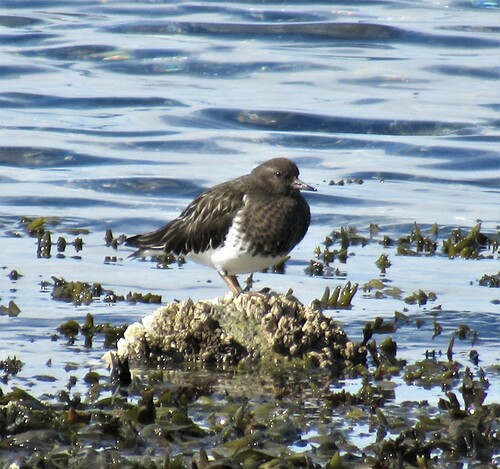 クロキョウジョシギ
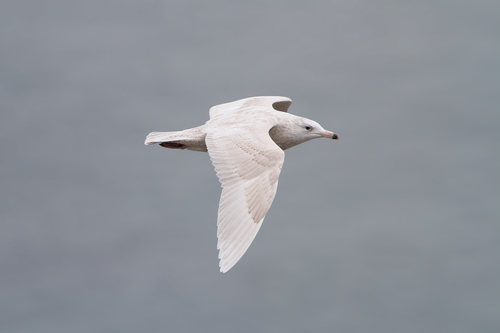 シロカモメ
要点
The most reliable field mark between Black Turnstone and Glaucous Gull is overall size and structure: Glaucous Gull is an enormous, pale gull with a thick yellow bill, while Black Turnstone is a small, compact shorebird with a short, dark, slightly upturned bill. In flight, Black Turnstone (of all ages) shows a bold white wingbar and white shoulder patch, while Glaucous Gull is uniformly pale with no black on wings or tail. Juvenile and winter Black Turnstones are darker and browner, but never approach the size or bulk of a Glaucous Gull. If you see a bird with orange or blackish legs, check the bill and body size: only the turnstone is small and dark-legged. Use context: turnstones are usually on rocky shores, gulls on open beaches or scavenging.
識別のコツ
- Size is the first check: Glaucous Gull is massive, dwarfing Black Turnstone. If the bird is anywhere near the size of a crow or larger, it's a gull, not a turnstone.
- Bill shape and color: Black Turnstone has a short, black, slightly upturned bill; Glaucous Gull has a long, thick, yellow bill (pink and black in juveniles).
- Leg color: Black Turnstone has blackish-brown legs with a reddish tinge; Glaucous Gull has pale legs (pinkish in juveniles, yellowish in adults). Never orange.
- Flight pattern (all ages): Black Turnstone shows a bold white wingbar, white shoulder patch, and white tail with a broad black band. Glaucous Gull is pale, with no black on wings or tail, and flight feathers are uniformly light.
- Juvenile plumage: Juvenile Black Turnstone is brownish with buff fringes and a grey-brown tail tip; juvenile Glaucous Gull is very pale grey, with a pink and black bill, and no dark tail band.
- Adult plumage: Black Turnstone adults have a black head and breast with white facial markings and a white belly; Glaucous Gull adults are pale grey above, white below, with a thick yellow bill and no black anywhere.
- Breast and head color: Black Turnstone (breeding) has a black head and breast; Glaucous Gull is always pale-headed and pale-breasted.
- Wing shape and jizz: Black Turnstone is compact, with short wings and rapid, direct flight. Glaucous Gull is long-winged, with a broad, powerful flight.
- Habitat context: Turnstones are tied to rocky coasts, jetties, and intertidal zones; Glaucous Gulls are more generalist, often seen on open beaches, cliffs, or scavenging.
- Feeding behavior: Black Turnstone actively flips stones and probes; Glaucous Gull scavenges, soars, or loafs.
- Voice: Black Turnstone's call is a rapid, high-pitched trill; Glaucous Gull's is a deep, laughing cry.
- Group association: Black Turnstone is usually in small groups or pairs; Glaucous Gull can be solitary or in large flocks, often with other gulls.
- Seasonal changes: Black Turnstone becomes browner in winter but never pale overall; Glaucous Gull remains pale year-round.
- Tail pattern: Black Turnstone has a white tail with a broad black band (all ages); Glaucous Gull has a pure white tail (no black) at all ages.
- If in doubt: Compare to nearby birds for scale, and look for the combination of size, bill, and flight pattern. No small, dark, stone-flipping bird is a Glaucous Gull.
大きさ
Glaucous Gull is vastly larger than Black Turnstone. Glaucous Gull averages about 1,400 grams in body mass and measures 55–77 cm in length, with a wingspan up to 170 cm. Black Turnstone is much smaller, at 22–25 cm long and 100–170 grams (less than a tenth the mass of the gull). Even at a distance, the gull's bulk, long wings, and powerful build are unmistakable compared to the compact, short-winged turnstone.
羽色
-
Juvenile/immature birds: Black Turnstone juveniles are brownish with buff fringes on the wing-coverts and scapulars, and a grey-brown tail tip. In flight, all ages show a bold white wingbar, white shoulder patch, and a white tail with a broad black band. Glaucous Gull juveniles are very pale grey overall, with a pink and black bill, and lack any black on the wings or tail; their flight feathers are pale, and the overall effect is a ghostly, uniform appearance.
-
Adults (breeding): Black Turnstone adults have a black head and breast with white facial markings, blackish-brown upperparts, and a white belly. Glaucous Gull adults are pale grey above, white below, with no black anywhere on the wings or tail, and have a thick yellow bill.
-
Adults (non-breeding): Black Turnstone becomes browner on the head and breast with less white. Glaucous Gull remains pale and uniform, with no seasonal change as dramatic as the turnstone's.
行動
Black Turnstone is typically seen actively probing and flipping stones or debris on rocky shores, moving quickly and low to the ground. Glaucous Gull is more likely to be seen standing or walking slowly, often in groups, and may scavenge, soar, or loaf on open beaches, ice, or near human activity. In flight, the gull is powerful and steady, while the turnstone is fast and direct, often low over rocks.
生息環境
Black Turnstone is most often found on rocky Pacific coasts, jetties, and breakwaters in winter, and wet meadows with sedges during breeding. Glaucous Gull frequents open coasts, beaches, cliffs, and sometimes inland near colonies, but is rarely as closely tied to rocks or intertidal zones as the turnstone. If the bird is feeding among boulders or flipping seaweed, turnstone is likely; if soaring or loafing in open areas, especially with other gulls, think Glaucous Gull.
声
Black Turnstone gives a higher, less harsh rattling trill than the similar call of Ruddy Turnstone; it also has a loud screeching alarm and soft purring notes. Glaucous Gull's call is a deep, laughing cry, similar to Herring Gull but lower-pitched. Calls are rarely confused: the turnstone's trills are distinctive and rapid, while the gull's voice is deeper and more drawn out.