

クロエリショウノガン 対 コユビシトドコヒバリ
Afrotis afra 対 Spizocorys starki
クロエリショウノガンとコユビシトドコヒバリのクイズ
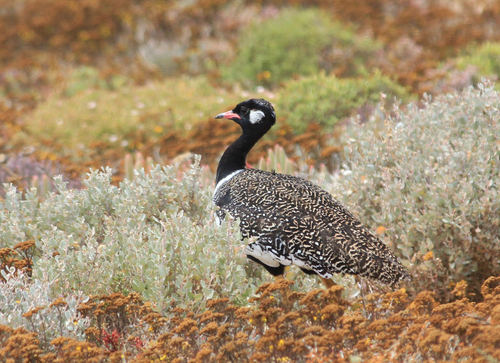 クロエリショウノガン
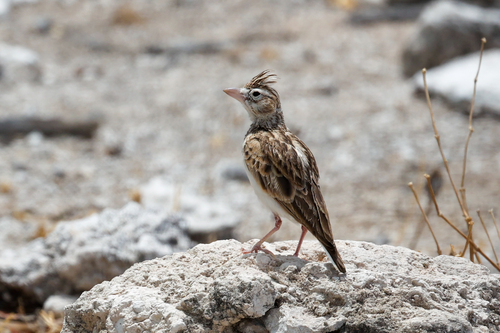 コユビシトドコヒバリ
要点
The most reliable field mark to separate Black Bustard (Afrotis afra) from Stark's Lark (Spizocorys starki) is overall size and structure: Black Bustard is a much larger, upright, long-legged bustard with bold black-and-white patterning (especially in males), while Stark's Lark is a small, sandy-brown, streaky lark with a short tail and a distinct pale eyebrow. In flight or on the ground, the bustard's striking checkered plumage and yellow legs stand out, whereas the lark blends in with its subtle streaks and raised crest. If you see a bird with a robust, reddish bill and black underparts, it's the bustard; a pale, streaky, crested bird with a swollen bill is the lark. Habitat overlap is possible, but the bustard is restricted to southwestern South Africa, while the lark ranges more widely in arid southern Africa.
識別のコツ
- Size and shape: Black Bustard is much larger and bulkier than Stark's Lark. If the bird appears pigeon-sized or larger, it's the bustard; if it's sparrow-sized, it's the lark.
- Leg color: Both sexes of Black Bustard have bright yellow legs, which stand out in the field. Stark's Lark does not have notably colored legs.
- Bill structure: The bustard has a robust, reddish bill with a black tip (longer in males), while the lark's bill is pale, short, and appears slightly swollen but not brightly colored.
- Plumage pattern (male bustard): Male Black Bustard is boldly checkered black and white with a black underbelly and neck, white on the underwings, cheeks, and eye stripes. No lark in the region shows this contrast.
- Plumage pattern (female bustard): Female bustard is checkered brown and white, with the head, neck, and breast matching the body. Still more patterned than the lark, but less contrasting than the male.
- Plumage pattern (lark): Stark's Lark is sandy-brown above with subtle streaks, a distinct pale eyebrow, whitish underparts with faint streaking, and a streaked, often raised crest. No bold black or white patches.
- Crest: Stark's Lark often shows a raised, streaked crest, especially when alert or in heat. Black Bustard lacks a crest.
- Tail: Black Bustard has a long tail (12–13 cm), while Stark's Lark has a short tail typical of larks.
- Posture: Bustard stands upright and tall, often walking slowly and deliberately. Lark is squat, often crouched or running quickly on the ground.
- Flight display: Black Bustard males may perform high, conspicuous flights to attract females. Stark's Lark performs aerial acrobatics with song, but is much smaller and less conspicuous in flight.
- Habitat: If in southwestern South Africa in open shrubland/grassland, consider bustard; if in arid, gravelly grasslands (especially after rain) in a wider southern African range, consider lark.
- Flocking: Stark's Lark is often in flocks, especially after rain, sometimes with other small birds. Black Bustard is usually solitary or in small groups.
- Vocalization: If you hear trills, whistles, and chirps from a displaying bird, it's likely Stark's Lark. Bustard vocalizations are not described here.
- Sexual dimorphism: Only the bustard shows strong male/female plumage differences; the lark does not.
- Confusion risk: Female bustard is less boldly marked and could be confused with a large, pale lark at a distance, but size, leg color, and bill shape are reliable separators.
大きさ
Black Bustard is dramatically larger than Stark's Lark. The bustard is a small bustard, but still much bulkier and taller than any lark, with a wingspan of 25–28 cm and a long tail (12–13 cm), standing upright on long, bright yellow legs. Stark's Lark is a typical small lark, weighing about 18.6 g, with a compact body, short tail, and much shorter legs. Even at a distance, the bustard's size and upright stance are obvious compared to the lark's squat, ground-hugging profile.
羽色
No age-specific upperwing or flight pattern marks are described for either species, so focus is on adult and sex differences. Male Black Bustard is boldly checkered black and white, with a black underbelly and neck, white on the underwings, cheeks, and eye stripes. Females are less contrasting but still have a checkered brown-and-white pattern, with the head, neck, and breast matching the body. Both sexes have bright yellow legs and a reddish bill with a black tip. Stark's Lark is much plainer: sandy-brown above with subtle streaks, a distinct pale eyebrow, whitish underparts with faint streaking, and a streaked, often raised crest. The lark's bill is pale and appears slightly swollen, and its legs are not described as brightly colored. In summary, the bustard is boldly patterned and striking, while the lark is cryptic and streaky.
行動
Black Bustard is ground-dwelling, often seen walking upright in open grassland or shrubland, sometimes displaying with high, conspicuous flights during breeding. It is generally solitary or in small groups. Stark's Lark is highly mobile and nomadic, forming flocks after rain and sometimes associating with other small seed-eating birds. The lark often seeks shade and adopts a posture with a raised crest and drooped wings in heat. In display, the lark performs aerial acrobatics with song. The bustard's slow, stately walk and upright stance contrast with the lark's quick, low, and often flocking behavior.
生息環境
Both species can occur in arid grasslands and shrublands, but Black Bustard is endemic to southwestern South Africa (Namaqualand to Cape Town and east to Makhanda), while Stark's Lark is found more widely in Angola, Botswana, Namibia, and South Africa. The bustard prefers open, semi-arid shrublands, grasslands, and savannas, sometimes near marshland. Stark's Lark favors arid grasslands with gravelly soils and avoids sandy areas. If you are outside southwestern South Africa, the bustard is unlikely; if you are in a gravelly arid grassland, especially after rain, the lark is more likely.
声
No vocalizations are described for Black Bustard in the provided notes. Stark's Lark, during courtship, gives a repertoire of trills, whistles, and chirps, often during aerial display. If you hear complex lark-like song and see a small, crested bird displaying, it's likely Stark's Lark.
クロエリショウノガン · コユビシトドコヒバリ · 苦手な鳥