

クロハラテリムク 対 ミカドスズメ
Notopholia corusca 対 Vidua regia
クロハラテリムクとミカドスズメのクイズ
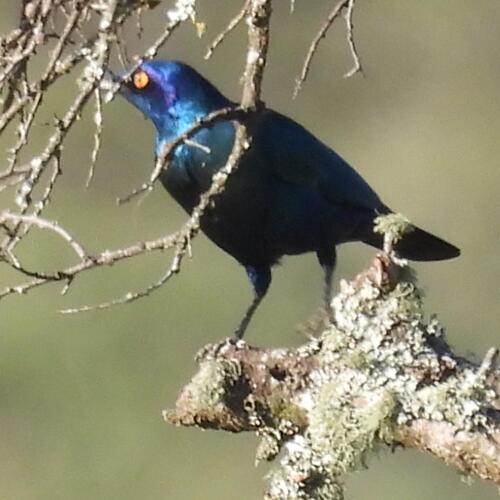 クロハラテリムク
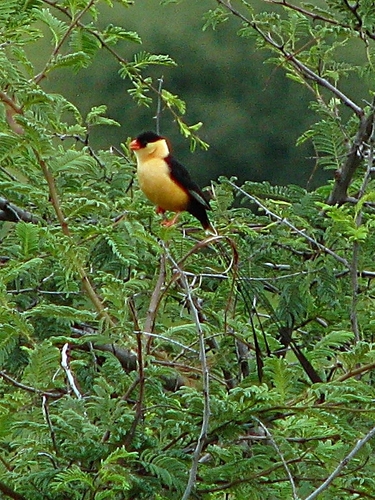 ミカドスズメ
要点
The most reliable field mark is the dramatic difference in tail structure and plumage, especially in breeding males: Shaft-tailed Whydah males sport extremely long, narrow tail streamers with a golden breast and black crown, while Black-bellied Starling is a glossy, compact starling with a normal tail and dark underparts. In non-breeding season or among females/immatures, the Whydah loses its long tail and adopts a plain, sparrow-like look, but still lacks the starling's gloss and structure. If you see a bird with a metallic sheen and short tail, it's the starling; if you see a bird with a long, streamer-like tail or a plain, seed-eating sparrow shape, it's the Whydah. Both species can occur in overlapping regions of southern Africa, but their habitat preferences and behaviors differ.
識別のコツ
- Tail shape and length (breeding season): Male Shaft-tailed Whydah has four extremely long, narrow tail streamers with expanded tips, far exceeding the body length—no starling ever shows this. Black-bellied Starling has a normal, short, squared or slightly rounded tail.
- Plumage gloss: Black-bellied Starling is always glossy and dark, with a metallic sheen on the head and upperparts. Whydah (any age or sex) never shows metallic gloss—breeding males are partly black and gold, non-breeding birds are plain brown and streaky.
- Underparts color: Starling has dark, blackish underparts; Whydah breeding males have a golden breast, and non-breeding birds are pale below.
- Bill shape and color: Starling has a thicker, straight bill typical of starlings; Whydah has a finer, seed-eater's bill, more conical and delicate.
- Size and structure: Starling is bulkier, with a more upright stance and heavier build; Whydah is petite and sparrow-like, except for the long tail in breeding males.
- Iris color: Starling's iris can change with mood, but this is subtle and rarely diagnostic in the field. Whydah's eye is dark and unremarkable.
- Habitat: Starling is found in woodland, forest edge, or moist areas; Whydah prefers open grasslands and savanna.
- Behavior: Starling is arboreal, often in small, noisy groups; Whydah is terrestrial, feeding on the ground, and breeding males may perform display flights with long tails.
- Seasonal changes (Whydah): Only breeding male Whydahs have the long tail and striking colors; non-breeding males and females are drab and can be confused with other small brown birds, but never with a glossy starling.
- Flight silhouette: Breeding male Whydah in flight is unmistakable due to the trailing streamers; starling in flight is compact, with rapid wingbeats and a short tail.
- Association with other birds: Whydah often seen with seed-eating flocks; starling with other starlings or in mixed arboreal flocks.
- Feeding: Starling forages in trees and bushes; Whydah feeds mainly on seeds on the ground.
- Voice: No diagnostic vocalizations are described in the notes, so do not rely on this for separation.
- Juvenile/immature confusion: No distinctive juvenile wing patterns are noted for either species; focus on structure and habitat for young birds.
- Pitfalls: Non-breeding Whydah males and females can superficially resemble other small brown birds, but never show the starling's gloss, size, or arboreal habits.
大きさ
Shaft-tailed Whydah is a small, sparrow-sized bird (body mass ~14.4g [wikidata]), noticeably lighter and more delicate than the robust, medium-sized Black-bellied Starling (no mass given, but all starlings are substantially heavier and bulkier than whydahs). The starling appears chunkier, with a thicker bill and a more upright stance, while the Whydah is petite, with a finer bill and, in breeding males, a tail that can make it appear much longer in silhouette.
羽色
No distinctive juvenile or immature upperwing pattern is described for either species, so focus is on adult and seasonal plumage.
-
Black-bellied Starling: Adults are glossy, dark birds with a metallic sheen, especially on the head and upperparts. The underparts are dark, giving the species its name. The iris can change color depending on mood or behavior, but this is subtle in the field. No seasonal or sexual dimorphism is noted.
-
Shaft-tailed Whydah: Breeding males are unmistakable, with a black crown and upperparts, golden breast, and four extremely long, black tail shaft feathers with expanded tips. Outside the breeding season, males lose the long tail and molt into a plain, olive-brown plumage similar to females. Females and non-breeding males are drab, sparrow-like, lacking any gloss or iridescence, and have a pale, streaky appearance. No metallic sheen is ever present in Whydah plumage, regardless of age or sex.
行動
Black-bellied Starling typically moves in small, noisy groups and forages in trees or bushes, often showing active, upright postures and frequent short flights. Shaft-tailed Whydah is more likely to be seen singly or in loose association with seed-eating flocks, feeding on the ground or low in grass. Breeding male Whydahs perform display flights, showing off their long tails, while non-breeding birds are more secretive and terrestrial. The starling is more arboreal and gregarious; the Whydah is more terrestrial and solitary or loosely social.
生息環境
Black-bellied Starling prefers woodland, forest edge, and well-vegetated areas, often near water or in moist environments. Shaft-tailed Whydah favors open habitats and grasslands, often in drier, more open country, and is rarely found in dense woodland. If you find the bird in thick trees or forest edge, starling is more likely; if in open grassland or savanna, especially among seed-eaters, Whydah is favored.