

Motmot

クロオビヒナフクロウ 対 マレーモリフクロウ

Strix huhula 対 Strix seloputo

クロオビヒナフクロウとマレーモリフクロウのクイズ
クロオビヒナフクロウ (Strix huhula) クロオビヒナフクロウ
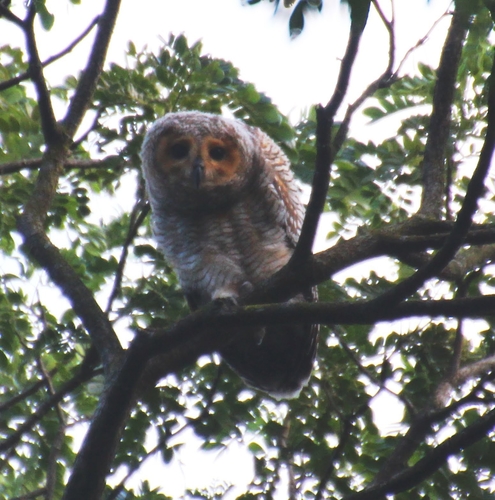
マレーモリフクロウ (Strix seloputo) マレーモリフクロウ

メディア

読み込み中…

要点

The most reliable field mark to separate Black-banded Owl from Spotted Wood-Owl is overall plumage pattern: Black-banded Owl is densely and finely barred black-and-white, with a black facial mask, while Spotted Wood-Owl shows a chocolate-brown head, orangish-buff face, and a boldly spotted and barred body with yellowish tones below. Black-banded Owl is smaller and more compact, with a distinctly dark, masked face and sooty tail with narrow white bars. Spotted Wood-Owl is much larger, with a strikingly pale, orange-buff facial disc, yellowish underparts, and prominent white spots above. Range does not overlap: Black-banded Owl is South American, Spotted Wood-Owl is Southeast Asian. These differences are visible in both perched and flight views, and are consistent across ages, as no age-specific wing or tail patterns are described for either species.

識別のコツ

  1. Overall size: Spotted Wood-Owl is much larger (44–48 cm) than Black-banded Owl (30–36 cm). If you have a sense of scale, this is a strong clue, but beware of lone birds or poor views.
  2. Facial pattern: Black-banded Owl has a striking black face mask encircling the eyes, giving a shadowed, masked look. Spotted Wood-Owl has an orangish-buff facial disc and a chocolate-brown head, which appears much paler and more open-faced.
  3. Body pattern: Black-banded Owl is densely and finely barred black-and-white all over, with no large spots. Spotted Wood-Owl has bold white spots and bars on the upperparts, and the underparts are dull yellow with broad white and narrow black bars.
  4. Tail pattern: Black-banded Owl's tail is sooty-brown with 4–5 narrow white bars and a white tip. Spotted Wood-Owl's tail pattern is not detailed, but the overall color impression is browner and less sharply banded.
  5. Bill color: Black-banded Owl has a yellow-orange bill and feet, while Spotted Wood-Owl's bill is greenish-black and its legs are olive. This is subtle but may help in close views.
  6. Leg feathering: Both species have well-feathered legs, but Black-banded Owl has black bristles and feathers extending to the base of the toes.
  7. Underpart color: Black-banded Owl is always blackish and white, never yellowish. Spotted Wood-Owl's underparts are distinctly dull yellow with broad white barring.
  8. Habitat and range: Black-banded Owl is strictly South American; Spotted Wood-Owl is strictly Southeast Asian. Any bird seen outside these ranges is almost certainly misidentified.
  9. No ear tufts: Both species lack ear tufts, so this is not useful for separation.
  10. Voice: Only Spotted Wood-Owl's call is described ('huhuhu' + 'whoo'), so unless you hear this exact pattern, do not rely on voice for separation.
  11. Flight vs perched: Both species are typically seen perched, but if seen in flight, look for the overall color and pattern: Black-banded Owl will appear dark and finely barred, Spotted Wood-Owl larger and more boldly spotted and yellowish.
  12. Juvenile/immature plumage: No age-specific flight or wing patterns are described for either species, so use adult-like field marks at all ages.
  13. Jizz: Spotted Wood-Owl is bulkier and longer-winged, while Black-banded Owl is more compact and shorter-tailed.
  14. Pitfalls: In poor light, Spotted Wood-Owl's orange face may appear darker, but the yellowish underparts and large size will still separate it from the smaller, more monochrome Black-banded Owl.
  15. Checklist fallback: If in doubt, use a combination of size, facial pattern, and underpart color for the most reliable separation.

大きさ

Black-banded Owl is medium-sized for a Strix, measuring 30–36 cm in length. In contrast, Spotted Wood-Owl is substantially larger, at 44–48 cm long, with a wing length (30–36 cm) that matches the entire body length of Black-banded Owl. This size difference is obvious if seen side by side, but may be harder to judge in isolation. Both lack ear tufts and have a rounded head, but Spotted Wood-Owl appears bulkier and longer-winged.

羽色

No age-specific wing or tail patterns are described for either species, so separation relies on overall coloration and pattern. Black-banded Owl of all ages is blackish overall, densely barred with fine, wavy white bands, and has a black face mask encircling the eyes. Its tail is sooty-brown with 4–5 narrow white bars and a white tip. The bill is yellow-orange. In contrast, Spotted Wood-Owl has a chocolate-brown head, orangish-buff facial disc, and a yellowish throat band (in the nominate subspecies). Its upperparts are coffee-brown with bold white spots and bars edged in black, and the underparts are dull yellow with broad white and narrow black bars. The bill is greenish-black, and the legs are olive. The face of Spotted Wood-Owl is much paler and more orange than the dark, masked look of Black-banded Owl. These differences are consistent in both perched and flight views.

行動

Both species are nocturnal and secretive, typically roosting in dense forest by day and hunting at night. No distinctive behavioral differences are described that would reliably separate them in the field. Both perch upright and are rarely seen in open flight during the day.

生息環境

Black-banded Owl is a resident of varied subtropical and tropical forests in South America, from lowlands to mid-elevations, and never migrates out of this region. Spotted Wood-Owl is found in Southeast Asia, in regions surrounding Borneo (but not on Borneo itself), and is absent from the Neotropics. Thus, any wild bird seen in South America is Black-banded Owl, and any in Southeast Asia is Spotted Wood-Owl. Habitat overlap is not possible.

声

The only vocalization described for Spotted Wood-Owl is a rolling 'huhuhu' followed by a long 'whoo.' No vocal description is given for Black-banded Owl in the provided notes, so voice is not a reliable separator based on this information.

より良い説明を送る

比較と同じ項目を使ってください。文章はすぐに公開されます。

The most reliable field mark to separate Black-banded Owl from Spotted Wood-Owl is overall plumage pattern: Black-banded Owl is densely and finely barred black-and-white, with a black facial mask, while Spotted Wood-Owl shows a chocolate-brown head, orangish-buff face, and a boldly spotted and barred body with yellowish tones below. Black-banded Owl is smaller and more compact, with a distinctly dark, masked face and sooty tail with narrow white bars. Spotted Wood-Owl is much larger, with a strikingly pale, orange-buff facial disc, yellowish underparts, and prominent white spots above. Range does not overlap: Black-banded Owl is South American, Spotted Wood-Owl is Southeast Asian. These differences are visible in both perched and flight views, and are consistent across ages, as no age-specific wing or tail patterns are described for either species.

  1. Overall size: Spotted Wood-Owl is much larger (44–48 cm) than Black-banded Owl (30–36 cm). If you have a sense of scale, this is a strong clue, but beware of lone birds or poor views.
  2. Facial pattern: Black-banded Owl has a striking black face mask encircling the eyes, giving a shadowed, masked look. Spotted Wood-Owl has an orangish-buff facial disc and a chocolate-brown head, which appears much paler and more open-faced.
  3. Body pattern: Black-banded Owl is densely and finely barred black-and-white all over, with no large spots. Spotted Wood-Owl has bold white spots and bars on the upperparts, and the underparts are dull yellow with broad white and narrow black bars.
  4. Tail pattern: Black-banded Owl's tail is sooty-brown with 4–5 narrow white bars and a white tip. Spotted Wood-Owl's tail pattern is not detailed, but the overall color impression is browner and less sharply banded.
  5. Bill color: Black-banded Owl has a yellow-orange bill and feet, while Spotted Wood-Owl's bill is greenish-black and its legs are olive. This is subtle but may help in close views.
  6. Leg feathering: Both species have well-feathered legs, but Black-banded Owl has black bristles and feathers extending to the base of the toes.
  7. Underpart color: Black-banded Owl is always blackish and white, never yellowish. Spotted Wood-Owl's underparts are distinctly dull yellow with broad white barring.
  8. Habitat and range: Black-banded Owl is strictly South American; Spotted Wood-Owl is strictly Southeast Asian. Any bird seen outside these ranges is almost certainly misidentified.
  9. No ear tufts: Both species lack ear tufts, so this is not useful for separation.
  10. Voice: Only Spotted Wood-Owl's call is described ('huhuhu' + 'whoo'), so unless you hear this exact pattern, do not rely on voice for separation.
  11. Flight vs perched: Both species are typically seen perched, but if seen in flight, look for the overall color and pattern: Black-banded Owl will appear dark and finely barred, Spotted Wood-Owl larger and more boldly spotted and yellowish.
  12. Juvenile/immature plumage: No age-specific flight or wing patterns are described for either species, so use adult-like field marks at all ages.
  13. Jizz: Spotted Wood-Owl is bulkier and longer-winged, while Black-banded Owl is more compact and shorter-tailed.
  14. Pitfalls: In poor light, Spotted Wood-Owl's orange face may appear darker, but the yellowish underparts and large size will still separate it from the smaller, more monochrome Black-banded Owl.
  15. Checklist fallback: If in doubt, use a combination of size, facial pattern, and underpart color for the most reliable separation.

Black-banded Owl is medium-sized for a Strix, measuring 30–36 cm in length. In contrast, Spotted Wood-Owl is substantially larger, at 44–48 cm long, with a wing length (30–36 cm) that matches the entire body length of Black-banded Owl. This size difference is obvious if seen side by side, but may be harder to judge in isolation. Both lack ear tufts and have a rounded head, but Spotted Wood-Owl appears bulkier and longer-winged.

No age-specific wing or tail patterns are described for either species, so separation relies on overall coloration and pattern. Black-banded Owl of all ages is blackish overall, densely barred with fine, wavy white bands, and has a black face mask encircling the eyes. Its tail is sooty-brown with 4–5 narrow white bars and a white tip. The bill is yellow-orange. In contrast, Spotted Wood-Owl has a chocolate-brown head, orangish-buff facial disc, and a yellowish throat band (in the nominate subspecies). Its upperparts are coffee-brown with bold white spots and bars edged in black, and the underparts are dull yellow with broad white and narrow black bars. The bill is greenish-black, and the legs are olive. The face of Spotted Wood-Owl is much paler and more orange than the dark, masked look of Black-banded Owl. These differences are consistent in both perched and flight views.

Both species are nocturnal and secretive, typically roosting in dense forest by day and hunting at night. No distinctive behavioral differences are described that would reliably separate them in the field. Both perch upright and are rarely seen in open flight during the day.

Black-banded Owl is a resident of varied subtropical and tropical forests in South America, from lowlands to mid-elevations, and never migrates out of this region. Spotted Wood-Owl is found in Southeast Asia, in regions surrounding Borneo (but not on Borneo itself), and is absent from the Neotropics. Thus, any wild bird seen in South America is Black-banded Owl, and any in Southeast Asia is Spotted Wood-Owl. Habitat overlap is not possible.

The only vocalization described for Spotted Wood-Owl is a rolling 'huhuhu' followed by a long 'whoo.' No vocal description is given for Black-banded Owl in the provided notes, so voice is not a reliable separator based on this information.

変更を破棄しますか?

保存していない編集があります。今離れると失われます。

クロオビヒナフクロウ · マレーモリフクロウ · 苦手な鳥