

Motmot

ツバメ 対 ハリオツバメ

Hirundo rustica 対 Hirundo smithii

ツバメとハリオツバメのクイズ
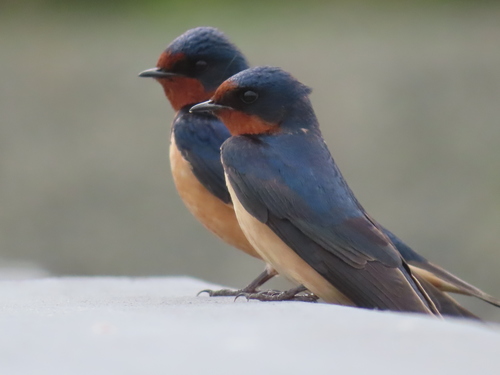
ツバメ (Hirundo rustica) ツバメ
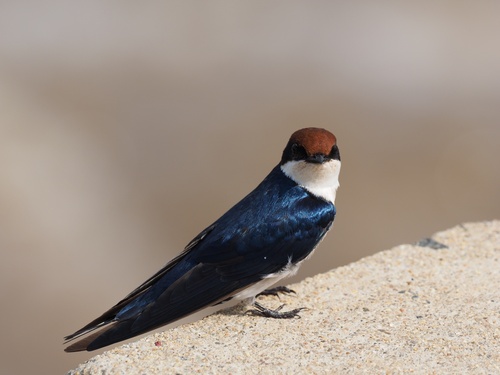
ハリオツバメ (Hirundo smithii) ハリオツバメ

メディア

読み込み中…

要点

The most reliable field mark to separate Barn Swallow from Wire-tailed Swallow is the color and pattern of the head and underparts, especially in adults: Barn Swallow shows a rufous (red) forehead and throat with a blue breast band, while Wire-tailed Swallow has a bright chestnut cap and pure white underparts. Juveniles of both species lack the long tail streamers or wires, so focus on head color—Barn Swallow juveniles have a pale rufous face, while Wire-tailed Swallow juveniles have a dull brown crown. In flight, both have long tails, but the 'wires' of Wire-tailed Swallow are much finer and more filamentous than the broader, deeply forked tail streamers of Barn Swallow. Both species are blue above and white below, but the precise shade and head pattern are key. Watch for context: Barn Swallow is widespread and often seen near people, while Wire-tailed Swallow is more closely tied to water, especially in Africa and Asia.

識別のコツ

  1. Head color in adults: Barn Swallow has a rufous (red) forehead and throat, separated from the white underparts by a blue breast band. Wire-tailed Swallow has a bright chestnut cap (entire crown), with a clear demarcation from the white face and underparts. This is the most reliable mark in perched birds.
  2. Tail shape and structure: Barn Swallow's tail is deeply forked with broad, ribbon-like outer feathers (streamers), and a line of white spots at the tip. Wire-tailed Swallow's tail is less deeply forked but has two extremely long, thin, wire-like outer feathers. In juveniles, both lack these features, so check other marks.
  3. Juvenile head color: Juvenile Barn Swallow has a pale rufous face and whiter underparts, while juvenile Wire-tailed Swallow has a dull brown crown and back. The brown crown is diagnostic for juvenile Wire-tailed Swallow.
  4. Breast band: Barn Swallow (all ages except some juveniles) shows a dark blue breast band separating the rufous throat from the white belly. Wire-tailed Swallow lacks any breast band—its white underparts are unbroken.
  5. Upperparts color: Both are blue above, but Barn Swallow is described as 'steel blue', sometimes less glossy in females, while Wire-tailed Swallow is 'bright blue'. This is subtle and best used in good light.
  6. Underparts color: Barn Swallow has off-white underparts, sometimes with a buffy wash in juveniles. Wire-tailed Swallow is bright white below in adults, with no wash or band.
  7. Tail spots: Barn Swallow shows a line of white spots across the outer end of the upper tail (visible in flight or when tail is spread). Wire-tailed Swallow lacks these spots.
  8. Sex differences: In both species, females have shorter tail streamers/wires than males, but the basic color pattern holds. Do not rely on tail length alone for sexing or ID.
  9. Flight jizz: Barn Swallow often appears longer and more 'swallow-like' with its deep forked tail, while Wire-tailed Swallow is smaller, more compact, and the wires trail behind more like filaments. In quick flight views, look for the overall tail shape and head color.
  10. Habitat context: If seen skimming low over a river or lake in Africa or Asia, especially in pairs or small groups, Wire-tailed Swallow is likely. Barn Swallow is more generalist and can be found in a wider range of open habitats, often near buildings.
  11. Voice: Barn Swallow gives a variety of calls, but these are not always diagnostic unless you know them well. Wire-tailed Swallow's calls are not detailed here.
  12. Juvenile confusion: Both species' juveniles lack long tail streamers/wires, so focus on head color (pale rufous face for Barn, brown crown for Wire-tailed) and presence/absence of breast band (Barn Swallow juvenile may have a faint or incomplete band, Wire-tailed never does).
  13. Geographic range: Barn Swallow is cosmopolitan, while Wire-tailed Swallow is limited to Africa and southern/southeastern Asia. If outside these regions, Wire-tailed is unlikely.
  14. Perched posture: Barn Swallow often perches on wires or open branches, showing off its long tail. Wire-tailed Swallow may do the same, but the wires are much finer and may be hard to see unless the tail is spread or backlit.
  15. Pitfalls: Female and juvenile Barn Swallows can appear dull and short-tailed, approaching the look of a Wire-tailed Swallow, but will never show a full chestnut cap or pure white underparts. Always check multiple features if unsure.

大きさ

Wire-tailed Swallow is slightly smaller and lighter than Barn Swallow. The Wire-tailed Swallow weighs about 12.7 grams [wikidata], while Barn Swallow is heavier (16–22 g) and has a slightly longer wingspan (32–34.5 cm vs. Wire-tailed Swallow's 18 cm length, wingspan not specified) [wikipedia]. Both are slender swallows, but Barn Swallow generally appears longer-bodied and more substantial, especially with its long tail streamers.

羽色

Juvenile Barn Swallows are brownish above with a pale rufous face and whiter underparts, lacking the long tail streamers of adults. Juvenile Wire-tailed Swallows have a dull brown crown, back, and tail, and also lack the distinctive tail wires; their cap is brown, not chestnut. Adult Barn Swallows have steel blue upperparts, a rufous forehead and throat, a blue breast band, and off-white underparts. Adult Wire-tailed Swallows are bright blue above, pure white below, and have a bright chestnut cap (not just the forehead). The tail of the Barn Swallow is deeply forked with broad streamers and a line of white spots at the tip, while Wire-tailed Swallow's tail is less deeply forked but has two very long, fine, wire-like outer feathers. Female Barn Swallows are duller and have shorter tail streamers, but still show the blue breast band and rufous face. Female Wire-tailed Swallows are similar to males but with shorter wires. In both species, immature birds can be confusing, but the head color and tail structure are key.

行動

Both species are aerial insectivores, often seen flying low over open areas. Wire-tailed Swallow is especially associated with water bodies and is often seen skimming low over rivers or lakes. Barn Swallow is more generalist, found in open country, farmland, and near human habitation, sometimes nesting under eaves or bridges. Both are agile flyers, but Wire-tailed Swallow may appear even more delicate and acrobatic due to its smaller size and long wires.

生息環境

Barn Swallow is extremely widespread and adaptable, found on all continents except Antarctica, and is common in open country, farmland, and near human settlements. Wire-tailed Swallow is more restricted to Africa and southern/southeastern Asia, and is closely tied to open country near water, such as rivers and lakes. While both may be seen near people, Wire-tailed Swallow is more likely to be found right at the water's edge.

声

Barn Swallow gives a variety of calls, including a 'witt' or 'witt-witt', and a loud 'splee-plink' when excited. Alarm calls include a sharp 'siflitt' for mammalian predators and a 'flitt-flitt' for raptors. Wire-tailed Swallow's vocalizations are not detailed in the notes, so calls are not a reliable separation point in this context.

より良い説明を送る

比較と同じ項目を使ってください。文章はすぐに公開されます。

The most reliable field mark to separate Barn Swallow from Wire-tailed Swallow is the color and pattern of the head and underparts, especially in adults: Barn Swallow shows a rufous (red) forehead and throat with a blue breast band, while Wire-tailed Swallow has a bright chestnut cap and pure white underparts. Juveniles of both species lack the long tail streamers or wires, so focus on head color—Barn Swallow juveniles have a pale rufous face, while Wire-tailed Swallow juveniles have a dull brown crown. In flight, both have long tails, but the 'wires' of Wire-tailed Swallow are much finer and more filamentous than the broader, deeply forked tail streamers of Barn Swallow. Both species are blue above and white below, but the precise shade and head pattern are key. Watch for context: Barn Swallow is widespread and often seen near people, while Wire-tailed Swallow is more closely tied to water, especially in Africa and Asia.

  1. Head color in adults: Barn Swallow has a rufous (red) forehead and throat, separated from the white underparts by a blue breast band. Wire-tailed Swallow has a bright chestnut cap (entire crown), with a clear demarcation from the white face and underparts. This is the most reliable mark in perched birds.
  2. Tail shape and structure: Barn Swallow's tail is deeply forked with broad, ribbon-like outer feathers (streamers), and a line of white spots at the tip. Wire-tailed Swallow's tail is less deeply forked but has two extremely long, thin, wire-like outer feathers. In juveniles, both lack these features, so check other marks.
  3. Juvenile head color: Juvenile Barn Swallow has a pale rufous face and whiter underparts, while juvenile Wire-tailed Swallow has a dull brown crown and back. The brown crown is diagnostic for juvenile Wire-tailed Swallow.
  4. Breast band: Barn Swallow (all ages except some juveniles) shows a dark blue breast band separating the rufous throat from the white belly. Wire-tailed Swallow lacks any breast band—its white underparts are unbroken.
  5. Upperparts color: Both are blue above, but Barn Swallow is described as 'steel blue', sometimes less glossy in females, while Wire-tailed Swallow is 'bright blue'. This is subtle and best used in good light.
  6. Underparts color: Barn Swallow has off-white underparts, sometimes with a buffy wash in juveniles. Wire-tailed Swallow is bright white below in adults, with no wash or band.
  7. Tail spots: Barn Swallow shows a line of white spots across the outer end of the upper tail (visible in flight or when tail is spread). Wire-tailed Swallow lacks these spots.
  8. Sex differences: In both species, females have shorter tail streamers/wires than males, but the basic color pattern holds. Do not rely on tail length alone for sexing or ID.
  9. Flight jizz: Barn Swallow often appears longer and more 'swallow-like' with its deep forked tail, while Wire-tailed Swallow is smaller, more compact, and the wires trail behind more like filaments. In quick flight views, look for the overall tail shape and head color.
  10. Habitat context: If seen skimming low over a river or lake in Africa or Asia, especially in pairs or small groups, Wire-tailed Swallow is likely. Barn Swallow is more generalist and can be found in a wider range of open habitats, often near buildings.
  11. Voice: Barn Swallow gives a variety of calls, but these are not always diagnostic unless you know them well. Wire-tailed Swallow's calls are not detailed here.
  12. Juvenile confusion: Both species' juveniles lack long tail streamers/wires, so focus on head color (pale rufous face for Barn, brown crown for Wire-tailed) and presence/absence of breast band (Barn Swallow juvenile may have a faint or incomplete band, Wire-tailed never does).
  13. Geographic range: Barn Swallow is cosmopolitan, while Wire-tailed Swallow is limited to Africa and southern/southeastern Asia. If outside these regions, Wire-tailed is unlikely.
  14. Perched posture: Barn Swallow often perches on wires or open branches, showing off its long tail. Wire-tailed Swallow may do the same, but the wires are much finer and may be hard to see unless the tail is spread or backlit.
  15. Pitfalls: Female and juvenile Barn Swallows can appear dull and short-tailed, approaching the look of a Wire-tailed Swallow, but will never show a full chestnut cap or pure white underparts. Always check multiple features if unsure.

Wire-tailed Swallow is slightly smaller and lighter than Barn Swallow. The Wire-tailed Swallow weighs about 12.7 grams [wikidata], while Barn Swallow is heavier (16–22 g) and has a slightly longer wingspan (32–34.5 cm vs. Wire-tailed Swallow's 18 cm length, wingspan not specified) [wikipedia]. Both are slender swallows, but Barn Swallow generally appears longer-bodied and more substantial, especially with its long tail streamers.

Juvenile Barn Swallows are brownish above with a pale rufous face and whiter underparts, lacking the long tail streamers of adults. Juvenile Wire-tailed Swallows have a dull brown crown, back, and tail, and also lack the distinctive tail wires; their cap is brown, not chestnut. Adult Barn Swallows have steel blue upperparts, a rufous forehead and throat, a blue breast band, and off-white underparts. Adult Wire-tailed Swallows are bright blue above, pure white below, and have a bright chestnut cap (not just the forehead). The tail of the Barn Swallow is deeply forked with broad streamers and a line of white spots at the tip, while Wire-tailed Swallow's tail is less deeply forked but has two very long, fine, wire-like outer feathers. Female Barn Swallows are duller and have shorter tail streamers, but still show the blue breast band and rufous face. Female Wire-tailed Swallows are similar to males but with shorter wires. In both species, immature birds can be confusing, but the head color and tail structure are key.

Both species are aerial insectivores, often seen flying low over open areas. Wire-tailed Swallow is especially associated with water bodies and is often seen skimming low over rivers or lakes. Barn Swallow is more generalist, found in open country, farmland, and near human habitation, sometimes nesting under eaves or bridges. Both are agile flyers, but Wire-tailed Swallow may appear even more delicate and acrobatic due to its smaller size and long wires.

Barn Swallow is extremely widespread and adaptable, found on all continents except Antarctica, and is common in open country, farmland, and near human settlements. Wire-tailed Swallow is more restricted to Africa and southern/southeastern Asia, and is closely tied to open country near water, such as rivers and lakes. While both may be seen near people, Wire-tailed Swallow is more likely to be found right at the water's edge.

Barn Swallow gives a variety of calls, including a 'witt' or 'witt-witt', and a loud 'splee-plink' when excited. Alarm calls include a sharp 'siflitt' for mammalian predators and a 'flitt-flitt' for raptors. Wire-tailed Swallow's vocalizations are not detailed in the notes, so calls are not a reliable separation point in this context.

変更を破棄しますか?

保存していない編集があります。今離れると失われます。

ツバメ · ハリオツバメ · 苦手な鳥