

ハイバネアリサザイ 対 サザナミアリモズ
Euchrepomis spodioptila 対 Cymbilaimus lineatus
ハイバネアリサザイとサザナミアリモズのクイズ
 ハイバネアリサザイ
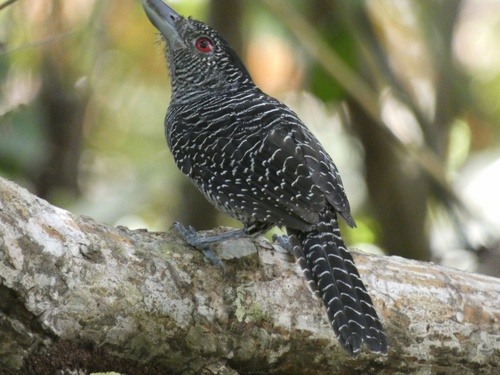 サザナミアリモズ
要点
The most reliable field mark is overall size and structure: Fasciated Antshrike is much larger and bulkier than Ash-winged Antwren, with a heavy, hooked bill and a strikingly barred plumage in all ages. Ash-winged Antwren is tiny, slim, and more delicate, with subtle sexual dimorphism and distinct wing bars. Immature Ash-winged Antwrens show olive or greenish edges to the flight feathers, while Fasciated Antshrike immatures already show some barring. If you see a small, active bird high in the canopy with two neat wingbars, think Ash-winged Antwren; a large, boldly barred bird with a thick bill is always Fasciated Antshrike.
識別のコツ
- Size is the first check: If the bird is small, delicate, and warbler-like, consider Ash-winged Antwren. If it is large, thickset, and heavy-billed, it is Fasciated Antshrike.
- Bill shape: Ash-winged Antwren has a fine, short, straight bill. Fasciated Antshrike has a massive, hooked bill reminiscent of a shrike—this is obvious even at a distance.
- Wingbars vs barring: Ash-winged Antwren (all ages) shows two neat, pale wingbars on blackish coverts. Fasciated Antshrike never shows wingbars; instead, look for narrow, regular barring across the entire body and wings.
- Immature/juvenile marks: Immature Ash-winged Antwrens have olive or greenish edges to the flight feathers and sometimes a greenish-yellow tinge to the wingbars and belly (especially in E. s. meridionalis). No barring is present. Immature Fasciated Antshrikes already show some barring, with subadult males having broader white bars than adults.
- Crown color: Male Ash-winged Antwren has a black crown/nape; female has yellowish-brown. Fasciated Antshrike males have a black crown/forehead with fine white bars, females a rufous crown.
- Back and rump: Ash-winged Antwren males have a rufous-chestnut back and rump, never seen in Fasciated Antshrike, which is barred throughout.
- Supercilium: Ash-winged Antwren has a pale (whitish or buffy) supercilium in both sexes; Fasciated Antshrike lacks a strong supercilium, as the facial pattern is dominated by barring.
- Underparts: Ash-winged Antwren is plain pale gray (male) or buffy (female) below, with no barring. Fasciated Antshrike is barred below in both sexes.
- Tail: Ash-winged Antwren has a plain gray-brown tail; Fasciated Antshrike has a barred tail (dark brown and pale buff or cinnamon in females).
- Iris color: Fasciated Antshrike has a red iris in both sexes; iris color is not mentioned for Ash-winged Antwren, so do not use this as a primary mark unless seen well.
- Foraging height: Ash-winged Antwren is almost always high in the subcanopy/canopy; Fasciated Antshrike is often lower (2–10 m) and can be seen at eye level.
- Behavior: Ash-winged Antwren is quick, agile, and often in mixed flocks; Fasciated Antshrike is slower, more methodical, and often alone or in pairs.
- Range overlap: Both can occur in Amazonian forests, but Ash-winged Antwren is much more restricted to intact terra firme forest and is rare in Ecuador and Colombia, while Fasciated Antshrike is widespread and common in suitable habitat.
- Sexual dimorphism: Both species show sexual dimorphism, but in the antshrike, both sexes are barred (with color differences), while in the antwren, males and females differ mainly in crown and underpart color, not barring.
- Never trust barring alone: If you see any barring on the underparts, back, or tail, it is always Fasciated Antshrike—Ash-winged Antwren is never barred at any age.
大きさ
Fasciated Antshrike is dramatically larger (17–18 cm, ~35–40 g) than Ash-winged Antwren (9.5–11 cm, 6.5–7.5 g). The antshrike is nearly twice as long and about five times heavier, with a much more robust and powerful build. The antwren is among the smallest antbirds, appearing dainty and light, while the antshrike is chunky and imposing. Even at a distance, the antshrike's size and thick bill stand out.
羽色
- Immature/juvenile birds: Ash-winged Antwren immatures (both sexes) have olive-green or greenish edges to their flight feathers, and in some subspecies, a greenish-yellow tinge to the wingbars and belly. This is never seen in Fasciated Antshrike, whose immatures already show some degree of barring, with subadult males having wider white bars than adults.
- Adult males: Ash-winged Antwren males have a black crown/nape, rufous-chestnut back, gray face with a white supercilium, and two white wingbars; underparts are pale gray. Fasciated Antshrike males are boldly and narrowly barred black-and-white all over, with a black forehead/crown and a heavy hooked bill. No rufous or chestnut tones.
- Adult females: Ash-winged Antwren females are yellowish-brown above with a buffy supercilium and underparts, and subtle wingbars. Fasciated Antshrike females have a rufous crown and are barred dark brown and pale yellowish-brown throughout, including the tail. Both sexes of the antshrike have a red iris, which is not noted for the antwren.
- Wing pattern in flight: Ash-winged Antwren always shows two neat white wingbars (adults and immatures), while Fasciated Antshrike never has wingbars—its pattern is all-over barring.
行動
Ash-winged Antwren is highly active and acrobatic, foraging quickly in the subcanopy and canopy, often as part of mixed-species flocks. It is rarely seen alone and almost never low in the forest. Fasciated Antshrike is more deliberate, often foraging lower (2–10 m) and sometimes alone or in pairs, with a heavier, more methodical movement. The antshrike’s large size and slower movements contrast with the tiny, restless antwren.
生息環境
Ash-winged Antwren is a canopy specialist of lowland terra firme evergreen forest, almost always in the subcanopy or canopy, and rarely below 600 m except in tepui regions. Fasciated Antshrike is much more widespread, found from Central America into most of South America (excluding the southern cone), and occupies a broader range of forest types and strata, often lower in the forest and not restricted to the canopy.