

Motmot

クロトウゾクカモメ 対 オオハシウミガラス

Stercorarius parasiticus 対 Alca torda

クロトウゾクカモメとオオハシウミガラスのクイズ
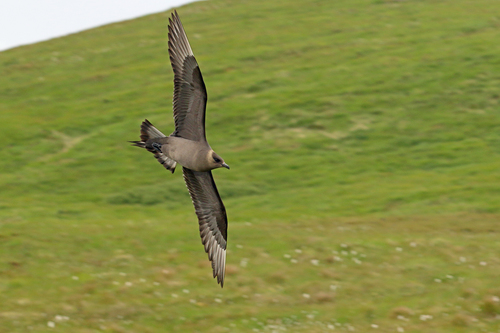
クロトウゾクカモメ (Stercorarius parasiticus) クロトウゾクカモメ
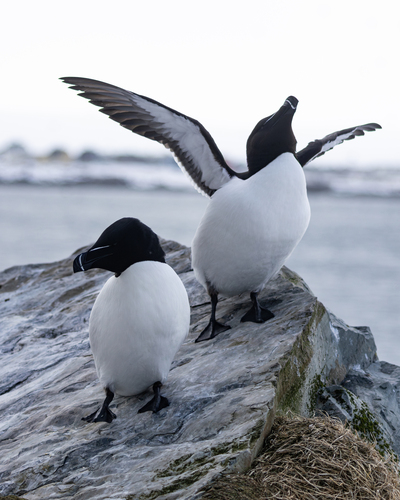
オオハシウミガラス (Alca torda) オオハシウミガラス

メディア

読み込み中…

要点

The most reliable field separation between Arctic Skua and Razorbill is their overall structure and flight style: Arctic Skua is a slim, predatory seabird with pointed wings, a longish tail (often with central streamers in adults), and a distinctly falcon-like, agile flight, while Razorbill is a thickset, short-necked auk with a deep, blunt bill, short tail, and rapid, direct wingbeats. In all plumages, Arctic Skua shows a white wing flash (on the bases of the primaries) visible in flight, whereas Razorbill’s wings are uniformly dark. Juvenile and immature Arctic Skuas can be confused with other jaegers but not with Razorbill, which always looks more like a puffin or murre in shape. Plumage differences are striking: Razorbill is sharply black-and-white with a heavy, vertically grooved bill, while Arctic Skua varies from pale to all-dark morphs but never has the Razorbill’s crisp pattern or bill. If seen perched, the bill and body shape are unmistakable. Both species may be seen offshore, but Razorbill is almost never seen chasing other birds or performing aerial piracy, unlike the Arctic Skua.

識別のコツ

  1. White wing flash (Arctic Skua): In all plumages and ages, Arctic Skua shows a bold white patch at the base of the primaries in flight, absent in Razorbill. Look for this especially in distant or backlit birds.
  2. Bill shape: Razorbill has a deep, laterally compressed, blunt-tipped black bill with vertical grooves and a white line (in breeding plumage), unique and diagnostic at any range. Arctic Skua’s bill is slender, hooked, and never shows grooves or a white line.
  3. Body structure: Arctic Skua is slim, long-winged, and agile, with a pointed tail (central streamers in adults). Razorbill is thickset, short-necked, and heavy-bodied, with a short, wedge-shaped tail and a horizontal stance.
  4. Flight style: Arctic Skua is buoyant, agile, and falcon-like, often twisting and chasing other birds. Razorbill flies low and direct, with rapid, whirring wingbeats, never chasing other birds.
  5. Tail shape: Adult Arctic Skuas have pointed central tail feathers (streamers) in breeding plumage, extending the tail beyond the wing tips. Razorbill’s tail is short and wedge-shaped, with only slightly longer central feathers, never streamer-like.
  6. Plumage pattern: Razorbill is sharply black above and white below in breeding plumage, with a black head and a thin white line from eye to bill. Arctic Skua (light morph) is brown above, white below, with a yellowish-white neck and black cap; dark morph is all dark brown. No Arctic Skua morph shows the crisp black-and-white contrast or facial lines of Razorbill.
  7. Wing pattern: Razorbill’s wings are uniformly dark above and below, with no white flash. Arctic Skua always shows the white wing flash in flight.
  8. Perched posture: Razorbill sits horizontally, often on rocks or cliffs, looking chunky and upright. Arctic Skua stands more upright, with a slimmer, predatory look.
  9. Feeding behavior: If seen chasing other seabirds in flight, it is Arctic Skua. Razorbill never engages in aerial piracy.
  10. Habitat context: Razorbill is found on rocky cliffs and at sea, often in groups, rarely far from land. Arctic Skua is more likely seen offshore, especially where gulls and terns are present, and breeds on tundra or islands.
  11. Seasonal changes: Razorbill’s face and bill pattern become less distinct in non-breeding season (throat and face behind eye white, bill grooves less marked), but overall black-and-white pattern remains. Arctic Skua’s plumage varies by morph but never matches Razorbill’s sharp contrast.
  12. Juvenile confusion: Juvenile Arctic Skua can be confused with other jaegers but not with Razorbill, which always has a thick bill and black-and-white pattern.
  13. Size impression: Arctic Skua is longer-winged and slimmer, Razorbill is chunkier and heavier-bodied, despite similar length.
  14. Feet in flight: Razorbill’s feet do not project beyond the tail in flight; Arctic Skua’s legs are shorter and less visible.
  15. Vocalizations: Arctic Skua gives nasal mewing and wailing calls on breeding grounds; Razorbill is generally silent at sea. Voice is not usually helpful for separation.

大きさ

Arctic Skua is slightly longer (41–48 cm) and has a much greater wingspan (107–125 cm) than Razorbill (37–39 cm body length, with wing length 201–216 mm), but Razorbill is heavier on average (505–890 g vs. 300–650 g for Arctic Skua) and appears much stockier. In the field, Arctic Skua looks slim and athletic, with long, pointed wings and a relatively long tail (especially in adults with streamers), while Razorbill is compact, thick-necked, and short-tailed, with a deep-chested, penguin-like profile. The Razorbill’s bill is much deeper and blunter than the slender, hooked bill of the Arctic Skua. In flight, Razorbill’s wings are short and paddle-shaped, giving a rapid, whirring impression, while Arctic Skua’s wings are long and pointed, suited for agile aerial pursuits.

羽色

Juvenile and immature Arctic Skuas are variable, ranging from pale to dark morphs, but all show a distinctive white wing flash on the base of the primaries in flight, regardless of age or morph. This is absent in Razorbill, which has uniformly dark wings above and below. Adult Arctic Skuas (light morph) show a brown back, white underparts, yellowish-white neck and head with a black cap, and pointed central tail feathers; dark morphs are all dark brown but still show the white wing flash. Razorbill adults in breeding plumage are sharply black above and white below, with a black head, neck, and back, a white belly, and a thin white line from the eye to the bill. In non-breeding plumage, Razorbill’s throat and face behind the eye become white, but the overall pattern remains crisply black-and-white. The bill of Razorbill is black with vertical grooves and a white line, unique among North Atlantic seabirds. Arctic Skua never shows this bill pattern or the sharp black-and-white contrast of Razorbill. In flight, Razorbill shows a short, wedge-shaped tail and no wing flash, while Arctic Skua’s tail is longer and pointed (especially in adults), and the white wing flash is always present.

行動

Arctic Skua is famous for its kleptoparasitic behavior, often seen chasing gulls and terns in agile, twisting flight to steal food. Its flight is falcon-like, with powerful, buoyant wingbeats and sudden changes of direction. When perched, it stands upright with a slim, predatory look. Razorbill, by contrast, is rarely seen in aerial pursuit; it is a diving specialist, swimming underwater with its wings to catch fish. On land, Razorbill stands horizontally, often in dense colonies on cliffs, and is awkward on land but agile underwater. In flight, Razorbill is direct and rapid, with short, whirring wingbeats and a low, straight trajectory, rarely engaging in aerial chases.

生息環境

Both species are marine, but their preferred habitats differ. Arctic Skua breeds on open tundra, fells, and islands, and is most often seen offshore or along coasts during migration, especially where gulls and terns are present. It is the most likely jaeger to be seen from shore. Razorbill is strictly marine except when breeding, nesting colonially in crevices and on cliffs along rocky coasts. At sea, Razorbill is usually seen in small groups or alone, often sitting low on the water, and is less likely to be seen far from land except during migration. Arctic Skua is more often observed in flight, especially when harassing other seabirds.

声

Arctic Skua is generally silent at sea, but on breeding grounds gives nasal mewing and wailing calls, and a shorter alarm call. Razorbill’s vocalizations are not described in the provided notes, but they are generally quiet at sea and more vocal at colonies. Voice is not a reliable separator at sea.

より良い説明を送る

比較と同じ項目を使ってください。文章はすぐに公開されます。

The most reliable field separation between Arctic Skua and Razorbill is their overall structure and flight style: Arctic Skua is a slim, predatory seabird with pointed wings, a longish tail (often with central streamers in adults), and a distinctly falcon-like, agile flight, while Razorbill is a thickset, short-necked auk with a deep, blunt bill, short tail, and rapid, direct wingbeats. In all plumages, Arctic Skua shows a white wing flash (on the bases of the primaries) visible in flight, whereas Razorbill’s wings are uniformly dark. Juvenile and immature Arctic Skuas can be confused with other jaegers but not with Razorbill, which always looks more like a puffin or murre in shape. Plumage differences are striking: Razorbill is sharply black-and-white with a heavy, vertically grooved bill, while Arctic Skua varies from pale to all-dark morphs but never has the Razorbill’s crisp pattern or bill. If seen perched, the bill and body shape are unmistakable. Both species may be seen offshore, but Razorbill is almost never seen chasing other birds or performing aerial piracy, unlike the Arctic Skua.

  1. White wing flash (Arctic Skua): In all plumages and ages, Arctic Skua shows a bold white patch at the base of the primaries in flight, absent in Razorbill. Look for this especially in distant or backlit birds.
  2. Bill shape: Razorbill has a deep, laterally compressed, blunt-tipped black bill with vertical grooves and a white line (in breeding plumage), unique and diagnostic at any range. Arctic Skua’s bill is slender, hooked, and never shows grooves or a white line.
  3. Body structure: Arctic Skua is slim, long-winged, and agile, with a pointed tail (central streamers in adults). Razorbill is thickset, short-necked, and heavy-bodied, with a short, wedge-shaped tail and a horizontal stance.
  4. Flight style: Arctic Skua is buoyant, agile, and falcon-like, often twisting and chasing other birds. Razorbill flies low and direct, with rapid, whirring wingbeats, never chasing other birds.
  5. Tail shape: Adult Arctic Skuas have pointed central tail feathers (streamers) in breeding plumage, extending the tail beyond the wing tips. Razorbill’s tail is short and wedge-shaped, with only slightly longer central feathers, never streamer-like.
  6. Plumage pattern: Razorbill is sharply black above and white below in breeding plumage, with a black head and a thin white line from eye to bill. Arctic Skua (light morph) is brown above, white below, with a yellowish-white neck and black cap; dark morph is all dark brown. No Arctic Skua morph shows the crisp black-and-white contrast or facial lines of Razorbill.
  7. Wing pattern: Razorbill’s wings are uniformly dark above and below, with no white flash. Arctic Skua always shows the white wing flash in flight.
  8. Perched posture: Razorbill sits horizontally, often on rocks or cliffs, looking chunky and upright. Arctic Skua stands more upright, with a slimmer, predatory look.
  9. Feeding behavior: If seen chasing other seabirds in flight, it is Arctic Skua. Razorbill never engages in aerial piracy.
  10. Habitat context: Razorbill is found on rocky cliffs and at sea, often in groups, rarely far from land. Arctic Skua is more likely seen offshore, especially where gulls and terns are present, and breeds on tundra or islands.
  11. Seasonal changes: Razorbill’s face and bill pattern become less distinct in non-breeding season (throat and face behind eye white, bill grooves less marked), but overall black-and-white pattern remains. Arctic Skua’s plumage varies by morph but never matches Razorbill’s sharp contrast.
  12. Juvenile confusion: Juvenile Arctic Skua can be confused with other jaegers but not with Razorbill, which always has a thick bill and black-and-white pattern.
  13. Size impression: Arctic Skua is longer-winged and slimmer, Razorbill is chunkier and heavier-bodied, despite similar length.
  14. Feet in flight: Razorbill’s feet do not project beyond the tail in flight; Arctic Skua’s legs are shorter and less visible.
  15. Vocalizations: Arctic Skua gives nasal mewing and wailing calls on breeding grounds; Razorbill is generally silent at sea. Voice is not usually helpful for separation.

Arctic Skua is slightly longer (41–48 cm) and has a much greater wingspan (107–125 cm) than Razorbill (37–39 cm body length, with wing length 201–216 mm), but Razorbill is heavier on average (505–890 g vs. 300–650 g for Arctic Skua) and appears much stockier. In the field, Arctic Skua looks slim and athletic, with long, pointed wings and a relatively long tail (especially in adults with streamers), while Razorbill is compact, thick-necked, and short-tailed, with a deep-chested, penguin-like profile. The Razorbill’s bill is much deeper and blunter than the slender, hooked bill of the Arctic Skua. In flight, Razorbill’s wings are short and paddle-shaped, giving a rapid, whirring impression, while Arctic Skua’s wings are long and pointed, suited for agile aerial pursuits.

Juvenile and immature Arctic Skuas are variable, ranging from pale to dark morphs, but all show a distinctive white wing flash on the base of the primaries in flight, regardless of age or morph. This is absent in Razorbill, which has uniformly dark wings above and below. Adult Arctic Skuas (light morph) show a brown back, white underparts, yellowish-white neck and head with a black cap, and pointed central tail feathers; dark morphs are all dark brown but still show the white wing flash. Razorbill adults in breeding plumage are sharply black above and white below, with a black head, neck, and back, a white belly, and a thin white line from the eye to the bill. In non-breeding plumage, Razorbill’s throat and face behind the eye become white, but the overall pattern remains crisply black-and-white. The bill of Razorbill is black with vertical grooves and a white line, unique among North Atlantic seabirds. Arctic Skua never shows this bill pattern or the sharp black-and-white contrast of Razorbill. In flight, Razorbill shows a short, wedge-shaped tail and no wing flash, while Arctic Skua’s tail is longer and pointed (especially in adults), and the white wing flash is always present.

Arctic Skua is famous for its kleptoparasitic behavior, often seen chasing gulls and terns in agile, twisting flight to steal food. Its flight is falcon-like, with powerful, buoyant wingbeats and sudden changes of direction. When perched, it stands upright with a slim, predatory look. Razorbill, by contrast, is rarely seen in aerial pursuit; it is a diving specialist, swimming underwater with its wings to catch fish. On land, Razorbill stands horizontally, often in dense colonies on cliffs, and is awkward on land but agile underwater. In flight, Razorbill is direct and rapid, with short, whirring wingbeats and a low, straight trajectory, rarely engaging in aerial chases.

Both species are marine, but their preferred habitats differ. Arctic Skua breeds on open tundra, fells, and islands, and is most often seen offshore or along coasts during migration, especially where gulls and terns are present. It is the most likely jaeger to be seen from shore. Razorbill is strictly marine except when breeding, nesting colonially in crevices and on cliffs along rocky coasts. At sea, Razorbill is usually seen in small groups or alone, often sitting low on the water, and is less likely to be seen far from land except during migration. Arctic Skua is more often observed in flight, especially when harassing other seabirds.

Arctic Skua is generally silent at sea, but on breeding grounds gives nasal mewing and wailing calls, and a shorter alarm call. Razorbill’s vocalizations are not described in the provided notes, but they are generally quiet at sea and more vocal at colonies. Voice is not a reliable separator at sea.

変更を破棄しますか?

保存していない編集があります。今離れると失われます。

クロトウゾクカモメ · オオハシウミガラス · 苦手な鳥