

アメリカオオタカ 対 ハネビロノスリ
Astur atricapillus 対 Buteo platypterus
アメリカオオタカとハネビロノスリのクイズ
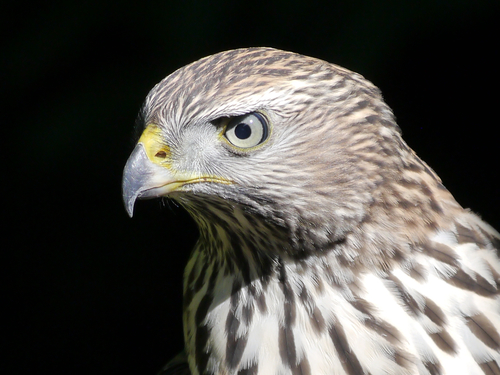 アメリカオオタカ
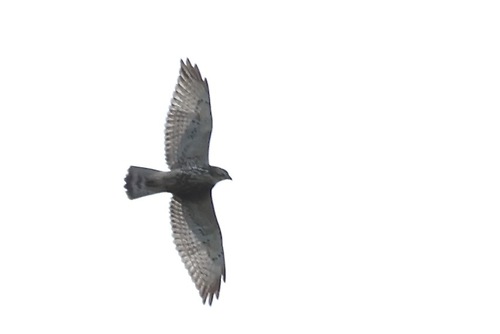 ハネビロノスリ
要点
Juvenile American Goshawks and Broad-winged Hawks can be confused in flight, but look first at the pattern of streaking on the underparts: juvenile goshawks show heavy, even vertical streaks, while juvenile broad-wings have lighter, more longitudinal barring. In all ages, structure is a major clue: goshawks are bulkier with broader bodies and longer tails, while broad-wings are compact with shorter tails and distinctly tapered wings. Adult plumage is more easily separated by the goshawk's fine gray barring and the broad-wing's bold horizontal belly bars and banded tail. In perched birds, note the goshawk's bulk and fierce expression versus the broad-wing's smaller, more delicate look. Flight style and wing shape also differ markedly.
識別のコツ
- Juvenile underpart streaking: Juvenile American Goshawks have heavy, even vertical streaks on the chest and belly; juvenile Broad-winged Hawks have lighter, less dense, more longitudinal barring. This is the most reliable mark for immatures.
- Adult underpart barring: Adult goshawks show fine gray barring below, never rusty; adult broad-wings have bold horizontal bars across the white underparts.
- Tail pattern: Broad-winged Hawks (all ages) have a short tail with two or three distinct white bands; goshawks have a longer tail with less sharply defined barring.
- Wing shape in flight: Broad-winged Hawks have short, broad, and distinctly tapered wings; American Goshawks have longer, broader wings and a longer tail, giving a more rectangular or paddle-shaped profile.
- Overall structure: Goshawks are bulkier, with a broad chest and relatively shorter tail for their size; broad-wings are compact and less robust.
- Flight style: Goshawks use deep, slow, deliberate wingbeats; broad-wings flap more quickly and soar with flat wings.
- Facial expression: Goshawks have a fierce, heavy-browed look; broad-wings appear gentler and smaller-headed.
- Perched jizz: Perched goshawks look large, broad-shouldered, and long-tailed; broad-wings are noticeably smaller and more compact.
- Plumage pitfalls: Both species' juveniles are brown above and streaked below, but the density and pattern of streaking differ. Do not rely on overall color alone.
- Dark morph confusion: Rare dark morph broad-wings are very dark overall but still have short tails and compact wings; goshawks never show this morph.
- Migration context: Large flocks of soaring raptors are almost always broad-wings, not goshawks.
- Range overlap: Both can occur in eastern North America, but goshawks are less common and more secretive, especially in migration.
- Size in the field: If you have a direct comparison, the goshawk will always look larger and bulkier than a broad-winged hawk.
- Tail length relative to wings: Goshawks' tails project well beyond the wingtips when perched; broad-wings' tails are short and barely project.
- Confusion with other raptors: If you suspect a Cooper's Hawk, check for the teardrop streaks (Cooper's) versus even streaks (goshawk), but broad-wings should separate by structure and tail pattern.
大きさ
Adult American Goshawks are substantially larger and bulkier than Broad-winged Hawks. Goshawks have a noticeably broader body and longer tail, while broad-wings are medium-sized Buteos with shorter tails and more compact proportions. The broad-winged hawk measures 32–44 cm in length with a wingspan of 74–100 cm, while goshawks are larger (exact numbers not given here, but no overlap in wing and tail length per morphometric studies). Weight can rarely overlap due to seasonal variation, but structure is consistently different.
羽色
Juvenile plumage is the main confusion point. Juvenile American Goshawks have heavy, even vertical streaks down the chest and belly, lacking the 'teardrop' shape seen in juvenile Cooper's Hawks and showing more solid streaking than juvenile Broad-winged Hawks. Juvenile broad-wings have more longitudinal (vertical) barring, but it is lighter and less dense than in goshawk, and their underparts are overall paler. Adults are easier: goshawks have fine gray barring below and never show rusty tones, while broad-wings have dark brown upperparts, white underparts with bold horizontal barring, and a tail with distinct white bands. The broad-wing's tail is shorter and shows a dark gray-black color with white lines at the middle, base, and tip. Dark morph broad-wings are rare and much darker overall, but still show the short tail and compact shape. In flight, broad-wings have short, broad, and tapered wings, while goshawks have longer, broader wings and a proportionally longer tail.
行動
Flight style is a strong separator: American Goshawks have deeper, more deliberate, and slower wingbeats compared to the quicker, more buoyant flight of Broad-winged Hawks. Goshawks often appear powerful and direct, sometimes gliding with wings slightly arched. Broad-wings soar on flat wings, often in large flocks during migration, and show a more compact, flappy flight when not soaring. Perched, goshawks look imposing and large, while broad-wings are smaller and less bulky.
生息環境
American Goshawks are birds of mature forests, often deep in woodlands and less likely to be seen in open areas. Broad-winged Hawks are also forest raptors but are more likely to be seen at forest edges or soaring above woodlands, especially during migration. During migration, broad-wings form large kettles, which is not a behavior seen in goshawks.