

アマゾンアリモズ 対 シロハラクリセジアリドリ
Thamnophilus amazonicus 対 Grallaria hypoleuca
アマゾンアリモズとシロハラクリセジアリドリのクイズ
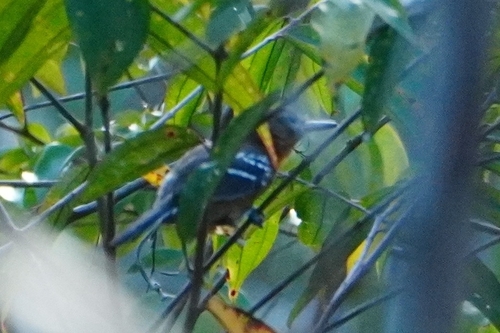 アマゾンアリモズ
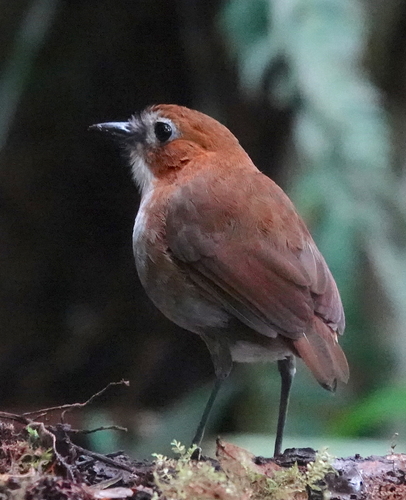 シロハラクリセジアリドリ
要点
The most reliable field mark separating Amazonian Antshrike from White-bellied Antpitta is overall shape and posture: antshrikes are slim, long-tailed, and often perch in tangles, while antpittas are plump, short-tailed, and almost always on or near the ground. Adult male Amazonian Antshrikes show strong sexual dimorphism with black and gray plumage, while all White-bellied Antpittas (both sexes) are warm brown above with a clean white belly and grayish breast. In flight or perched, the antshrike’s white-spotted black wings and longer tail contrast sharply with the antpitta’s plain rufous-brown wings and very short tail. If you see a bird hopping on the ground with a rotund, upright stance, it is the antpitta; if it is foraging in mid-level tangles with a hooked bill and spotted wings, it is the antshrike.
識別のコツ
- Overall shape and posture: Antshrike is slim, long-tailed, and perches horizontally in tangles; antpitta is plump, short-tailed, and stands upright on the ground. This is the fastest field separation at any distance.
- Tail length: Antshrike has a noticeably longer tail, often flicked or fanned; antpitta’s tail is extremely short, barely extending beyond the body.
- Bill shape: Antshrike’s bill is long, stout, and hooked at the tip (like a shrike); antpitta’s bill is shorter, more conical, and not hooked.
- Wing pattern: Antshrike shows bold white spots and edges on blackish wings (both sexes, but especially males); antpitta’s wings are plain reddish brown, never spotted or edged white.
- Sexual dimorphism: Only antshrike shows strong male/female differences (males black/gray, females rufous/olive); antpitta sexes are identical.
- Underparts: Antshrike males are gray below, females bright yellowish red-brown to buff; antpitta is always white-bellied with a grayish breast and rufous-brown sides.
- Head pattern: Antshrike males have black forehead/crown, females bright rufous crown; antpitta has a rufous or dusky brown crown with some black streaks, and white or gray lores.
- Back color: Antshrike males are black to gray, females deep olive; antpitta is always rufous or dusky brown above.
- Tail pattern: Antshrike’s tail is black with white tips/spots (both sexes, though less in some subspecies); antpitta’s tail is plain reddish brown, sometimes tawny underneath, never with white.
- Leg color: Antshrike’s leg color is not described; antpitta has blue-gray legs and feet (may help if seen well).
- Foraging height: Antshrike is usually in mid-story tangles (1–17 m up), rarely on ground; antpitta is almost always on the ground.
- Movement: Antshrike hops and lunges through vines, sometimes sallying upward; antpitta runs and hops on the ground, often pausing upright.
- Range: Antshrike is widespread in Amazonian lowlands; antpitta is restricted to Andean foothills/cloud forests of Colombia, Ecuador, Peru.
- Size impression: Antpitta is much bulkier and heavier for its length; antshrike is lighter and more agile.
- Subspecies variation: Antshrike subspecies vary in darkness and underpart color, but all share spotted wings/tail and sexual dimorphism; antpitta subspecies only differ in depth of brown on upperparts and flanks, never in pattern.
大きさ
White-bellied Antpitta is substantially larger and bulkier: 16–18 cm long and weighing 62–69 g ([wikipedia]), compared to Amazonian Antshrike’s 14–15 cm and 17–21 g ([wikipedia]). The antpitta is not only longer but much heavier and rounder, with a noticeably plump body and very short tail. The antshrike is slimmer, lighter, and has a proportionally longer tail and bill.
羽色
- Juvenile/immature wing pattern: No age-specific upperwing or flight pattern marks are described for either species; all contrasts are based on adult and basic plumage ([wikipedia]).
- Adult Amazonian Antshrike: Males are black and gray above with a black tail tipped and spotted white, and black wings with white spots/edges. Underparts are gray. Females are rufous-crowned, with bright yellowish red-brown underparts and deep olive back, wings and tail browner with pale olive edges. Subspecies vary in darkness and underpart color, but all have some combination of spotted wings/tail and sexual dimorphism.
- Adult White-bellied Antpitta: Both sexes are similar: rufescent or dusky brown above, white or gray lores on a rufous face, reddish brown wings and tail, white throat and belly, grayish breast with rufous brown sides, flanks olive or tawny, undertail coverts tawny. No wing spots or sexual dimorphism. Subspecies castanea is deeper brown above and on flanks.
- Key contrast: Antshrike always shows some white in wings/tail and sexual dimorphism; antpitta is plain brown above, white below, and monomorphic.
行動
Amazonian Antshrike forages singly or in pairs, usually 1–17 m above ground, hopping through vine tangles and gleaning insects from foliage. It often joins mixed-species flocks and sometimes follows army ants, but is rarely on the ground. White-bellied Antpitta is almost entirely terrestrial, running and hopping on the forest floor in dense vegetation, sometimes following ant swarms or even people to catch disturbed prey. Its movement is more like a small mammal: upright, bouncing, and rarely perching above ground. The antshrike is more active in mid-story and lower canopy, while the antpitta is strictly ground-level.
生息環境
Amazonian Antshrike is widespread in lowland Amazonian forests across most of South America (except Argentina, Chile, Paraguay, Uruguay), favoring dense thickets, vine tangles, and bamboo in humid forests ([wikipedia]). White-bellied Antpitta is restricted to montane forests of Colombia, Ecuador, and Peru, usually at higher elevations, in dense undergrowth. If you are in Amazonian lowlands, expect antshrike; in Andean foothills or cloud forest, expect antpitta.
アマゾンアリモズ · シロハラクリセジアリドリ · 苦手な鳥