

Motmot

シロハラチャムクドリ 対 ニショクハタオリ

Lamprotornis bicolor 対 Ploceus bicolor

シロハラチャムクドリとニショクハタオリのクイズ
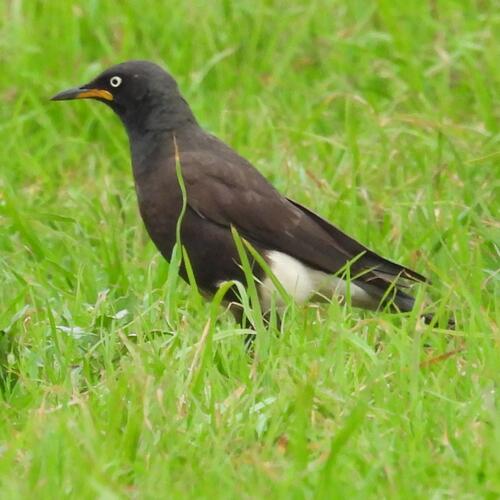
シロハラチャムクドリ (Lamprotornis bicolor) シロハラチャムクドリ
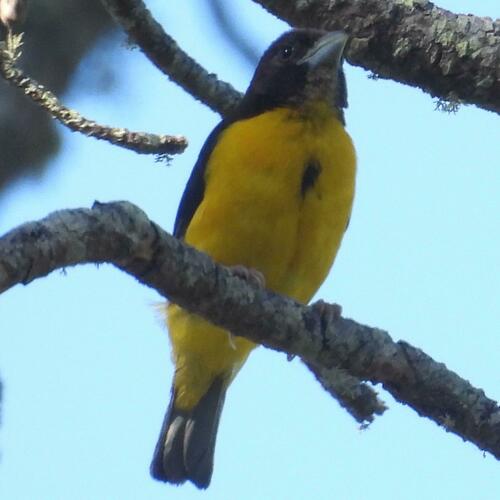
ニショクハタオリ (Ploceus bicolor) ニショクハタオリ

メディア

読み込み中…

要点

The most reliable field mark to separate African Pied Starling from Dark-backed Weaver is the starling's bold white lower belly and undertail, which stands out against its otherwise dark, slightly glossy plumage; the weaver lacks this sharp contrast and is never as boldly pied below. Juvenile starlings are duller but still show pale underparts, while the weaver is more uniformly colored. Structurally, the starling is larger, longer-tailed, and has a stouter bill; the weaver is smaller, more compact, and has a typical weaver's conical bill. Habitats rarely overlap: starlings favor open country and farmland, often near livestock, while weavers are birds of forest and dense woodland. Voice and flocking behavior also differ, but the underpart contrast and size are the quickest field checks.

識別のコツ

  1. White lower belly and undertail (all ages): Only African Pied Starling shows a sharply demarcated white lower belly and undertail, contrasting with the rest of the dark plumage. Dark-backed Weaver never shows this bold pied pattern.
  2. Bill shape: Starlings have a straight, medium-length bill with a yellow lower mandible (adult), while weavers have a short, thick, conical bill typical of seed-eaters. Bill color is also a clue: adult starlings have a yellow lower mandible, juveniles dull yellow; weavers' bills are never yellow.
  3. Iris color: Adult starlings have a white iris, juveniles brown; weavers do not show a white iris.
  4. Size and structure: Starlings are much larger and longer-tailed, with a heavier build. Weavers are smaller, more compact, and short-tailed.
  5. Gloss of plumage: Adult starlings may show a slight gloss on black areas; juveniles are duller. Weavers lack any gloss.
  6. Habitat context: Starlings are found in open country, farmland, and near livestock; weavers are restricted to forest and dense woodland. If you see the bird in open grassland or with cattle, it is almost certainly a starling.
  7. Flocking behavior: Large flocks (sometimes 1000+) and association with livestock point to starlings. Weavers are rarely seen in such large groups and do not associate with livestock.
  8. Perching behavior: Starlings often perch on wires, fences, or even on livestock; weavers are more likely to be seen in trees or shrubs, especially near their woven nests.
  9. Flight style: Starlings have strong, direct flight; weavers' flight is more bounding and undulating, but this is subtle and less reliable than plumage or structure.
  10. Voice: The starling's harsh, repeated 'skeer kerrra kerrra' is distinctive; weavers' calls are higher-pitched and less harsh.
  11. Juvenile confusion: Juvenile starlings are duller and lack gloss, but still show pale underparts; juvenile weavers remain uniformly colored and never show a bold white belly.
  12. No overlap in range: While both species can occur in southern Africa, their preferred habitats rarely overlap. Use location as a supporting clue, but not as a sole identifier.
  13. Association with other species: Starlings may be seen with European Starlings or Wattled Starlings; weavers are more likely to be seen with other weavers or small songbirds.
  14. Nest location: Starlings nest in riverbanks, holes, or even man-made structures; weavers build hanging woven nests in trees. Nest type can be a useful clue if seen.
  15. Feeding behavior: Starlings forage on the ground, often near livestock, and may eat insects disturbed by animals. Weavers feed more on seeds and are less likely to be seen on the ground in open areas.

大きさ

African Pied Starling is a noticeably larger bird, reaching about 27–28 cm in length, with a heavier, longer-tailed appearance. The Dark-backed Weaver is smaller and more compact, typical of weavers, and does not approach the starling's bulk or length. In the field, this size difference is usually obvious, especially when birds are seen side by side or near familiar objects (like livestock for the starling).

羽色

Adult African Pied Starlings have mostly dull black plumage with a slight gloss, but are instantly recognized by their striking white lower belly and undertail, which contrast sharply with the rest of the bird. The iris is white and the lower mandible yellow. Juveniles are duller, with unglossed plumage and a brown iris, but still show pale underparts. In contrast, Dark-backed Weavers lack any bold white on the underparts; they are more uniformly colored, with a dark back and paler, but not white, underparts. The weaver's plumage is never as sharply pied as the starling's, and their bill is always conical (not starling-like). No distinctive upperwing or flight pattern is described for either species, but the starling's white underparts can be visible even in flight, especially from below.

行動

African Pied Starlings are highly gregarious outside the breeding season, forming large flocks and often associating with livestock, sometimes perching on animals to feed on ectoparasites. They are frequently seen in open country, foraging on the ground or flying between perches. Dark-backed Weavers are much less conspicuous, usually seen singly or in small groups, and tend to stay within forest or dense woodland, often weaving nests. Starlings may be seen feeding with other starlings, but rarely with weavers.

生息環境

African Pied Starling is found in open habitats—grassland, karoo scrub, thornbush, agricultural land—and is often seen near farm animals. It is common in much of South Africa, Lesotho, and Eswatini, but avoids arid northwest and eastern lowlands. Dark-backed Weaver, in contrast, is a bird of forests and dense woodland, sparsely distributed across central and southern Sub-Saharan Africa. The two species rarely overlap in habitat: if you are in open farmland, expect starlings; in dense forest, expect weavers.

声

African Pied Starling has a distinctive 'skeer kerrra kerrra' call and a soft warbling song, which is quite different from the typical weaver chatter. While the weaver's song is not described here, weavers generally have higher-pitched, more rapid calls. If you hear the starling's harsh, repeated calls, it is a strong clue.

より良い説明を送る

比較と同じ項目を使ってください。文章はすぐに公開されます。

The most reliable field mark to separate African Pied Starling from Dark-backed Weaver is the starling's bold white lower belly and undertail, which stands out against its otherwise dark, slightly glossy plumage; the weaver lacks this sharp contrast and is never as boldly pied below. Juvenile starlings are duller but still show pale underparts, while the weaver is more uniformly colored. Structurally, the starling is larger, longer-tailed, and has a stouter bill; the weaver is smaller, more compact, and has a typical weaver's conical bill. Habitats rarely overlap: starlings favor open country and farmland, often near livestock, while weavers are birds of forest and dense woodland. Voice and flocking behavior also differ, but the underpart contrast and size are the quickest field checks.

  1. White lower belly and undertail (all ages): Only African Pied Starling shows a sharply demarcated white lower belly and undertail, contrasting with the rest of the dark plumage. Dark-backed Weaver never shows this bold pied pattern.
  2. Bill shape: Starlings have a straight, medium-length bill with a yellow lower mandible (adult), while weavers have a short, thick, conical bill typical of seed-eaters. Bill color is also a clue: adult starlings have a yellow lower mandible, juveniles dull yellow; weavers' bills are never yellow.
  3. Iris color: Adult starlings have a white iris, juveniles brown; weavers do not show a white iris.
  4. Size and structure: Starlings are much larger and longer-tailed, with a heavier build. Weavers are smaller, more compact, and short-tailed.
  5. Gloss of plumage: Adult starlings may show a slight gloss on black areas; juveniles are duller. Weavers lack any gloss.
  6. Habitat context: Starlings are found in open country, farmland, and near livestock; weavers are restricted to forest and dense woodland. If you see the bird in open grassland or with cattle, it is almost certainly a starling.
  7. Flocking behavior: Large flocks (sometimes 1000+) and association with livestock point to starlings. Weavers are rarely seen in such large groups and do not associate with livestock.
  8. Perching behavior: Starlings often perch on wires, fences, or even on livestock; weavers are more likely to be seen in trees or shrubs, especially near their woven nests.
  9. Flight style: Starlings have strong, direct flight; weavers' flight is more bounding and undulating, but this is subtle and less reliable than plumage or structure.
  10. Voice: The starling's harsh, repeated 'skeer kerrra kerrra' is distinctive; weavers' calls are higher-pitched and less harsh.
  11. Juvenile confusion: Juvenile starlings are duller and lack gloss, but still show pale underparts; juvenile weavers remain uniformly colored and never show a bold white belly.
  12. No overlap in range: While both species can occur in southern Africa, their preferred habitats rarely overlap. Use location as a supporting clue, but not as a sole identifier.
  13. Association with other species: Starlings may be seen with European Starlings or Wattled Starlings; weavers are more likely to be seen with other weavers or small songbirds.
  14. Nest location: Starlings nest in riverbanks, holes, or even man-made structures; weavers build hanging woven nests in trees. Nest type can be a useful clue if seen.
  15. Feeding behavior: Starlings forage on the ground, often near livestock, and may eat insects disturbed by animals. Weavers feed more on seeds and are less likely to be seen on the ground in open areas.

African Pied Starling is a noticeably larger bird, reaching about 27–28 cm in length, with a heavier, longer-tailed appearance. The Dark-backed Weaver is smaller and more compact, typical of weavers, and does not approach the starling's bulk or length. In the field, this size difference is usually obvious, especially when birds are seen side by side or near familiar objects (like livestock for the starling).

Adult African Pied Starlings have mostly dull black plumage with a slight gloss, but are instantly recognized by their striking white lower belly and undertail, which contrast sharply with the rest of the bird. The iris is white and the lower mandible yellow. Juveniles are duller, with unglossed plumage and a brown iris, but still show pale underparts. In contrast, Dark-backed Weavers lack any bold white on the underparts; they are more uniformly colored, with a dark back and paler, but not white, underparts. The weaver's plumage is never as sharply pied as the starling's, and their bill is always conical (not starling-like). No distinctive upperwing or flight pattern is described for either species, but the starling's white underparts can be visible even in flight, especially from below.

African Pied Starlings are highly gregarious outside the breeding season, forming large flocks and often associating with livestock, sometimes perching on animals to feed on ectoparasites. They are frequently seen in open country, foraging on the ground or flying between perches. Dark-backed Weavers are much less conspicuous, usually seen singly or in small groups, and tend to stay within forest or dense woodland, often weaving nests. Starlings may be seen feeding with other starlings, but rarely with weavers.

African Pied Starling is found in open habitats—grassland, karoo scrub, thornbush, agricultural land—and is often seen near farm animals. It is common in much of South Africa, Lesotho, and Eswatini, but avoids arid northwest and eastern lowlands. Dark-backed Weaver, in contrast, is a bird of forests and dense woodland, sparsely distributed across central and southern Sub-Saharan Africa. The two species rarely overlap in habitat: if you are in open farmland, expect starlings; in dense forest, expect weavers.

African Pied Starling has a distinctive 'skeer kerrra kerrra' call and a soft warbling song, which is quite different from the typical weaver chatter. While the weaver's song is not described here, weavers generally have higher-pitched, more rapid calls. If you hear the starling's harsh, repeated calls, it is a strong clue.

変更を破棄しますか?

保存していない編集があります。今離れると失われます。

シロハラチャムクドリ · ニショクハタオリ · 苦手な鳥