

カゲロウチョウ 対 ハシジロコウギョクチョウ
Lagonosticta rubricata 対 Lagonosticta rhodopareia
カゲロウチョウとハシジロコウギョクチョウのクイズ
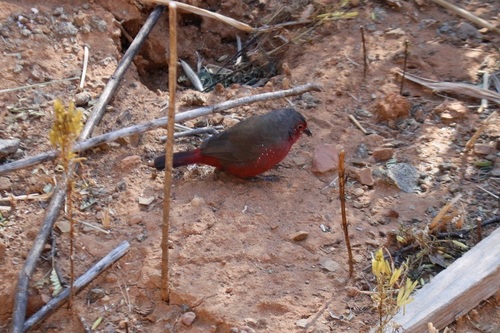 カゲロウチョウ
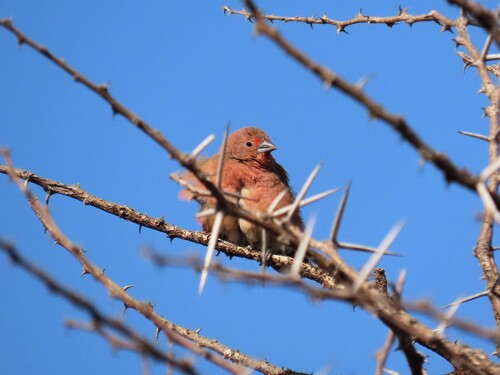 ハシジロコウギョクチョウ
要点
The most reliable field mark between African Firefinch and Jameson's Firefinch is the combination of head and underpart coloration, especially in adult males: African Firefinch shows a lead-grey crown and nape with deep scarlet underparts marked by white spots on the upper breast and flanks, while Jameson's Firefinch lacks the grey head and typically has a more uniformly red or pinkish underpart without the same spotting pattern. Juvenile African Firefinches lack red below, which can cause confusion with young Jameson's, but the greyish belly and darker vent of African Firefinch remain helpful. Both species are small, ground-foraging estrildids with similar structure, but subtle differences in plumage and context are key. Voice and habitat can help, but plumage—especially head and underpart pattern—is the best separator.
識別のコツ
- Head Color (Adult Males): African Firefinch has a lead-grey crown, nape, and neck, while Jameson's Firefinch lacks grey on the head, showing a more uniformly reddish or pinkish head. This is the quickest field check in good light.
- Underpart Pattern (Adult Males): African Firefinch shows deep scarlet underparts with small white spots on the upper breast and flanks; Jameson's Firefinch is more uniformly red or pinkish below and lacks the white spotting.
- Belly and Vent (All Ages): African Firefinch has a greyish center to the belly, becoming blackish on the vent and undertail coverts, which can be visible when the bird is fluffed or preening. Jameson's Firefinch is more evenly colored below.
- Juvenile Plumage: Juvenile African Firefinch lacks red on the underparts and shows a greyish belly and dark vent; juvenile Jameson's is also less red but lacks the grey head and has more uniform underparts. Look for the greyish belly and vent contrast in African Firefinch juveniles.
- Bill Color: African Firefinch has a blackish-grey bill with a pink base to the lower mandible. Bill color in Jameson's is not detailed here, but any obvious pinkish base may hint at African Firefinch.
- Tail and Rump: African Firefinch has a deep carmine red rump and uppertail coverts with black on the tail. While Jameson's may also show red, the combination with head and underpart pattern is more important.
- Sex Differences: Female African Firefinch is duller than the male but still shows the grey head and some red below, though less intense. Female Jameson's is also less bright but lacks the grey head.
- Flight and Upperwing Pattern: No distinctive upperwing or flight pattern differences are described, so do not rely on this in the field.
- Behavior: Both species forage on the ground and stay close to cover; behavior is not a reliable separator.
- Habitat: African Firefinch is more likely in dense, humid, grassy or bracken-rich areas, but habitat overlap is possible. Use habitat only as supporting context.
- Voice: If you hear a harsh ticking alarm call or a loud 'tui-tui-tui-tui,' suspect African Firefinch. Absence of distinctive calls is not diagnostic.
- Size and Structure: Both are small, compact finches with short, pointed bills; size is not a useful field mark.
- Mixing with Other Firefinches: Both may join mixed flocks, so check carefully for the head and underpart pattern when multiple firefinches are present.
- Season and Age: Be especially cautious with juveniles and non-breeding birds, as both can appear duller and less red. Focus on head color and belly/vent pattern in these cases.
- Pitfalls: Immature African Firefinch can be mistaken for Jameson's due to lack of red below, but the greyish belly and dark vent are clues. Always check for the lead-grey head in African Firefinch, even in dull birds.
大きさ
Both species are very similar in size and structure, making size an unreliable separator in the field. African Firefinch measures 10–11 cm in length and weighs 8.6–11.7 g [wikipedia], while Jameson's Firefinch averages about 9.3 g [wikidata]. Both are small, compact finches with short, pointed bills. Any slight difference in mass is not likely to be noticeable in the field.
羽色
Adult male African Firefinch is distinctive with a lead-grey crown, nape, and neck, olive-brown upperparts, and deep scarlet underparts marked by small white spots on the upper breast and flanks. The rump and uppertail coverts are deep carmine red, and the tail is partly black. The bill is blackish-grey with a pink base to the lower mandible. Females are similar but duller, and juveniles lack red below, showing more brownish or greyish underparts. In contrast, Jameson's Firefinch lacks the grey head and typically shows a more uniform red or pinkish coloration on the underparts, without the white spotting on the breast and flanks. Juvenile Jameson's are also less red below, but the absence of grey on the head and the more uniform underparts help distinguish them from juvenile African Firefinch, which has a greyish belly and blackish vent. Upperwing and flight pattern differences are not described in detail for either species, so focus on perched views and underpart/head pattern for all ages.
行動
Both species are ground-foraging finches, often seen in pairs or small family groups. African Firefinch tends to stay close to dense cover and retreats quickly when alarmed. Both species may mix with other firefinches. There is no strong behavioral distinction between the two in the field, though African Firefinch may be slightly more secretive and less likely to be seen in open areas compared to some other firefinches.
生息環境
African Firefinch prefers humid, thickly vegetated habitats such as forest edges, bracken, rank grass, and dense undergrowth, often near watercourses or in rural gardens but usually close to cover. Jameson's Firefinch is also found in sub-Saharan Africa but is more sparsely distributed and may occur in similar habitats, though specific microhabitat preferences are not detailed here. Both can overlap in range and habitat, so context helps but is not definitive.
声
African Firefinch gives a varied song of ringing notes, squeaky whistles, trills, and warbles, with a harsh ticking alarm call reminiscent of a Eurasian wren. Common calls include a rising trilling twitter and a loud, clear 'tui-tui-tui-tui' often followed by 'wink-wink-wink.' Jameson's Firefinch vocalizations are not described here, so voice is only useful if African Firefinch's distinctive calls are recognized.
カゲロウチョウ · ハシジロコウギョクチョウ · 苦手な鳥