

Rufous-chested Swallow vs Mosque Swallow
Cecropis semirufa contro Cecropis senegalensis
Fai un quiz con Rufous-chested Swallow e Mosque Swallow
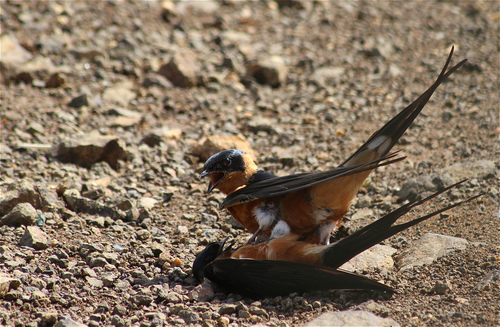 Rufous-chested Swallow
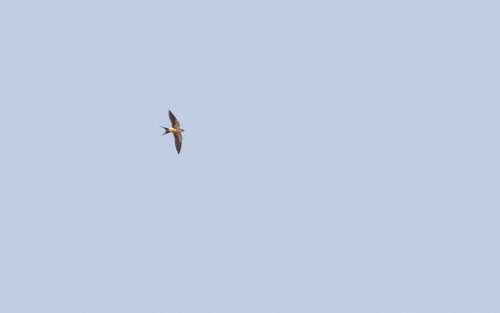 Mosque Swallow
In breve
The most reliable field mark between Rufous-chested Swallow and Mosque Swallow is the underwing: Mosque Swallow shows very pale underwing coverts contrasting sharply with dark flight feathers, while Rufous-chested Swallow has no white on the underwing at any age. Rufous-chested is also slightly smaller with longer tail streamers and a darker crown that extends below the eye, lacking the whitish collar of Mosque Swallow. Juvenile Rufous-chested Swallows have blue on the side of the head, not the dull red of similar species, but Mosque Swallow juveniles are browner overall. In flight or perched, look for the combination of size, tail length, and underwing pattern to separate them, especially in immature birds.
Consigli di identificazione
- Underwing pattern in flight (all ages): Mosque Swallow shows very pale underwing coverts contrasting with dark flight feathers—look for this strong contrast when the bird banks or glides overhead. Rufous-chested Swallow has uniformly dark underwings with no pale area; this is a key separator even at distance.
- Tail streamer length: Rufous-chested Swallow has longer, more slender tail streamers, especially in adults. Mosque Swallow's tail is shorter and less deeply forked, particularly in females.
- Crown and face pattern: Rufous-chested Swallow's dark blue crown extends below the eye, giving a hooded look. Mosque Swallow has a glossy blue crown but with whitish lores and sides of the head, forming a pale collar—check for this pale face in perched birds.
- Size and bulk: Mosque Swallow is noticeably larger and heavier-bodied than Rufous-chested Swallow. If seen together or with other swallows for scale, Mosque Swallow stands out as the largest.
- Rump and underparts: Both have rufous rumps and underparts, but Mosque Swallow's throat and upper breast are paler rufous, grading to darker rufous on the belly. Rufous-chested Swallow is more uniformly rufous below.
- Juvenile head color: Juvenile Rufous-chested Swallow has blue on the sides of the head, while Mosque Swallow juveniles are browner and lack this blue—check for this in autumn and winter when juveniles predominate.
- Perched jizz: Rufous-chested Swallow appears more slender and elongated due to its longer tail. Mosque Swallow is bulkier and sits more upright.
- Habitat context: In dense woodland, especially with baobabs or mopane, Mosque Swallow is more likely. In open country, near bridges or buildings, Rufous-chested Swallow is favored. However, overlap can occur, so use habitat only as supporting evidence.
- Social behavior: Mosque Swallow may be seen in small groups, especially at termite emergences or bushfires. Rufous-chested Swallow is usually solitary or in pairs, rarely in groups.
- Nesting sites: If you observe birds entering tree cavities (especially baobabs), Mosque Swallow is more likely. Rufous-chested Swallow prefers man-made structures or natural cavities in open country.
- Sex differences: Female Mosque Swallow has shorter tail streamers than the male, but both sexes have the pale underwing. Rufous-chested Swallow shows less sexual dimorphism in tail length.
- Flight style: Mosque Swallow's flight is slow, falcon-like, and involves much gliding; Rufous-chested Swallow is buoyant but less likely to glide extensively.
- Pitfall—confusion with red-rumped swallows: Juvenile Rufous-chested Swallow may resemble red-rumped swallows but is separated by blue on the side of the head (not dull red). Mosque Swallow is much larger and bulkier than any red-rumped swallow.
- Seasonal movement: Rufous-chested Swallow is migratory in much of its range, so check local seasonality—if present outside the breeding season, Mosque Swallow is more likely.
- When in doubt: Focus on the underwing pattern and tail streamer length in flight, and the face pattern when perched. These are the most reliable field marks across all ages and seasons.
Taglia
Mosque Swallow is the largest and heaviest African swallow, measuring 21–23 cm in length. Rufous-chested Swallow is slightly smaller and lighter, with proportionally longer tail streamers relative to its body. In direct comparison, Mosque Swallow appears bulkier and more robust, while Rufous-chested is more slender and elongated due to its tail.
Piumaggio
- Juveniles: Rufous-chested Swallow juveniles have blue on the sides of the head, while Mosque Swallow juveniles are overall browner and lack this blue.
- Underwing (all ages): Mosque Swallow shows very pale underwing coverts that contrast with dark flight feathers, a feature visible in flight and diagnostic at all ages. Rufous-chested Swallow lacks any white or pale on the underwing—its underwing is uniformly dark.
- Crown and face: Rufous-chested Swallow has a dark blue crown that extends below the eye, giving a hooded look. Mosque Swallow has a glossy blue crown but with whitish lores and sides of the head, forming a distinct pale collar.
- Rump and underparts: Both have rufous rumps and underparts, but Mosque Swallow's throat and upper breast are paler rufous, shading to darker rufous below. Rufous-chested Swallow is more uniformly rufous below.
- Tail: Rufous-chested Swallow has longer tail streamers, especially noticeable in adults. Mosque Swallow females have shorter streamers, and the tail appears less elongated overall.
Comportamento
Both species feed on flying insects, often foraging high above the ground. Mosque Swallow has a slow, falcon-like flight with much gliding and often forages high above woodland canopy, sometimes in loose flocks. Rufous-chested Swallow's flight is described as slow and buoyant, and it is generally solitary or in pairs, rarely in groups. Both perch on wires and twigs, but Rufous-chested is less likely to be seen in larger gatherings.
Habitat
Rufous-chested Swallow prefers dry open country and is often found near human structures like bridges, deserted buildings, or tree holes for nesting. It is migratory in much of its range, especially in southern Africa, but can be resident in some equatorial regions. Mosque Swallow is a woodland species, especially in southern Africa, favoring dense broad-leaved woodland with mopane or miombo, and often nests in tree cavities (notably baobabs), but also uses buildings and culverts. In West Africa, Mosque Swallow can be found in more open habitats, including forest clearings and savanna. Habitat overlap is possible, but Mosque Swallow is more tied to woodland, while Rufous-chested is more open-country and anthropogenic.
Rufous-chested Swallow · Mosque Swallow · I miei uccelli difficili