

Oriental Reed Warbler vs Marsh Grassbird
Acrocephalus orientalis contro Helopsaltes pryeri
Fai un quiz con Oriental Reed Warbler e Marsh Grassbird
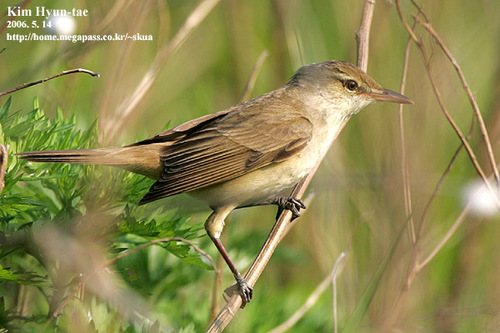 Oriental Reed Warbler
 Marsh Grassbird
In breve
The most reliable field mark between Oriental Reed Warbler and Marsh Grassbird is the Oriental Reed Warbler’s distinctive pale tips to the tail feathers, visible in all plumages and especially useful when the bird is in flight or flicking its tail. Oriental Reed Warbler is also noticeably larger, with a heavier, longer bill and a more robust jizz, while Marsh Grassbird is smaller, slimmer, and lacks the pale tail tips. Structural differences in bill and tail shape, as well as subtle plumage distinctions around the face and underparts, help separate them when perched. Voice and habitat can support identification but are less diagnostic than the tail and size.
Consigli di identificazione
- Pale tail tips (all ages): Oriental Reed Warbler always shows distinct whitish tips to the tail feathers, visible when perched or in flight. Marsh Grassbird never shows this feature; if you see pale tail tips, rule out Marsh Grassbird.
- Size and structure: Oriental Reed Warbler is noticeably larger and bulkier, with a longer, heavier bill and more robust body. Marsh Grassbird is smaller, slimmer, and more delicate, with a finer bill.
- Bill color and shape: Oriental Reed Warbler’s bill is brownish above, pink below, with a bright orange gape—especially obvious in fresh birds or when singing. Marsh Grassbird’s bill is shorter, finer, and lacks the orange gape.
- Tail shape: Oriental Reed Warbler has a shorter, more square-ended tail compared to the longer, more graduated tail of some other reed warblers, but Marsh Grassbird’s tail is not described as square-ended or with pale tips.
- Face pattern: Oriental Reed Warbler shows a strong dark eyestripe and a whitish supercilium (eyebrow). Marsh Grassbird’s face is plainer, with a less distinct supercilium and less facial contrast.
- Throat and breast streaking: Oriental Reed Warbler has narrow greyish streaks on the throat and breast, which can be seen at close range. Marsh Grassbird lacks mention of such streaking, suggesting a plainer underpart.
- Underparts: Oriental Reed Warbler is whitish below with browner flanks and undertail-coverts. Marsh Grassbird’s underparts are generally plainer and less contrasting.
- Feet color: Oriental Reed Warbler has grey feet, which may help if seen well; Marsh Grassbird’s feet color is not specified but is unlikely to be as distinctive.
- Perching behavior: Oriental Reed Warbler often sings or calls from exposed perches atop reeds or bushes. Marsh Grassbird is more secretive, rarely perching openly.
- Flight jizz: Oriental Reed Warbler appears larger and more powerful in flight, while Marsh Grassbird is lighter and more fluttery.
- Habitat context: If the bird is in a tall, open reedbed and singing from a prominent perch, Oriental Reed Warbler is more likely. If it is creeping through dense, grassy or sedgy marsh, Marsh Grassbird is more probable.
- Vocalizations: If you hear a loud, harsh 'chack' or a mixture of warbling and croaking notes from an exposed perch, suspect Oriental Reed Warbler. Marsh Grassbird’s song is not described here, so use caution.
- Season and location: Both species can overlap in East Asia, but Oriental Reed Warbler is more likely in extensive reedbeds, especially during migration and breeding.
- Juvenile confusion: Even in juvenile or first-winter plumages, the pale tail tips of Oriental Reed Warbler remain a key separator from Marsh Grassbird.
- When in doubt: If the bird lacks pale tail tips, is small and slim, with a plain face and underparts, and is behaving secretively in grassy marsh, lean toward Marsh Grassbird.
Taglia
Oriental Reed Warbler is a large warbler, measuring 18–20 cm in length with a wingspan of 23–26 cm [wikipedia]. Marsh Grassbird is smaller and slimmer overall, with no direct measurements provided here, but it is notably less bulky and more delicate in structure. The Oriental Reed Warbler’s longer, heavier bill and more robust body are apparent when both species are seen side by side or with experience. Marsh Grassbird’s proportions are more typical of Locustellidae: slender, with a finer bill and less imposing presence.
Piumaggio
- Juvenile/immature/first-winter (and adult) in flight: Oriental Reed Warbler shows obvious whitish tips to the tail feathers, a feature not present in Marsh Grassbird at any age. This pale tail tip is visible both when the bird is perched and especially in flight, and is a key separator in all plumages.
- Adults (perched): Oriental Reed Warbler is brown above with a paler rump, whitish underparts, and browner flanks and undertail-coverts. It has a dark eyestripe and a whitish supercilium (stripe above the eye), with narrow greyish streaks on the throat and breast. Marsh Grassbird lacks the pale tail tip and typically has less contrast in the face pattern, with a less distinct supercilium and no mention of streaking on the throat/breast in the available notes. The underparts of Marsh Grassbird are generally plainer and less contrasting than Oriental Reed Warbler.
- Bill and feet: Oriental Reed Warbler’s bill is longer, heavier, brownish above and pink below with a bright orange gape; feet are grey. Marsh Grassbird’s bill is shorter and finer, with no mention of a colorful gape.
Comportamento
Oriental Reed Warbler often sings from a prominent perch such as the top of a reed stem or bush, making it conspicuous. Its jizz is more upright and robust, matching its larger size and heavier bill. Marsh Grassbird, typical of Locustellidae, is more skulking and less likely to perch openly, often moving through dense swamp vegetation and showing a more secretive, creeping behavior. In flight, Oriental Reed Warbler appears larger and more powerful, while Marsh Grassbird is lighter and more fluttery.
Habitat
Both species occur in wetland habitats, but Oriental Reed Warbler is more strictly associated with reedbeds, especially tall reeds and bushy edges. Marsh Grassbird prefers swamps and marshes with dense, grassy vegetation, often in areas where reeds are less dominant. While their ranges overlap in East Asia, the microhabitat can be a clue: Oriental Reed Warbler favors open reedbeds and visible perches, Marsh Grassbird is more often hidden in grassy, sedgy, or marshy areas.
Voce
Oriental Reed Warbler’s song is a mixture of warbling phrases and guttural, croaking notes, often delivered from a prominent perch. It also gives a loud, harsh 'chack' call. Marsh Grassbird’s vocalizations are not described in the provided notes, so voice is less reliable for separation unless Oriental Reed Warbler’s distinctive song or call is heard.
Oriental Reed Warbler · Marsh Grassbird · I miei uccelli difficili