

Fulmaro vs Flesh-footed Shearwater
Fulmarus glacialis contro Ardenna carneipes
Fai un quiz con Fulmaro e Flesh-footed Shearwater
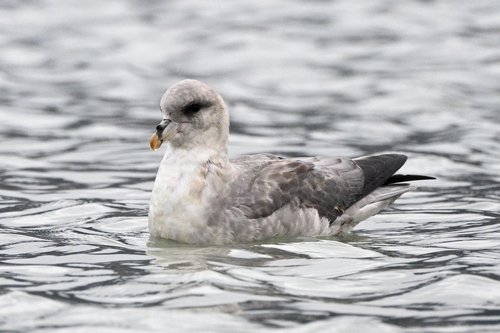 Fulmaro
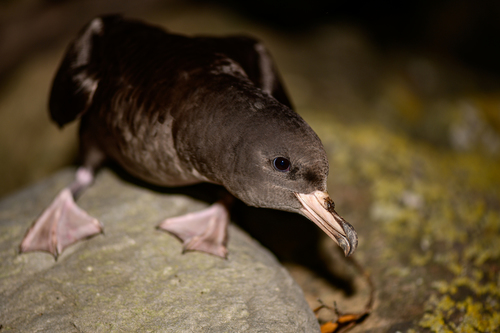 Flesh-footed Shearwater
In breve
The most reliable field mark to separate Northern Fulmar from Flesh-footed Shearwater is overall coloration and bill structure: Fulmars (especially pale morphs) show a white head and body with grey wings and a thick, pale yellow bill, while Flesh-footed Shearwaters are uniformly dark with a pale bill tipped black and noticeably pinkish feet. Fulmars have a bull-necked, compact look and a stiff, shallow wingbeat, whereas Flesh-footed Shearwaters appear sleeker with longer wings and a more buoyant, gliding flight. In flight, the fulmar’s pale inner primaries and contrasting wing pattern (on pale morphs) are distinctive, while the shearwater is dark overall. Bill color and shape are especially useful at close range. Both species can be seen at sea, but their ranges overlap only rarely.
Consigli di identificazione
- Overall coloration: Pale morph Northern Fulmars show a striking white head and body with grey wings and tail—never matched by the uniformly dark Flesh-footed Shearwater. If you see obvious white, it's not a Flesh-footed.
- Bill color and structure: Fulmars have a thick, pale yellow bill with a pronounced tube on top (naricorns), giving a stubby look. Flesh-footed Shearwaters have a slimmer, pale bill with a distinct black tip—look for this two-tone effect at close range.
- Feet color: Flesh-footed Shearwater has pale pinkish feet, sometimes visible trailing behind in flight or when perched; Fulmar's legs are bluish but rarely as obvious.
- Flight style: Fulmars fly with stiff, shallow wingbeats and a bull-necked, compact appearance. Shearwaters have longer, narrower wings and a more buoyant, arcing flight, often banking and gliding.
- Head and neck: Fulmars look thick-necked and heavy-headed, while Flesh-footed Shearwaters have a sleeker, more streamlined head and neck profile.
- Wing pattern: On Fulmars, especially pale morphs, look for pale inner primaries above and a contrast between paler upperparts and grey wings. Flesh-footed Shearwaters are dark above and below, lacking any pale panels or contrasts.
- Underwing: Only the dark morph Fulmar has extensive dark underwings, but even then, the overall structure and bill shape differ from the shearwater.
- Tail: Fulmars have a short, squared tail, while shearwaters have a longer, more tapered tail—though this can be subtle at distance.
- Jizz on water: Fulmars appear chunky and sit high; shearwaters look sleeker and sit lower.
- Range and context: If seen in cold northern waters, Fulmar is far more likely; in the Indo-Pacific, especially near Australia/New Zealand, expect Flesh-footed Shearwater.
- Intermediate morphs: Fulmars can be intermediate in tone, but even the darkest Fulmars are not as uniformly blackish as Flesh-footed Shearwater. Check for any pale in the head or body.
- Bill tip: The black-tipped bill of Flesh-footed Shearwater is unique—no Fulmar shows this pattern.
- Leg color: Pinkish legs are diagnostic for Flesh-footed Shearwater if seen well; Fulmar's bluish legs are less conspicuous.
- Confusion risk: Gulls are sometimes confused with Fulmars, but the bill and flight style are very different; Flesh-footed Shearwater is rarely mistaken for a gull due to its dark color and shearwater jizz.
- No strong age/sex differences: Neither species shows strong age- or sex-related plumage differences relevant for field separation.
Taglia
Both species are similar in overall size, but the Northern Fulmar is slightly heavier on average (body mass 450–1000g [wikipedia], compared to the Flesh-footed Shearwater's average of 609g [wikidata]). Fulmar wingspan is 102–112 cm, length about 46 cm. The shearwater is described as medium-large, but no direct length or wingspan is provided. In the field, size is not a strong separator due to overlap and variation.
Piumaggio
- Juvenile/immature wing pattern: No specific juvenile/first-winter upperwing marks are described for either species, so age-specific flight marks are not diagnostic here.
- Northern Fulmar: Pale morphs have a white head and body with grey wings and tail; all morphs show pale inner primaries above, and only the dark morph has extensive dark underwings. The bill is thick, pale yellow, and the legs are bluish. Fulmars can appear intermediate between light and dark morphs, especially in the Pacific. The Pacific morph also has a darker tail than the Atlantic morph.
- Flesh-footed Shearwater: Uniformly dark (blackish) overall, with no pale areas on the head or underparts. The bill is pale with a distinct black tip, and the feet are pale pinkish—often visible in flight or when perched. No mention of contrasting wing panels or underwing pattern.
- Key contrast: Fulmars (especially pale morphs) are much paler overall, with obvious contrast between white head/body and grey wings, while Flesh-footed Shearwaters are dark throughout. Bill color and thickness are also different.
Comportamento
Northern Fulmars have a stiff, shallow wingbeat and look bull-necked and compact in flight, often gliding low over the water with little flexing at the wrist. Their flight is strong and direct, quite unlike the more buoyant, arcing, and gliding flight of shearwaters. Flesh-footed Shearwaters are more graceful, with longer, narrower wings and a more relaxed, dynamic flight style, often banking and shearing over waves. On water, fulmars appear chunky and sit high, while shearwaters look sleeker and lower in the water.
Habitat
Northern Fulmar is primarily found in subarctic North Atlantic and North Pacific waters, rarely straying into the Southern Hemisphere. Flesh-footed Shearwater mainly inhabits the Indo-Pacific, breeding on islands in Australia and New Zealand and ranging widely at sea. Overlap is rare except in pelagic waters off the Pacific. Fulmars are more likely in cold, northern waters, while Flesh-footed Shearwaters are expected in warmer, southern oceans.
Fulmaro · Flesh-footed Shearwater · I miei uccelli difficili