

Monteiro's Hornbill vs Southern Red-billed Hornbill
Tockus monteiri contro Tockus rufirostris
Fai un quiz con Monteiro's Hornbill e Southern Red-billed Hornbill
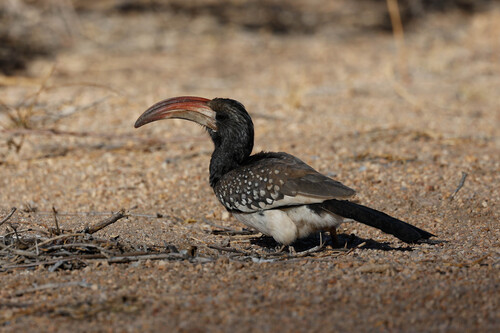 Monteiro's Hornbill
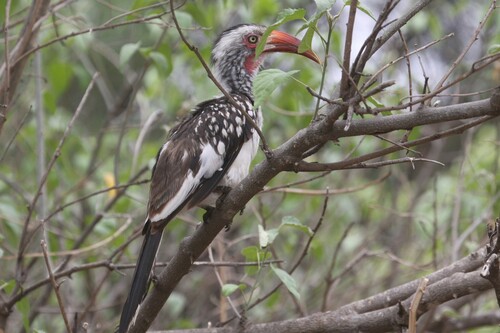 Southern Red-billed Hornbill
In breve
The most reliable field mark to separate Monteiro's Hornbill from Southern Red-billed Hornbill is the combination of facial skin color and iris: Monteiro's females show turquoise facial skin, while Southern Red-billed Hornbill has pale orbital skin (pink to greyish) and a yellow iris. Monteiro's is also notably larger and bulkier, with a longer tail and heavier bill. Both species have spotted wings and white underparts, but Monteiro's has a strikingly white belly and more extensive white in the tail. Subtle differences in head and neck pattern, as well as bill coloration, help clinch the ID when seen well. Immature and adult birds are best separated by these facial and structural features, as wing pattern is similar.
Consigli di identificazione
- Facial skin and iris color: Female Monteiro's Hornbill shows turquoise facial skin, while Southern Red-billed Hornbill has pale (pink to greyish) orbital skin and a yellow iris. This is often the quickest way to separate them if the head is seen well. Male Monteiro's lacks the turquoise, so use other marks in that case.
- Eye color: Monteiro's Hornbill has black eyes; Southern Red-billed Hornbill has yellow irises. This is visible in good light and close views.
- Bill structure and color: Both species have a red bill, but Southern Red-billed Hornbill's lower mandible is variably blackish, especially in males. Monteiro's bill is all red and heavier, especially in males. Bill size is a good clue when seen side-by-side or with experience.
- Size and structure: Monteiro's is much larger and bulkier, with a longer tail and heavier build. Southern Red-billed is more slender and smaller overall. In mixed flocks or when seen with other hornbills, Monteiro's stands out by size and jizz.
- Tail pattern: Monteiro's has white outer tail feathers, giving a strong white edge to the tail in flight or when fanned. Southern Red-billed's tail is less extensively white, though both show some white.
- Belly and underparts: Monteiro's has a strikingly white belly, contrasting with its black back. Southern Red-billed also has white underparts, but the effect is less bold due to more streaking on the neck and less contrast overall.
- Neck and head streaking: Southern Red-billed Hornbill shows ample blackish streaking from the ear coverts down the side of the neck, which Monteiro's lacks. This is subtle but useful at close range.
- Wing spotting: Both species have white spots on the wings and white secondary flight feathers. This is not a reliable separator.
- Sexual dimorphism: Female Monteiro's is smaller and shows turquoise facial skin. Southern Red-billed shows little sexual dimorphism except for slightly larger males and longer bills.
- Habitat and range: If in arid, rocky, central-western Namibia, Monteiro's is much more likely. In bushveld, savanna, or outside Namibia, Southern Red-billed is expected. Overlap is minimal except in northern Namibia.
- Behavior: Monteiro's feeds exclusively on insects and rarely drinks, while Southern Red-billed is more generalist. Not usually diagnostic in the field.
- Display: Southern Red-billed does not raise its wings in display, but this is not a reliable field mark unless observing courtship.
- Voice: Southern Red-billed's accelerating kuk kuk kuk... call may help, but Monteiro's vocalizations are not described here.
- Immature birds: No distinctive immature wing or tail pattern is described for either species; use facial skin, iris, and structure for separation.
- Pitfalls: Both species have red bills and spotted wings, so do not rely on these alone. Always check facial skin, iris, and overall size/structure when possible.
Taglia
Monteiro's Hornbill is the largest member of the Tockus genus, measuring 54–58 cm in length and weighing 210–400 g, making it noticeably bigger and heavier than Southern Red-billed Hornbill. Southern Red-billed Hornbill is smaller overall, with males being larger than females but still not approaching the bulk or length of Monteiro's. In the field, Monteiro's appears longer-tailed and more robust, especially when perched or in flight.
Piumaggio
- Juveniles/Immatures: No distinctive age-specific upperwing pattern is described for either species; both show white spots on the wings and white secondary flight feathers from a young age.
- Adults: Monteiro's Hornbill has a white belly, black back, white-spotted wings, and white secondary flight feathers. The outer tail feathers are white, giving a strong white tail edge in flight. Females have turquoise facial skin, while both sexes have black eyes and a red bill. Southern Red-billed Hornbill also has spotted wing coverts and white underparts, but is best told by its yellow iris, pale orbital skin (pink to greyish), and blackish streaking from ear coverts down the side of the neck. Its bill is red, with the lower mandible variably blackish, and the throat is white. Both species have similar wing spotting, but Monteiro's shows a more solidly white belly and more extensive white in the tail.
Comportamento
Monteiro's Hornbill is exclusively insectivorous, often foraging for arthropods and rarely needing to drink, reflecting its adaptation to arid environments. Southern Red-billed Hornbill is more generalist in feeding, and its display behavior differs: it does not raise its wings in display, unlike some other red-billed hornbills. Monteiro's migrates locally to breed after good rains, while Southern Red-billed Hornbill is more sedentary within its range.
Habitat
Monteiro's Hornbill is near-endemic to Namibia, favoring dry woodlands and arid rocky areas, especially in the southwest. Southern Red-billed Hornbill occupies savannas and drier bushlands across southern Africa, but is replaced by Damara Red-billed Hornbill in the most arid western Namibian woodlands. Thus, Monteiro's is more likely in rocky, arid, central-western Namibia, while Southern Red-billed is widespread in bushveld and savanna but generally absent from the driest zones.
Voce
Southern Red-billed Hornbill gives an accelerating series of kuk kuk kuk notes ending in a kuk-we kuk-we crescendo. No distinctive vocalization is described for Monteiro's Hornbill in the provided notes, so voice is not a reliable separator based on available information.
Monteiro's Hornbill · Southern Red-billed Hornbill · I miei uccelli difficili