
Motmot

Albanella minore vs Astore

Circus pygargus contro Astur gentilis

Fai un quiz con Albanella minore e Astore
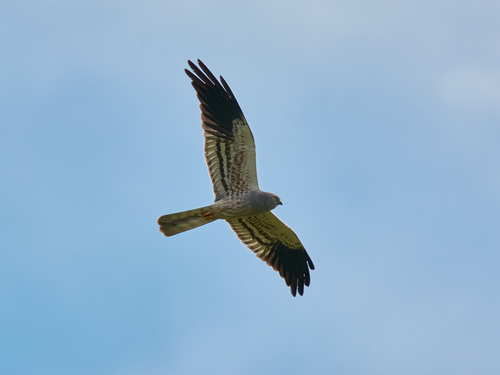
Albanella minore (Circus pygargus) Albanella minore
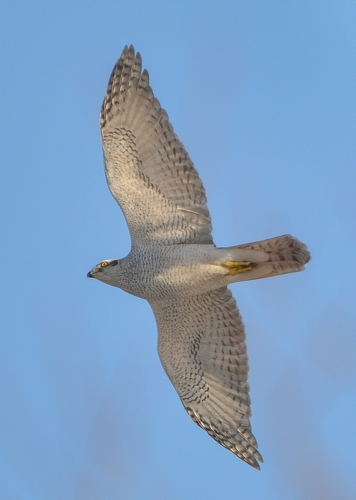
Astore (Astur gentilis) Astore

Media

Caricamento…

In breve

The most reliable field mark to separate Montagu's Harrier from Eurasian Goshawk is overall structure and flight style: Montagu's Harrier is much more slender, with long, narrow, pointed wings and a long tail, giving it a buoyant, elastic flight, while Eurasian Goshawk is robust, with broad, rounded wings and a shorter tail, suited for powerful, direct flight. Juvenile Montagu's Harrier lacks the pale collar of Pallid Harrier, but is still slimmer and more graceful than any goshawk. Adult plumage is also distinctive: male Montagu's Harrier is pale grey with black wingtips and black secondary bands, while adult Goshawk is blue-grey above with strong white supercilia and heavy barring below. Size is a major clue—Goshawk is nearly three times heavier and appears much bulkier. In perched views, Goshawk's thick legs and fierce stare contrast with the more delicate, long-legged harrier.

Consigli di identificazione

  1. Structure in flight: Montagu's Harrier is slender, with long, narrow, pointed wings and a long tail; Goshawk is broad-winged, short-tailed, and powerfully built. This is most obvious in side-by-side comparison or with experience.
  2. Flight style: Montagu's Harrier flies low with buoyant, elastic wingbeats, wings in a dihedral; Goshawk's flight is deeper, more deliberate, and less buoyant, with a 'flap-flap-glide' pattern and occasional soaring.
  3. Juvenile underparts: Juvenile Montagu's Harrier is uniformly red-brown below, with plain belly and underwing coverts; juvenile Goshawk is variable but always has some streaking or barring below, never plain rufous.
  4. Adult male plumage: Montagu's Harrier males are pale grey with black wingtips and black secondary bands; Goshawk males are blue-grey above with white supercilia and strong barring below.
  5. Adult female/juvenile confusion: Female Montagu's Harrier is brown above, pale yellow-brown below with streaks and spots, and a white rump; female/juvenile Goshawk is brown above, heavily barred or streaked below, and lacks the white rump.
  6. Tail pattern: Both species have barred tails, but Goshawk's is broader and more obvious, with 3–5 dark bars; Montagu's Harrier's tail is longer and slimmer in proportion.
  7. Eye color: Goshawk juveniles have pale yellow eyes, adults orange; Montagu's Harrier does not show this age-related eye color change.
  8. Perched posture: Goshawk sits upright with thick legs and fierce stare; Montagu's Harrier is more delicate, long-legged, and less upright.
  9. Bill and legs: Goshawk has a large, powerful bill and thick, robust legs; Montagu's Harrier's bill and legs are finer.
  10. Habitat: Montagu's Harrier is almost never in dense forest; Goshawk is rarely in open fields except on passage.
  11. Melanistic birds: Melanistic Montagu's Harriers are very dark, but still slim and long-winged; Goshawk shows more subtle color variation, especially in Asia, but always has the same structure.
  12. Supercilia: Goshawk (all ages) shows strong white supercilia; Montagu's Harrier lacks this feature.
  13. Migration timing: Montagu's Harrier is a long-distance migrant, absent from breeding areas in winter; Goshawk is more resident.
  14. Sexual dimorphism: Montagu's Harrier shows strong plumage differences between sexes; Goshawk less so, but females are much larger than males.
  15. Common pitfalls: Juvenile Montagu's Harrier is most likely to be confused with other harriers, not Goshawk; Goshawk is more likely to be confused with Sparrowhawk, but is always bulkier and more powerful than any harrier.

Taglia

Montagu's Harrier is a lightweight raptor (average mass 315.5 g) with a wingspan of 97–115 cm and length 43–47 cm. Eurasian Goshawk is much heavier (average mass 926 g), with a more powerful build. In the field, Goshawk appears stocky and broad-chested, with a thick neck and robust legs, while Montagu's Harrier is slim, long-winged, and long-tailed. Even a small male Goshawk is noticeably larger and bulkier than any Montagu's Harrier, and the difference is especially obvious in flight or when perched side by side.

Piumaggio

Juvenile Montagu's Harrier is uniformly red-brown below, lacking the pale collar of Pallid Harrier, and shows a plain belly and underwing coverts without spots. Juvenile Goshawk is brown above and variable below, from nearly white to heavily streaked or barred with cinnamon-brown, but always with a barred tail (3–5 dark bands) and no rusty tones on the underside. Adult male Montagu's Harrier is pale grey with black wingtips and black bands on the secondaries above and below, plus rusty streaks on belly and flanks. Adult female Montagu's is brown above and pale yellow-brown below with streaks and spotted coverts, and a white rump. Adult Goshawk is blue- or brown-grey above with strong white supercilia and dense dark barring below; the tail is always barred. Eye color in Goshawk changes from pale yellow in juveniles to orange in adults. Melanistic Montagu's Harriers are rare but very dark, while Goshawk shows more clinal variation, from pale to nearly black, especially in Asia.

Comportamento

Montagu's Harrier hunts with low, buoyant, elastic flight over open country, wings held in a marked dihedral, and often appears tern-like in its smooth, graceful wingbeats. Goshawk is a forest hunter, flying with deep, deliberate wingbeats and glides, often using a 'flap-flap-glide' pattern. Goshawk can soar on migration, but is generally more direct and powerful in flight, less buoyant than harriers. When perched, Goshawk sits upright, often on a thick branch, with a fierce stare and thick legs; Montagu's Harrier perches lower, appears more delicate, and is rarely seen in dense woodland.

Habitat

Montagu's Harrier breeds in large open areas—grasslands, marshes, and farmland—across the Palearctic and winters in Africa and South Asia. Eurasian Goshawk is a bird of temperate forests, rarely venturing into open country except on migration. If seen in open fields or marshes, Montagu's Harrier is far more likely; in dense woodland, Goshawk is the default. Habitat context is a strong clue, especially when combined with flight style.

Invia una descrizione migliore

Usa le stesse sezioni del confronto. Il testo viene pubblicato subito.

The most reliable field mark to separate Montagu's Harrier from Eurasian Goshawk is overall structure and flight style: Montagu's Harrier is much more slender, with long, narrow, pointed wings and a long tail, giving it a buoyant, elastic flight, while Eurasian Goshawk is robust, with broad, rounded wings and a shorter tail, suited for powerful, direct flight. Juvenile Montagu's Harrier lacks the pale collar of Pallid Harrier, but is still slimmer and more graceful than any goshawk. Adult plumage is also distinctive: male Montagu's Harrier is pale grey with black wingtips and black secondary bands, while adult Goshawk is blue-grey above with strong white supercilia and heavy barring below. Size is a major clue—Goshawk is nearly three times heavier and appears much bulkier. In perched views, Goshawk's thick legs and fierce stare contrast with the more delicate, long-legged harrier.

  1. Structure in flight: Montagu's Harrier is slender, with long, narrow, pointed wings and a long tail; Goshawk is broad-winged, short-tailed, and powerfully built. This is most obvious in side-by-side comparison or with experience.
  2. Flight style: Montagu's Harrier flies low with buoyant, elastic wingbeats, wings in a dihedral; Goshawk's flight is deeper, more deliberate, and less buoyant, with a 'flap-flap-glide' pattern and occasional soaring.
  3. Juvenile underparts: Juvenile Montagu's Harrier is uniformly red-brown below, with plain belly and underwing coverts; juvenile Goshawk is variable but always has some streaking or barring below, never plain rufous.
  4. Adult male plumage: Montagu's Harrier males are pale grey with black wingtips and black secondary bands; Goshawk males are blue-grey above with white supercilia and strong barring below.
  5. Adult female/juvenile confusion: Female Montagu's Harrier is brown above, pale yellow-brown below with streaks and spots, and a white rump; female/juvenile Goshawk is brown above, heavily barred or streaked below, and lacks the white rump.
  6. Tail pattern: Both species have barred tails, but Goshawk's is broader and more obvious, with 3–5 dark bars; Montagu's Harrier's tail is longer and slimmer in proportion.
  7. Eye color: Goshawk juveniles have pale yellow eyes, adults orange; Montagu's Harrier does not show this age-related eye color change.
  8. Perched posture: Goshawk sits upright with thick legs and fierce stare; Montagu's Harrier is more delicate, long-legged, and less upright.
  9. Bill and legs: Goshawk has a large, powerful bill and thick, robust legs; Montagu's Harrier's bill and legs are finer.
  10. Habitat: Montagu's Harrier is almost never in dense forest; Goshawk is rarely in open fields except on passage.
  11. Melanistic birds: Melanistic Montagu's Harriers are very dark, but still slim and long-winged; Goshawk shows more subtle color variation, especially in Asia, but always has the same structure.
  12. Supercilia: Goshawk (all ages) shows strong white supercilia; Montagu's Harrier lacks this feature.
  13. Migration timing: Montagu's Harrier is a long-distance migrant, absent from breeding areas in winter; Goshawk is more resident.
  14. Sexual dimorphism: Montagu's Harrier shows strong plumage differences between sexes; Goshawk less so, but females are much larger than males.
  15. Common pitfalls: Juvenile Montagu's Harrier is most likely to be confused with other harriers, not Goshawk; Goshawk is more likely to be confused with Sparrowhawk, but is always bulkier and more powerful than any harrier.

Montagu's Harrier is a lightweight raptor (average mass 315.5 g) with a wingspan of 97–115 cm and length 43–47 cm. Eurasian Goshawk is much heavier (average mass 926 g), with a more powerful build. In the field, Goshawk appears stocky and broad-chested, with a thick neck and robust legs, while Montagu's Harrier is slim, long-winged, and long-tailed. Even a small male Goshawk is noticeably larger and bulkier than any Montagu's Harrier, and the difference is especially obvious in flight or when perched side by side.

Juvenile Montagu's Harrier is uniformly red-brown below, lacking the pale collar of Pallid Harrier, and shows a plain belly and underwing coverts without spots. Juvenile Goshawk is brown above and variable below, from nearly white to heavily streaked or barred with cinnamon-brown, but always with a barred tail (3–5 dark bands) and no rusty tones on the underside. Adult male Montagu's Harrier is pale grey with black wingtips and black bands on the secondaries above and below, plus rusty streaks on belly and flanks. Adult female Montagu's is brown above and pale yellow-brown below with streaks and spotted coverts, and a white rump. Adult Goshawk is blue- or brown-grey above with strong white supercilia and dense dark barring below; the tail is always barred. Eye color in Goshawk changes from pale yellow in juveniles to orange in adults. Melanistic Montagu's Harriers are rare but very dark, while Goshawk shows more clinal variation, from pale to nearly black, especially in Asia.

Montagu's Harrier hunts with low, buoyant, elastic flight over open country, wings held in a marked dihedral, and often appears tern-like in its smooth, graceful wingbeats. Goshawk is a forest hunter, flying with deep, deliberate wingbeats and glides, often using a 'flap-flap-glide' pattern. Goshawk can soar on migration, but is generally more direct and powerful in flight, less buoyant than harriers. When perched, Goshawk sits upright, often on a thick branch, with a fierce stare and thick legs; Montagu's Harrier perches lower, appears more delicate, and is rarely seen in dense woodland.

Montagu's Harrier breeds in large open areas—grasslands, marshes, and farmland—across the Palearctic and winters in Africa and South Asia. Eurasian Goshawk is a bird of temperate forests, rarely venturing into open country except on migration. If seen in open fields or marshes, Montagu's Harrier is far more likely; in dense woodland, Goshawk is the default. Habitat context is a strong clue, especially when combined with flight style.

Scartare le modifiche?

Hai modifiche non salvate. Se esci ora, andranno perse.

Albanella minore · Astore · I miei uccelli difficili