

Parrocchetto monaco vs Pileated Parrot
Myiopsitta monachus contro Pionopsitta pileata
Fai un quiz con Parrocchetto monaco e Pileated Parrot
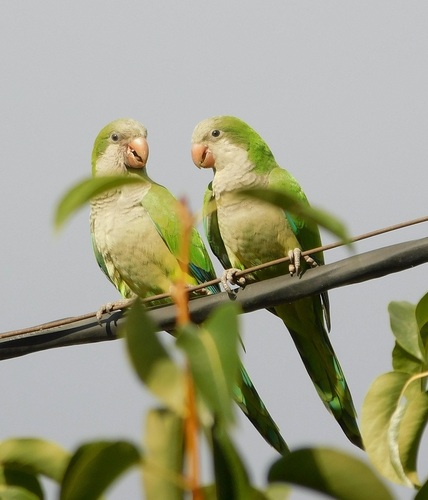 Parrocchetto monaco
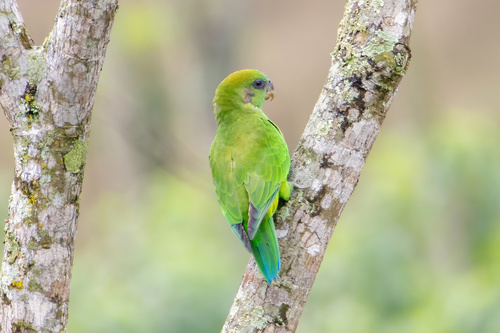 Pileated Parrot
In breve
The most reliable field mark between Monk Parakeet and Pileated Parrot is the head and underpart coloration: Monk Parakeet shows a pale grey, scalloped forehead and breast, while Pileated Parrot (adult male) has a striking red crown and lores, and the female lacks red but may show a faint blue wash. Both species are green parrots with blue in the wings, but Monk Parakeet is larger, longer-tailed, and has a distinctive orange bill. In flight or at rest, Monk Parakeet's pale face and breast contrast with its green body, while Pileated Parrot appears all green with a colored cap (red in males, faint blue in females). Immature Pileated Parrots can be confusing, but the lack of a pale grey face and the presence of some blue or reduced red on the head help separate them.
Consigli di identificazione
- Head and face color: Monk Parakeet always shows a pale grey, scalloped forehead and breast, regardless of age or sex. Pileated Parrot never shows this; males have a red crown and lores, females a faint blue wash, and immatures have reduced red or blue, but never pale grey.
- Bill color: Monk Parakeet has a prominent orange bill, while Pileated Parrot's bill is not described as orange and is less conspicuous in the field.
- Tail shape and length: Monk Parakeet has a long, tapering tail, often extending well beyond the wingtips when perched. Pileated Parrot's tail is shorter and less pointed.
- Body size: Monk Parakeet is significantly longer (29 cm) and bulkier than Pileated Parrot (20–22 cm), though their weights overlap. Use this with caution unless both species are seen together.
- Underparts: Monk Parakeet shows a greenish-yellow abdomen with a pale grey breast; Pileated Parrot is green with a yellowish abdomen but lacks the pale grey breast.
- Wing coloration in flight: Both species have blue in the wings, but Monk Parakeet's blue is restricted to the remiges and is usually visible as a flash in flight. Pileated Parrot's blue is duller and found on primaries, primary coverts, and tail edges.
- Sexual dimorphism: Only Pileated Parrot shows strong sexual dimorphism: males have a red head, females do not. Monk Parakeet sexes are visually indistinguishable in the field.
- Juvenile confusion: Immature Pileated Parrots may lack strong head color, but never show a pale grey face; Monk Parakeet juveniles look like adults.
- Social behavior: Monk Parakeet is often in large, noisy flocks and may be seen building or occupying large stick nests. Pileated Parrot is more often in pairs or small groups and does not build communal nests.
- Habitat: Monk Parakeet is common in urban, suburban, and agricultural areas, often far from forest. Pileated Parrot is a forest species and rarely found in open or urban habitats.
- Perched jizz: Monk Parakeet appears longer, with a proportionally longer tail and a more upright posture. Pileated Parrot is more compact and less elongated.
- Vocalizations: Monk Parakeet is very noisy, with harsh, throaty calls. If you hear a loud, social flock in a city or open area, Monk Parakeet is likely.
- Color morphs: While Monk Parakeet can show blue, yellow, or white morphs in captivity, wild birds are almost always green with the standard pattern. Pileated Parrot does not show such color morphs.
- Nest association: If you see a large stick nest with multiple chambers, Monk Parakeet is the only likely builder; Pileated Parrot does not build such nests.
- Pitfall: Female and immature Pileated Parrots can be mistaken for Monk Parakeet if the red or blue head color is faint, but the absence of a pale grey face and the habitat context should help clarify the ID.
Taglia
Monk Parakeet is noticeably larger, averaging 29 cm in length with a 48 cm wingspan and weighing 95–120 g. Pileated Parrot is smaller, at 20–22 cm long and 98–120 g. While their weights overlap, Monk Parakeet is longer and more robust overall, with a proportionally longer, tapering tail. Size alone may not be diagnostic at a distance, but the Monk Parakeet's longer body and tail are often apparent when perched or in flight.
Piumaggio
- Juvenile/immature birds: Immature Monk Parakeets resemble adults, with pale grey face and breast and blue in the wings, lacking strong age-specific wing patterns. Immature Pileated Parrots (males) show less red on the head than adults, while females have less blue on the wings and a faint blue wash on the forehead and breast, but never a pale grey face.
- Adults: Monk Parakeet has a pale grey forehead and breast with darker scalloping, bright green upperparts, greenish-yellow underparts, dark blue remiges, and a long, tapering tail. The orange bill is prominent. Pileated Parrot adults are essentially all green with a yellowish abdomen and dull blue primaries, primary coverts, and tail edges. Adult males have a bold red forehead, crown, lores, and upper ear coverts; females lack red but may show faint blue on the forehead and breast. Both sexes of Pileated Parrot lack the pale grey face and breast of Monk Parakeet. In flight, Monk Parakeet's blue flight feathers and pale face stand out, while Pileated Parrot shows a mostly green body with blue in the wings and tail, and a colored cap in males.
Comportamento
Monk Parakeet is highly gregarious, often seen in noisy flocks and known for building large, communal stick nests, sometimes with multiple chambers. Pileated Parrot is less colonial and more likely to be seen in pairs or small groups, without the elaborate communal nesting behavior. Monk Parakeets are often conspicuous due to their social behavior and tendency to gather in urban or open areas, while Pileated Parrots are more discreet and forest-associated.
Habitat
Monk Parakeet is adaptable and often found in open or urban habitats, including parks, city edges, and agricultural areas, especially in feral populations. Pileated Parrot is more restricted to forested habitats in Argentina, Brazil, and Paraguay, and is less likely to be found in urban settings. Habitat context can be a helpful clue: Monk Parakeet is more likely in cities or farmland, while Pileated Parrot is a forest bird.
Voce
Monk Parakeet has a loud, throaty call described as chape(-yee) or quak quaki quak-wi quarr, with harsh screeches (skveet). Pileated Parrot's vocalizations are not detailed in the provided notes, so calls are not reliably diagnostic here, but Monk Parakeet's noisy, social calls are distinctive in urban and open settings.
Parrocchetto monaco · Pileated Parrot · I miei uccelli difficili