

Levaillant's Cisticola vs Croaking Cisticola
Cisticola tinniens contro Cisticola natalensis
Fai un quiz con Levaillant's Cisticola e Croaking Cisticola
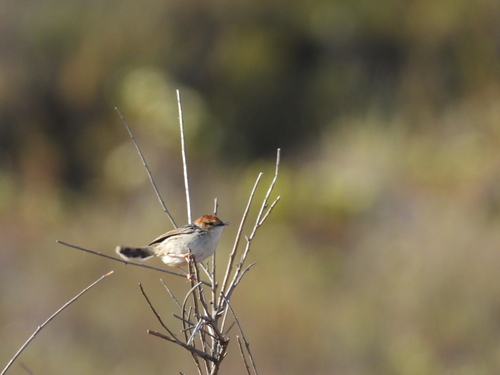 Levaillant's Cisticola
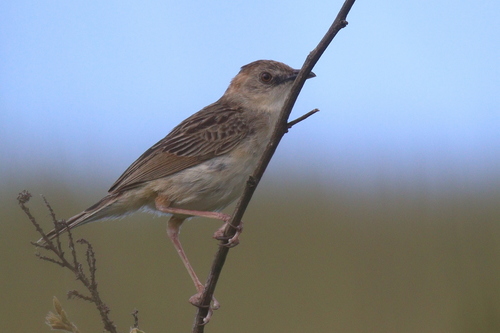 Croaking Cisticola
In breve
The most reliable field mark between Levaillant's Cisticola and Croaking Cisticola is size: Croaking is the largest cisticola, noticeably bigger and heavier than Levaillant's. In the field, Croaking Cisticola shows a broad, pale-tipped tail that is often flicked, and a heavier bill, while Levaillant's is smaller with a reddish cap and a more delicate, straight bill. Both have grey-brown, heavily streaked upperparts and rufous wing panels, but Levaillant's has buffy white underparts and a russet tail, whereas Croaking's underparts are more whitish. Their habitats overlap in wet grasslands, but Levaillant's is more tied to marshes and reedbeds, while Croaking prefers rank grassland near water. If heard, Croaking's distinctive 'breep-breep' croak is diagnostic.
Consigli di identificazione
- Size is key: Croaking Cisticola is the largest cisticola and noticeably bulkier than Levaillant's. If the bird appears large and robust for a cisticola, suspect Croaking.
- Tail shape and behavior: Croaking has a broad, pale-tipped tail that is flicked frequently. Levaillant's tail is longish, russet brown, and less obviously flicked.
- Bill structure: Croaking shows a heavy, thick bill, while Levaillant's has a shorter, straight, more delicate bill. This is best seen at close range or in good light.
- Crown color: Levaillant's has a reddish cap, which is often visible when perched or in good light. Croaking lacks this feature.
- Underparts color: Levaillant's underparts are buffy white (adults) or yellowish (juveniles), while Croaking's are more whitish with less buff or yellow tone.
- Upperparts and streaking: Both are grey-brown and heavily streaked above, but this is not diagnostic between the two.
- Wing panel: Both show a rufous/chestnut panel in the folded wing; this is not a reliable separator.
- Supercilium and face: Levaillant's has a buffy white supercilium and face, which can help in close views. Croaking's facial pattern is less distinct.
- Eye color: Levaillant's has a light brown eye, but this is subtle and rarely diagnostic in the field.
- Feet and legs: Both have pinkish-brown legs and feet; not useful for separation.
- Juvenile underparts: If the bird is a juvenile with yellowish underparts, Levaillant's is more likely.
- Song: If you hear a froglike 'breep-breep' croak, it's Croaking Cisticola. Levaillant's gives a higher, tinkling or wailing song.
- Habitat context: In dense reedbeds or sedges, especially in upland marshes, Levaillant's is more likely. In open, rank grassland near water, especially in broader sub-Saharan Africa, Croaking is more probable.
- Behavioral cues: Croaking is more skulking and often heard rather than seen, especially outside breeding season. Levaillant's may perch higher and be more visible in reeds.
- Seasonal effects: Levaillant's becomes browner above in non-breeding plumage but retains the reddish cap and buffy underparts; Croaking's plumage is less variable.
Taglia
Croaking Cisticola is the largest cisticola, averaging about 14 cm in length, and is noticeably bulkier than Levaillant's Cisticola, which is smaller at 12–15 cm. Croaking also has a heavier bill and a broader tail, while Levaillant's is more slender overall. In direct comparison, Croaking will stand out as the bigger, more robust bird, especially when seen side by side or in mixed flocks.
Piumaggio
- Juvenile/immature birds: Levaillant's Cisticola juveniles have yellower underparts, while Croaking's are not specifically described but are likely paler below, matching adults. No distinctive upperwing pattern for either species in immature plumages is noted, so focus on underpart color for young birds.
- Adults (breeding): Both species are grey-brown above with heavy black streaking and a rufous/chestnut wing panel. Levaillant's shows a reddish cap, buffy white underparts, and a russet brown tail. Croaking has a broader, pale-tipped tail, more whitish underparts, and a heavier bill. The supercilium and face are buffy white in Levaillant's; these features are less emphasized in Croaking.
- Non-breeding: Levaillant's becomes browner above and loses some contrast, but still shows the reddish cap and buffy underparts. Croaking's plumage is less seasonally variable, remaining grey-brown and streaked.
- Tail: Croaking's tail is broader and pale-tipped, often flicked; Levaillant's is longish and russet brown.
Comportamento
Croaking Cisticola frequently flicks its broad, pale-tipped tail, a behavior less pronounced in Levaillant's. Both species are skulking and often stay low in dense vegetation, but Croaking is more likely to be heard than seen, especially outside the breeding season. Levaillant's may be more visible in reedbeds and sedges, sometimes perching higher. Both species are insectivorous and forage in similar ways, but Croaking's larger size and heavier bill may make its movements appear more robust.
Habitat
Levaillant's Cisticola is tightly associated with marshlands, reedbeds, sedges, and rank grass near water, especially in upland areas south of the equator. Croaking Cisticola also favors wet areas but is more typical of rank grassland near swamps or water, and its range extends more broadly across sub-Saharan Africa. Where both occur, Levaillant's is more likely in dense reeds or sedges, while Croaking prefers open, grassy patches adjacent to wetlands.
Voce
Croaking Cisticola is best identified by its distinctive, froglike 'breep-breep' croak, which stands out among cisticolas and is the most reliable field mark if heard. Levaillant's Cisticola gives a musical 'chrip-trrrup-trreee', a wailing 'tee tee tee', and harsh alarm notes. The songs are quite different: Croaking's is low and croaky, Levaillant's is higher-pitched and tinkling.
Levaillant's Cisticola · Croaking Cisticola · I miei uccelli difficili