

Great Dusky Swift vs Gray-rumped Swift
Cypseloides senex contro Chaetura cinereiventris
Fai un quiz con Great Dusky Swift e Gray-rumped Swift
 Great Dusky Swift
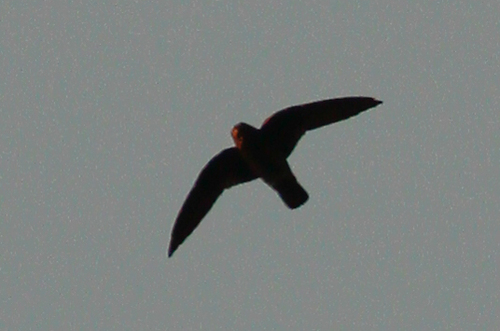 Gray-rumped Swift
In breve
The most reliable way to separate Great Dusky Swift from Grey-rumped Swift is by size and rump color: Great Dusky is much larger and lacks the Grey-rumped's distinctive pale rump. Juvenile birds of both species have pale fringes on the wing feathers, but only Grey-rumped shows a wide, contrasting gray rump and uppertail coverts at all ages. In flight, Great Dusky appears uniformly dark brown above and below, while Grey-rumped shows a sharp pale rump band against otherwise glossy black upperparts. Structural differences are also important: Great Dusky is bulkier with a longer wingspan, while Grey-rumped is compact with a short, square tail and bulging wings. These differences hold in all plumages and are especially useful when birds are seen together or in mixed swift flocks.
Consigli di identificazione
- Size is the single most reliable field mark: Great Dusky Swift is more than twice the length and several times the mass of Grey-rumped Swift. If you see a swift that looks large, heavy, or comparable to a White-collared Swift, it is not a Grey-rumped.
- Rump color is diagnostic at all ages: Grey-rumped Swift always shows a wide, pale gray rump and uppertail coverts, which contrast sharply with the glossy black back and wings. Great Dusky Swift never shows a pale rump; its rump is brown, intermediate between the head and back, and blends with the rest of the upperparts.
- Juvenile wing fringes: Both species' juveniles have pale fringes to the wing feathers, but this is not a separator. Focus on rump color and size for young birds.
- Upperparts gloss: Grey-rumped Swift is glossy black above, while Great Dusky is chocolate to dark brown with a frosted face. In good light, the difference in sheen is visible.
- Underparts: Great Dusky Swift is paler brown below than above, but still uniform. Grey-rumped Swift has lighter gray underparts, with some subspecies showing pale undertail coverts; none are as dark or uniform as Great Dusky.
- Tail shape: Grey-rumped Swift has a short, square tail, often appearing stubby in flight. Great Dusky Swift has a longer, more proportionate tail that is blackish brown.
- Wing shape: Grey-rumped Swift's wings bulge in the middle and hook at the end, giving a distinctive silhouette. Great Dusky's wings are broad but less obviously hooked.
- Flight style: Great Dusky Swift flies with slower, heavier wingbeats and a powerful, direct flight. Grey-rumped Swift is rapid, agile, and often wheels tightly with quick flicks.
- Facial appearance: Great Dusky Swift's face appears frosted due to pale gray feather edges on the crown and throat. Grey-rumped Swift does not show this frosted effect.
- Perched posture: Great Dusky Swift appears robust and large-headed when perched; Grey-rumped Swift is more compact with a proportionally large head and short tail.
- Habitat context: Great Dusky Swift is most likely near waterfalls or cliffs in southeastern South America. Grey-rumped Swift is widespread and can be found in a variety of open habitats, including urban areas and forests.
- Flock composition: If you see a mixed swift flock with a few much larger, darker birds among smaller, pale-rumped swifts, the large ones are likely Great Dusky.
- Voice: Only Grey-rumped Swift's calls are described ('tsip' and burry 'trrreeew' notes). If you hear these, it supports Grey-rumped, but absence of vocalization is not diagnostic.
- Geographic range: If you are outside Argentina, Brazil, Paraguay, or Bolivia, Great Dusky Swift is unlikely. If in Central America or the Caribbean, you are almost certainly seeing Grey-rumped Swift.
- Pitfall: Do not rely on underwing color or subtle differences in brown tones; rump color and size are much more reliable. Juvenile pale wing fringes occur in both and are not a separator.
Taglia
Great Dusky Swift is dramatically larger, measuring about 18 cm in length and weighing around 80 g ([wikidata]), making it the largest Cypseloides. In contrast, Grey-rumped Swift is only about 10.5 cm long and weighs about 17 g ([wikipedia]). This size gap is obvious in the field, especially if both species are present. Great Dusky appears heavy and broad-winged, while Grey-rumped is small, compact, and much lighter in build. Even at a distance, the size difference is often apparent by the slower, heavier wingbeats of Great Dusky versus the rapid, agile flight of Grey-rumped.
Piumaggio
-
Juveniles: Both species' juveniles have pale fringes to the wing feathers, but only Grey-rumped Swift (all ages) shows a wide, pale gray rump and uppertail coverts, which is a key field mark. Great Dusky juveniles are otherwise like adults: dark brown overall with a slightly frosted face, but no pale rump.
-
Adults: Great Dusky Swift is chocolate to dark brown above and below, with a frosted gray face and no contrasting rump. The back is darker than the rump, but the rump is never pale or sharply demarcated. Grey-rumped Swift adults are glossy black above with a broad, pale gray rump and uppertail coverts, and lighter gray underparts. The undertail coverts vary by subspecies but are never as uniformly dark as Great Dusky. The upperwing of Great Dusky is brown, while Grey-rumped is glossy black; in flight, the pale rump of Grey-rumped stands out against the dark body and wings.
-
Subspecies: Some Grey-rumped subspecies have darker rumps or underparts, but all retain at least a paler rump than the rest of the upperparts, never matching the uniformity of Great Dusky.
Comportamento
Both species are aerial insectivores, but Great Dusky Swift often feeds in large flocks, sometimes with White-collared Swifts. Its flight is heavier and more powerful, matching its larger size. Grey-rumped Swift is much more agile, with rapid, flickering wingbeats and a tendency to wheel and dart in tight groups. Perched, Great Dusky appears robust and large-headed, while Grey-rumped is compact with a proportionally larger head and short tail. Great Dusky may be seen near waterfalls or cliffs, while Grey-rumped is more likely to be found near open areas and sometimes urban structures.
Habitat
Great Dusky Swift is found in Argentina, Brazil, Paraguay, and possibly Bolivia, often near waterfalls or rocky outcrops. Grey-rumped Swift has a much broader range, occurring from Honduras through most of South America (except Chile, French Guiana, Suriname, Uruguay), and on several Caribbean islands. Grey-rumped is more likely in Central America and the northern half of South America, while Great Dusky is restricted to the southeast. Overlap is possible in southeastern Brazil and adjacent areas, but generally, Great Dusky is more localized and habitat-specific.
Voce
Grey-rumped Swift gives a bright, repeated 'tsip' and a series of 3–4 burry, drawn-out notes ('trrreeew-trrreeew-trrreeew'). No vocalization details are provided for Great Dusky Swift in the notes, so voice is not a reliable separator based on this information.
Great Dusky Swift · Gray-rumped Swift · I miei uccelli difficili