

Garden Emerald vs Bronze-tailed Plumeleteer
Chlorostilbon assimilis contro Chalybura urochrysia
Fai un quiz con Garden Emerald e Bronze-tailed Plumeleteer
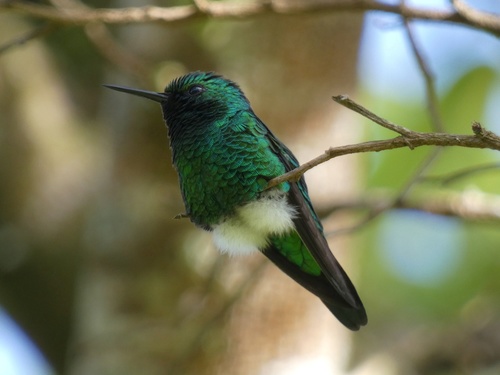 Garden Emerald
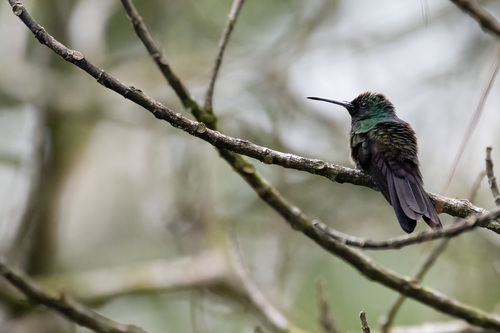 Bronze-tailed Plumeleteer
In breve
The most reliable field mark to separate Garden Emerald from Bronze-tailed Plumeleteer is size and structure: the Plumeleteer is much larger and bulkier, with a heavier, slightly decurved bill and a longer, broader tail, while the Garden Emerald is tiny and compact with a shorter, straighter bill. Adult male Garden Emeralds are a vivid metallic green with a blue-black forked tail, while male Plumeleteers have a bronze-green tail and long, fluffy white undertail coverts. Females and immatures can be confusing, but the Plumeleteer is always noticeably larger and shows more extensive white or gray undertail coverts. In flight or perched, check for the Plumeleteer's size and broad tail versus the Garden Emerald's daintier build and more deeply forked tail.
Consigli di identificazione
- Size is the most immediate clue: Plumeleteer is nearly twice the mass of Garden Emerald and noticeably longer and bulkier. If the bird looks small and delicate, think Garden Emerald; if it looks robust and heavy, suspect Plumeleteer.
- Bill structure: Plumeleteer has a heavier, slightly decurved bill with a black maxilla and red or pinkish base to the mandible, while Garden Emerald’s bill is shorter, straighter, and all dark.
- Tail shape and color: Garden Emerald has a blue-black, deeply forked tail with a bluish gloss (central feathers); Plumeleteer’s tail is broader, less forked, and bronze-green or purplish (depending on subspecies), lacking the blue gloss.
- Undertail coverts: Male Plumeleteers have long, fluffy white (or sooty in melanorrhoa) undertail coverts, which are much more prominent than the small white thigh tufts of Garden Emerald. Females also show more extensive grayish white undertail coverts than Garden Emerald.
- Underparts (males): Garden Emerald males are bright, metallic green below, sometimes with a blue sheen. Plumeleteer males are glittering green below, but isaurae has a blue throat and breast, and melanorrhoa has a darker, dusky bronze belly.
- Underparts (females): Garden Emerald females are pale gray below with little or no green flecking; Plumeleteer females are gray below with green flecks on the sides (more in melanorrhoa, less in isaurae).
- Face pattern (females/immatures): Garden Emerald females have a white or grayish spot behind the eye and dusky cheeks, a mark not described for Plumeleteer females.
- Juvenile/immature marks: Immature Plumeleteers have buffy or cinnamon fringing on crown, nape, and rump feathers; Garden Emerald juveniles do not show this.
- Perched jizz: Garden Emerald perches more upright and looks compact; Plumeleteer appears heavier and more horizontal.
- Flight style: Garden Emerald is quick and agile, often hovering at flowers in open areas; Plumeleteer is steadier and more powerful, often seen chasing other hummingbirds.
- Habitat context: In dense forest or mature secondary growth, expect Plumeleteer; in open gardens or scrubby edges, Garden Emerald is more likely.
- Geographic range: Both overlap in Costa Rica and Panama, but Plumeleteer extends north to Nicaragua and south to Ecuador; Garden Emerald is restricted to Costa Rica and Panama.
- Vocalization: Not reliably diagnostic; both are generally quiet and have similar, unremarkable calls.
- Subspecies variation: If you see a male with a blue throat and breast, it is Plumeleteer (isaurae); Garden Emerald never shows this.
- Tail tip color (females): Garden Emerald females have pale gray tips on the outer tail feathers; Plumeleteer females have gray tips but with more extensive grayish undertail coverts.
Taglia
Garden Emerald is a truly small hummingbird, measuring 7.8–8.5 cm and weighing 3–4.1 g. Bronze-tailed Plumeleteer is much larger: 10.5–12 cm long, with males weighing about 7.1 g and females 6.1 g—nearly double the mass of a Garden Emerald. This difference is obvious in the field, especially when both species are seen at the same feeder or flowering patch. The Plumeleteer appears bulkier, with a more robust body and a proportionally longer tail.
Piumaggio
- Juveniles/Immatures: Juvenile Garden Emerald males resemble adult females but are darker gray below; no distinctive upperwing or flight pattern is described for either species at this age. Immature Plumeleteers look like adults but have buffy to cinnamon fringing on the crown, nape, and rump feathers, which is absent in Garden Emerald.
- Adult Males: Garden Emerald males are metallic green above, brighter green below, with a blue-black forked tail and white thigh tufts. Plumeleteer males (nominate and melanorrhoa) are metallic green above with glittering green underparts, but their tail is bronze-green (or purplish black in melanorrhoa), and they have long, fluffy white undertail coverts (shorter and sooty in melanorrhoa). The isaurae subspecies has a blue throat and breast, bluish green belly, and a brighter bronze tail.
- Adult Females: Garden Emerald females are bright metallic green to bronze green above, with bluish green uppertail coverts, blue-black tail with pale gray tips on outer feathers, dusky cheeks, a white spot behind the eye, and pale gray underparts. Plumeleteer females are metallic green above, gray below with green flecks on the sides (darker gray in melanorrhoa, paler in isaurae), and have grayish white undertail coverts with gray-tipped outer tail feathers. The undertail coverts are always more extensive and fluffier in Plumeleteer.
- Tail: Garden Emerald has a more deeply forked tail with blue-black and bluish gloss; Plumeleteer has a broader, less forked tail with a bronze or purplish cast.
Comportamento
Both species are active nectar feeders, but the Plumeleteer is more aggressive and often dominates feeding territories, especially at Heliconia patches. Garden Emeralds are more likely to be seen in open gardens and edges, flitting quickly and perching on exposed twigs. Plumeleteers tend to forage from the understory to mid-strata and are less likely to be seen in fully open areas, often remaining within or near forest edge. In mixed-species situations, the Plumeleteer’s larger size and assertive behavior are apparent.
Habitat
Garden Emerald is found in Costa Rica and Panama, typically in gardens, open areas, and edges. Bronze-tailed Plumeleteer has a broader range (Nicaragua to Ecuador) and prefers the interior and edges of humid forest, mature secondary forest, and semi-open areas like banana plantations, but generally avoids fully open habitats. If you are in a dense forest interior, Plumeleteer is more likely; in open gardens or scrub, Garden Emerald is expected.
Voce
Garden Emerald’s vocalizations are not well known but are thought to resemble Canivet’s Emerald: an endlessly repeated, wiry 'tseee tseeree' and a dry, scratchy 'chut' or 'chit.' Bronze-tailed Plumeleteer’s voice is not described in the provided notes, so vocalization is not a reliable separator in this case.
Garden Emerald · Bronze-tailed Plumeleteer · I miei uccelli difficili