

Assiolo vs Civetta nana
Otus scops contro Glaucidium passerinum
Fai un quiz con Assiolo e Civetta nana
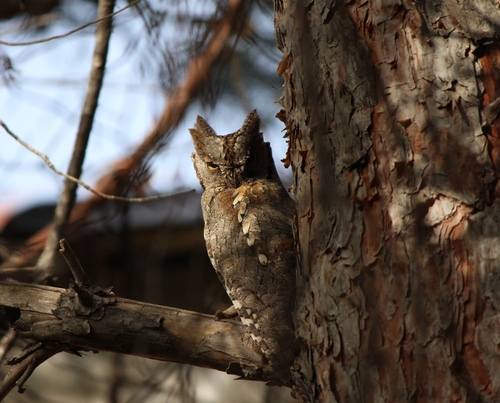 Assiolo
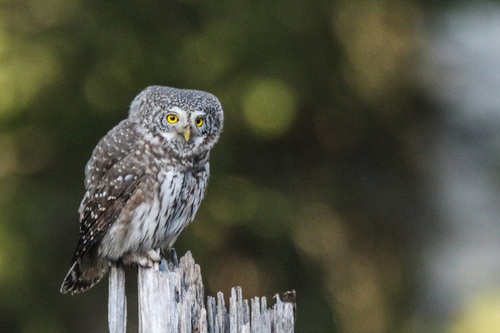 Civetta nana
In breve
The most reliable field mark to separate Eurasian Scops Owl from Eurasian Pygmy-Owl is the presence of small ear-tufts in Scops Owl, which are always absent in Pygmy-Owl. Scops Owl is also slightly larger and longer-winged, with a more upright posture and paler, less patterned plumage overall. Pygmy-Owl is compact, lacks ear-tufts, and shows a distinctive white half-collar on the nape and spotted sides. In flight, Scops Owl's long, narrow wings contrast with the Pygmy-Owl's shorter, rounded wings and relatively longer tail. Vocalizations are quite different, with Scops Owl giving a deep, toad-like whistle, while Pygmy-Owl produces a high-pitched, fluted series of notes.
Consigli di identificazione
- Ear-tufts present (Scops Owl) vs absent (Pygmy-Owl): Scops Owl always shows small, pointed ear-tufts, especially when alert; Pygmy-Owl never has ear-tufts. This is the single most reliable mark in all seasons and ages.
- Head shape: Scops Owl has a more angular, 'horned' look due to ear-tufts, while Pygmy-Owl's head is rounded and small, with a flat crown.
- Plumage pattern: Scops Owl is overall grey-brown and fairly plain, with a pale face and shoulder line but little obvious patterning. Pygmy-Owl is more spotted, especially on the sides and back, and has a distinctive white half-collar on the nape (visible from behind or in profile).
- Tail pattern: Pygmy-Owl's tail is dark with five narrow, whitish bars—look for this in perched or flying birds. Scops Owl's tail is less distinctly barred and generally paler.
- Underparts: Scops Owl has paler, less marked underparts; Pygmy-Owl's belly is white with brown speckles, often appearing more heavily marked below.
- Size and structure: Scops Owl is slightly larger and more elongated, with long, narrow wings and a more upright posture. Pygmy-Owl is compact, short-necked, and appears smaller-headed and rounder overall.
- Flight style: Scops Owl flies with strong, direct wingbeats on long, pointed wings. Pygmy-Owl's flight is quicker, more fluttery, with shorter, rounded wings and a relatively longer tail.
- Perching behavior: Pygmy-Owl often perches in the open, sometimes on the tops of conifers, and is active during the day. Scops Owl is more secretive, often roosting in dense foliage and is mainly crepuscular or nocturnal.
- Vocalization: Scops Owl's call is a deep, toad-like whistle, repeated at intervals. Pygmy-Owl gives a high-pitched, fluted series of notes, spaced by about two seconds. The difference in pitch and rhythm is diagnostic if heard.
- Habitat: In mixed or edge habitats in southern Europe, expect Scops Owl; in dense boreal or montane forests, especially in northern Europe and Siberia, expect Pygmy-Owl.
- Facial features: Pygmy-Owl has white to grey 'eyebrows' and yellow eyes, giving a different facial expression compared to the paler, less contrasting face of Scops Owl.
- Bill and feet: Pygmy-Owl has a greyish-yellow, hooked bill and disproportionately large feet for its size (adapted for taking large prey); these are subtle but may be visible at close range.
- Seasonal context: Scops Owl is migratory in much of its range and is absent from northern forests in winter; Pygmy-Owl is resident year-round in boreal forests.
- Sex and age: No strong sexual dimorphism in field marks for either species; age-specific flight or wing patterns are not described as diagnostic in the sources.
- Common pitfalls: Beware of assuming all small, plain owls are Pygmy-Owl—always check for ear-tufts and overall structure. In poor light, the pale shoulder line of Scops Owl can be confused with the white nape collar of Pygmy-Owl, but the collar is always on the back of the neck and more complete in Pygmy-Owl.
Taglia
Eurasian Scops Owl is slightly larger, measuring 19–21 cm in length with a wingspan of 47–54 cm (no mass given in the sources). Eurasian Pygmy-Owl is the smallest European owl, with females 17.4–19 cm and males 15.2–17 cm in length, and an average adult mass of 65.5 g. In the field, Scops Owl often appears more elongated and upright, while Pygmy-Owl is notably compact and small-headed. The difference is subtle at a distance, but Scops Owl's longer wings and overall lankier structure can be apparent in flight or perched side-by-side.
Piumaggio
No age-specific upperwing or flight pattern marks are described for either species in the sources, so focus is on adult and general plumage. Scops Owl is predominantly grey-brown with a paler face, underparts, and a pale shoulder line; its plumage is relatively plain and cryptic, with small ear-tufts that are often visible when perched. Pygmy-Owl is more variable in color, ranging from reddish to greyish-brown, and is distinctly spotted on the sides and back. The Pygmy-Owl's tail is darker with five narrow, whitish bars, and it has a white half-collar on the nape—features not seen in Scops Owl. The Pygmy-Owl's belly is mostly white with brown speckles, while Scops Owl's underparts are paler but less heavily marked. The absence of ear-tufts in Pygmy-Owl is a key difference at all ages.
Comportamento
Scops Owl perches upright and is often more secretive, relying on camouflage. Its flight is strong and direct on long, narrow wings, reflecting its migratory habits. Pygmy-Owl is more active during the day (diurnal), often perching conspicuously on exposed branches, and is known for its bold hunting behavior, including catching birds in flight and storing prey. Pygmy-Owl's flight is quicker and more fluttery, with shorter, rounded wings and a relatively longer tail, giving a different jizz compared to the more streamlined Scops Owl.
Habitat
Scops Owl breeds in southern Europe to southern Siberia and the western Himalayas, wintering in sub-Saharan Africa but is resident in parts of Mediterranean Europe. It favors open woodlands, groves, and sometimes parks. Pygmy-Owl is a boreal and montane species, found in the forests of northern and central Europe to Siberia, preferring coniferous or mixed woodlands. In areas of overlap, Pygmy-Owl is more likely in dense, mature forest, while Scops Owl is more associated with open or edge habitats.
Voce
Scops Owl gives a deep, repetitive whistle, reminiscent of midwife toads (Alytes), and is lower-pitched than most owl calls. Both sexes give this call. Pygmy-Owl's call is much higher in pitch: a series of clear, fluted notes spaced by about two seconds, with males and females similar but females higher. Before and after the mating season, both sexes may give a short, rising series of notes. The pitch and rhythm are quite different between the two species and are useful for separation, especially at dusk or dawn.