

Rosella orientale vs Red-rumped Parrot
Platycercus eximius contro Psephotus haematonotus
Fai un quiz con Rosella orientale e Red-rumped Parrot
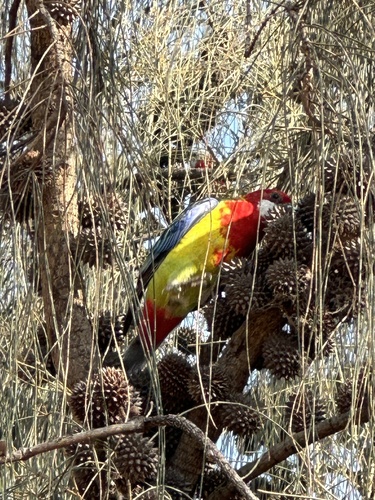 Rosella orientale
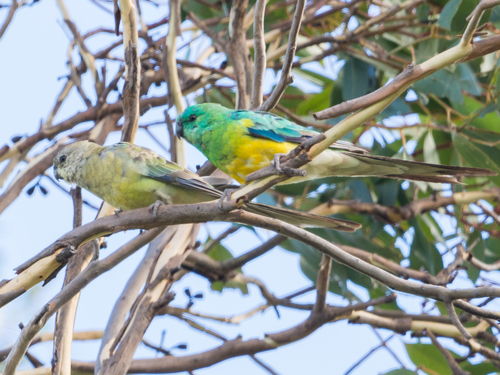 Red-rumped Parrot
In breve
The most reliable field mark is the white cheek patch and red head of the Eastern Rosella (all ages and sexes) versus the absence of both in Red-rumped Parrot, which instead shows a green head and, in adult males only, a distinctive red rump patch. For immature birds in flight, look for the underwing stripe: both female and juvenile Eastern Rosellas have a pale underwing stripe, as do female and immature male Red-rumped Parrots, but only adult male Red-rumped Parrots lose this mark. Adult male Red-rumped Parrots are bright green with a red rump and yellow underparts, while Eastern Rosellas are more multicolored with a scalloped black-and-yellow back and blue in the wings. Structure is also helpful: Eastern Rosellas are bulkier with a broader head and stouter bill, while Red-rumped Parrots are slimmer and longer-tailed. Both species can be found in southeastern Australia, but habitat and context may help in ambiguous cases.
Consigli di identificazione
- White cheek patch (all ages, both sexes): Only Eastern Rosella shows a large white cheek patch on a red head. Red-rumped Parrot never has a white cheek or red head.
- Red head (all ages, both sexes): Eastern Rosella always has a red head, while Red-rumped Parrot's head is green in males and dull olive in females/juveniles.
- Red rump (adult males only): Adult male Red-rumped Parrot has a bright brick-red rump, visible in flight or when perched with tail lifted. Eastern Rosella never shows a red rump; its rump is pale green or bluish-green depending on subspecies.
- Underwing stripe (in flight, age-specific): Both female and juvenile Eastern Rosellas have a pale underwing stripe. In Red-rumped Parrot, all females and immature males have an off-white underwing bar, but adult males (about 2 years+) lose this mark. Thus, a green parrot with a red rump and no underwing bar in flight is an adult male Red-rumped Parrot.
- Back pattern: Eastern Rosella has a black back with yellowish or greenish scalloped margins, giving a scaled look. Red-rumped Parrot's back is plain green-blue (male) or olive-green (female/juvenile), lacking the scalloped pattern.
- Breast and belly color: Eastern Rosella has a red upper breast, yellow lower breast, and pale green belly. Red-rumped Parrot males have yellow underparts; females are pale olive below.
- Wing color: Both have blue in the wings, but Eastern Rosella's is more extensive and includes lateral tail feathers. Red-rumped Parrot males have blue highlights and yellow shoulder patches.
- Bill color: Eastern Rosella's bill is white; Red-rumped Parrot's is grey (darker in males), and brownish in immatures.
- Size and shape: Eastern Rosella is slightly larger and bulkier, with a broader head and stouter bill. Red-rumped Parrot is slimmer, with a longer, more pointed tail.
- Sexual dimorphism: Red-rumped Parrot is strongly dimorphic; only males have the bright green, yellow, and red rump. Females and juveniles are dull olive-green, lacking the red rump. Eastern Rosella is less dimorphic; females are duller but still have the red head and white cheek.
- Juvenile confusion: Juvenile Eastern Rosellas are duller but retain the red head and white cheek. Juvenile Red-rumped Parrots resemble females but have a red rump and light blue-green face.
- Habitat context: In open grassy areas, especially golf courses and urban lawns, Red-rumped Parrot is more likely. In forest edge, parks with mature trees, or gardens, Eastern Rosella is more likely.
- Flight jizz: Red-rumped Parrot is slimmer and flies fast and direct, often low over grass. Eastern Rosella is bulkier and may appear more deliberate in flight.
- Subspecies variation: Eastern Rosella subspecies differ in rump and back color, but all retain the red head and white cheek, which are always diagnostic.
- Pitfall: Female and juvenile Red-rumped Parrots lack the red rump and are dull olive, which can lead to confusion with other green parrots, but never show a red head or white cheek.
Taglia
Eastern Rosella is slightly larger, averaging 30 cm (12 in) in length [wikipedia], while Red-rumped Parrot is about 28 cm (11 in) [wikipedia]. Eastern Rosella appears stockier and heavier-bodied, with a broader head and stouter bill, compared to the slimmer, more elongated Red-rumped Parrot. Weight for Red-rumped Parrot is 45–77 g; no direct weight is given for Eastern Rosella, but it is generally heavier and more robust in appearance.
Piumaggio
- Juvenile and female underwing stripe: Both species' females and juveniles show a pale underwing stripe, visible in flight. In Eastern Rosella, this is present in all females and juveniles. In Red-rumped Parrot, the underwing bar is present in all females and in immature males, but lost by adult males (from about 2 years old). Thus, a male Red-rumped Parrot without an underwing bar is an adult male; all others show it.
- Head and cheek color: Eastern Rosella always has a red head and large white cheek patch (all ages and sexes). Red-rumped Parrot never has a red head or white cheeks; males have a green head and face, females and juveniles are duller greenish-olive.
- Back and rump: Eastern Rosella has a scalloped black back with yellow or green margins, and a pale green or bluish-green rump (depending on subspecies). Red-rumped Parrot adult males have a bright brick-red rump, which is diagnostic; females and juveniles have a lime-green rump.
- Body and underparts: Eastern Rosella has a red upper breast, yellow lower breast, fading to pale green on the belly. Red-rumped Parrot males are bright emerald green above, with yellow underparts; females are much duller, mostly olive-green with paler underparts.
- Wings: Both species have blue in the wings, but Eastern Rosella's wing and lateral tail feathers are more extensively bluish, and the tail is dark green. Red-rumped Parrot has blue highlights and yellow shoulder patches (in males), with blue outer wing tips visible in flight.
- Bill and iris: Eastern Rosella has a white bill and brown iris; Red-rumped Parrot has a grey bill (darker in males) and light brown or grey-brown iris.
Comportamento
Eastern Rosellas are often seen feeding on the ground or perched in trees, sometimes in pairs or small groups. They can appear more deliberate and less restless than Red-rumped Parrots. Red-rumped Parrots are typically seen in pairs or small flocks, often feeding on the ground in open grassy areas. Their flight is fast and direct, and they may flush readily from the ground. Courtship displays in Red-rumped Parrot males involve tail fanning and head bobbing, exposing yellow and blue wing patches, but such behavior is not a reliable field mark for separation unless observed closely.
Habitat
Both species occur in southeastern Australia, but with some habitat preferences. Eastern Rosella is often found in open woodlands, parks, gardens, and forest edges, and is also established in parts of New Zealand. Red-rumped Parrot is more closely associated with open woodland, grassy areas, and the Murray-Darling Basin, and is commonly seen in open country, golf courses, and grassy urban spaces. Overlap is possible, but Red-rumped Parrot is less likely in dense woodland or forest compared to Eastern Rosella.
Rosella orientale · Red-rumped Parrot · I miei uccelli difficili