

Burrowing Parakeet vs White-eyed Parakeet
Cyanoliseus patagonus contro Psittacara leucophthalmus
Fai un quiz con Burrowing Parakeet e White-eyed Parakeet
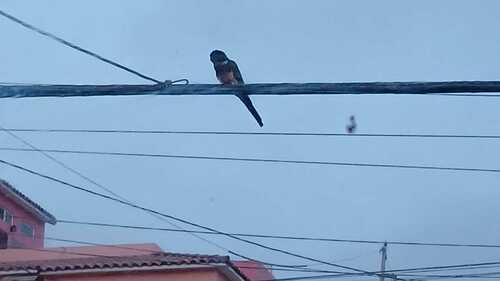 Burrowing Parakeet
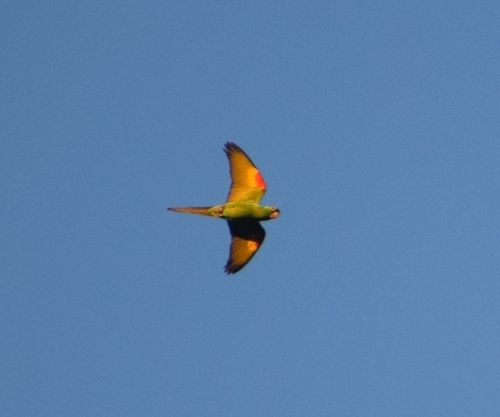 White-eyed Parakeet
In breve
The most reliable field mark to separate Burrowing Parakeet from White-eyed Parakeet is the combination of a bold, bare white eye-ring and a distinctive white breast patch on Burrowing Parakeet, versus the White-eyed Parakeet’s mostly green plumage with scattered red flecks and a less conspicuous bare eye-ring. In flight or at rest, Burrowing Parakeet shows a long, graduated tail and a striking mix of orange-red and yellow on the belly and thighs, while White-eyed Parakeet is slimmer, shorter-tailed, and lacks the strong color contrasts below. Juvenile White-eyed Parakeets lack much of the red on the head and wings, which can cause confusion, but the Burrowing Parakeet’s white breast mark and heavier build remain distinctive at all ages. Both species have bare skin around the eye, but the rest of their facial and underpart patterns are quite different if seen well.
Consigli di identificazione
- White breast patch (Burrowing Parakeet): Look for a variable but often prominent white patch on the breast, sometimes extending widely, especially in the Chilean subspecies. White-eyed Parakeet never shows this mark. Works for all ages.
- Bare white eye-ring: Burrowing Parakeet has a broad, conspicuous bare white eye-ring and post-ocular patch, standing out at a distance. White-eyed Parakeet also has bare skin around the eye, but it is narrower and less obvious, sometimes yellowish. Reliable at all ages.
- Underparts color: Burrowing Parakeet shows a striking combination of orange-red on the lower belly and yellow on the lower back, thighs, and vent. White-eyed Parakeet is green below, sometimes paler, with no strong color contrasts.
- Head and neck flecking: Adult White-eyed Parakeet has scattered red flecks on the head and neck, and red at the bend of the wing. Burrowing Parakeet lacks red on the head and has a plain olive-brown head.
- Tail shape and length: Burrowing Parakeet’s tail is long, graduated, and often appears blue-tinged from above. White-eyed Parakeet’s tail is shorter, less graduated, and olive below.
- Bill color: Burrowing Parakeet has a grey bill (immatures with a horn-colored patch on the upper mandible), while White-eyed Parakeet’s bill is always horn-colored.
- Size and structure: Burrowing Parakeet is much bulkier and longer, with a heavy, deep-chested look and long tail. White-eyed Parakeet is slimmer and more compact.
- Juvenile confusion: Juvenile White-eyed Parakeets lack most red on the head and wings, making them appear plainer, but they still lack the white breast patch and bold eye-ring of Burrowing Parakeet. Juvenile Burrowing Parakeets already show the key marks.
- Flight appearance: In flight, Burrowing Parakeet’s long tail and color contrasts below (yellow and red) are visible. White-eyed Parakeet in flight shows a mostly green body, with red at the wing bend and yellow underwing coverts if seen well.
- Habitat and range: If in Chile or southern Argentina, Burrowing Parakeet is far more likely. White-eyed Parakeet is absent from Chile and prefers more forested or urban habitats elsewhere.
- Flock behavior: Burrowing Parakeet often forages on the ground or perches on cliffs; White-eyed Parakeet is more arboreal.
- Sexual dimorphism: Burrowing Parakeet males may show brighter and more extensive red on the belly, but this is subtle and not always visible. Both sexes of White-eyed Parakeet look alike.
- Subspecies variation: Chilean Burrowing Parakeets have the brightest yellow and red underparts and the most extensive white breast patch, but all subspecies show the basic pattern. White-eyed Parakeet subspecies may vary in size and amount of red, but never show a white breast patch or strong yellow underparts.
- Perched vs. flight views: The white breast patch and underpart colors of Burrowing Parakeet are visible both perched and in flight. The red and yellow wing markings of White-eyed Parakeet are most obvious in flight or with wings spread.
- Voice: Not diagnostic with the available notes; both are noisy and social, but field separation should rely on plumage and structure.
Taglia
Burrowing Parakeet is significantly larger and heavier than White-eyed Parakeet. Adult Burrowing Parakeets reach 39–52 cm in length and are the largest New World conure, with males weighing up to 340 g (females to 304 g) [wikipedia]. In contrast, White-eyed Parakeet is smaller at 32–35 cm in length and averages 158 g [wikidata], with a maximum recorded weight of 218 g. The Burrowing Parakeet also has a much longer, more graduated tail, which is obvious both perched and in flight. The White-eyed Parakeet is slimmer, with a proportionally shorter tail and more compact jizz.
Piumaggio
- Juveniles/Immatures: Juvenile White-eyed Parakeets resemble adults but have little or no red on the head and wings, making them appear plainer green overall. Juvenile Burrowing Parakeets look like adults but have a horn-colored patch on the upper mandible and a pale grey iris, with the white breast mark and colored underparts already present [wikipedia].
- Adults: Burrowing Parakeet is olive-brown to olive-green above, with a variable but often prominent white breast patch, grey-brown throat, orange-red lower belly, and yellow on the lower back, thighs, and vent. The bare white eye-ring is bold. The tail is long and graduated, olive-green above with a blue cast. White-eyed Parakeet is mostly green, paler below, with scattered red flecks on the head and neck, red at the bend of the wing, and yellow on the outer greater underwing coverts. The bare skin around the eye is white to yellowish, but not as broad or obvious as in Burrowing Parakeet. The bill is horn-colored. No strong breast patch or contrasting underparts. Subspecies variation in both, but these marks are consistent.
Comportamento
Burrowing Parakeet is often seen in noisy, tight flocks, sometimes on the ground or perched on cliffs and banks where it nests in burrows. Its flight is strong and direct, with the long tail trailing behind. White-eyed Parakeet is also gregarious, forming flocks, but is more arboreal and less likely to be seen on the ground. Its flight is swift, with a more compact appearance due to the shorter tail. Both species are social and vocal, but Burrowing Parakeet’s larger size and heavier flight style stand out.
Habitat
Burrowing Parakeet is native to Argentina and Chile, often found in open country, steppe, and areas with cliffs or riverbanks for nesting [wikipedia]. It is absent from most of tropical South America. White-eyed Parakeet is widespread across South America except Chile, occurring in a wide range of habitats from forest edges and savannas to urban parks and plantations [wikipedia]. Thus, Burrowing Parakeet is highly localized, while White-eyed Parakeet is far more widespread and adaptable.
Burrowing Parakeet · White-eyed Parakeet · I miei uccelli difficili