

Black-winged Petrel vs Gould's Petrel
Pterodroma nigripennis contro Pterodroma leucoptera
Fai un quiz con Black-winged Petrel e Gould's Petrel
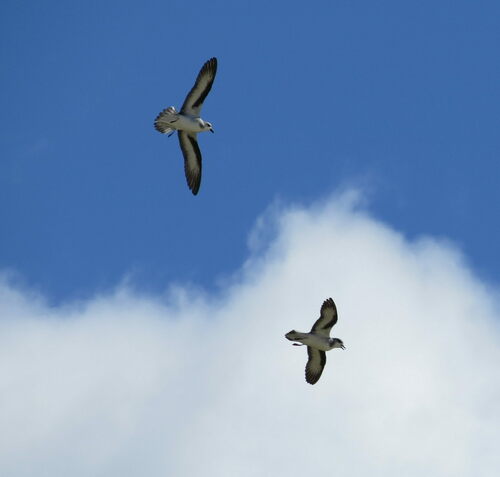 Black-winged Petrel
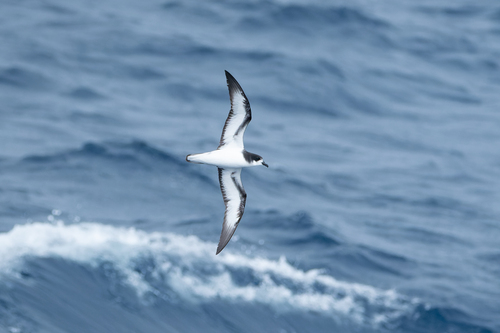 Gould's Petrel
In breve
Il segno distintivo più affidabile tra Black-winged Petrel e Gould's Petrel è il pattern delle ali superiori in volo: Gould's Petrel mostra una distintiva forma scura a 'M' o 'W' sulle ali superiori, mentre Black-winged Petrel non ha questo segno e ha invece un'ala superiore grigia chiara più uniforme con bordi esterni scuri. Entrambi sono petrelli piccoli e con ali lunghe con parti inferiori bianche, ma Gould's Petrel ha una testa visibilmente più scura con una fronte e un viso bianchi, mentre Black-winged Petrel ha un cappuccio e una nuca grigia chiara con guance bianche e un collare scuro. Le differenze strutturali sono sottili, ma Gould's Petrel tende ad essere leggermente più grande e pesante. Prestare attenzione al pattern delle ali e ai segni sulla testa, specialmente in volo, è fondamentale per separare queste due specie.
Consigli di identificazione
- Look for the dark 'M' or 'W' on the upperwings in flight: Gould's Petrel (all ages) shows a bold dark pattern across the upperwings, while Black-winged Petrel lacks this and instead has a more uniform pale grey upperwing with dark outer edges. This is the most reliable mark in flight.
- Check the head pattern: Gould's Petrel has a noticeably dark head with a white forehead and face, creating a sharp contrast. Black-winged Petrel's head is paler, with a pale grey cap and nape, white cheeks, and a dark collar, resulting in a softer, less contrasting look.
- Assess the underwing: Black-winged Petrel has black outer edges to the underwing, while Gould's Petrel (especially New Caledonian subspecies) may show reduced pigmentation here, but this is subtle and variable.
- Tail shape and pattern: Black-winged Petrel has a square-cut, black-and-white barred tail. Gould's Petrel's tail is shorter and more rounded, and some subspecies show white or mainly white inner vanes on the outer tail feathers.
- Structure and jizz: Both species are long-winged and slender, but Gould's Petrel may look slightly bulkier and has a shorter, rounder tail. These differences are subtle and best used in direct comparison.
- Size: Gould's Petrel is marginally larger and heavier, but this is rarely apparent unless birds are side by side.
- Sex and age: Males of Gould's Petrel are slightly larger, but sex differences are not useful in the field. Both species show similar plumage across ages, except for the diagnostic upperwing pattern in Gould's Petrel.
- Plumage pitfalls: Both species are white below and dark above, which can lead to confusion at a distance. Focus on the upperwing pattern and head contrast rather than overall color.
- Habitat and context: If seen breeding, note the location: Gould's Petrel breeds mainly off eastern Australia and New Caledonia, while Black-winged Petrel has a wider Pacific range. At sea, range overlap is possible.
- Behavior: Feeding behavior is similar and not diagnostic; both may be seen skimming or pattering at the surface.
- Voice: No diagnostic vocal differences are noted in the available sources.
- Season: Both are pelagic outside the breeding season; breeding timing and location may help if known, but are not visible in the field.
- Subspecies variation: Some Gould's Petrel subspecies (e.g., New Caledonian) are paler above and have more white in the tail, but the upperwing 'M' remains the key mark.
- When in doubt: Prioritize the upperwing pattern in flight and the head/face contrast when perched or on the water.
- Common pitfalls: Do not rely on overall size or general darkness above; these are too variable and overlap between the species.
Taglia
Gould's Petrel è marginalmente più grande, misurando circa 30 cm di lunghezza con un'apertura alare di 70 cm e pesando 180–200 g, mentre Black-winged Petrel ha una lunghezza media di 29 cm, un'apertura alare di 67 cm e una massa di 167 g. Queste differenze sono lievi e non sempre evidenti sul campo, quindi la dimensione da sola non è un separatore affidabile. Entrambe le specie sono petrelli piccoli e snelli con ali lunghe e strette, ma Gould's Petrel può apparire leggermente più robusto, specialmente in confronto diretto.
Piumaggio
- Immature and adult flight views: Gould's Petrel di tutte le età mostra un audace pattern scuro a 'M' o 'W' sulle ali superiori, formato dalla colorazione marrone scuro e grigia tipica del gruppo Cookilaria. Questo segno è visibile sia nei giovani che negli adulti ed è il miglior segno di campo in volo. Black-winged Petrel non ha questo pattern 'M'; invece, le sue ali superiori sono grigie chiare vicino alla base con grigio scuro lungo il bordo esterno, dando un aspetto più uniforme e meno decorato.
- Head and face: Gould's Petrel ha una testa visibilmente scura con una fronte e un viso bianchi, creando un forte contrasto. Black-winged Petrel ha un cappuccio e una nuca grigia chiara, guance bianche e un collare grigio scuro, risultando in un pattern facciale meno contrastante e più dolcemente sfumato.
- Underparts: Entrambe le specie sono bianche sotto, ma l'ala inferiore di Gould's Petrel può mostrare meno pigmentazione in alcune sottospecie (in particolare la forma della Nuova Caledonia), mentre Black-winged Petrel ha bordi esterni neri sull'ala inferiore.
- Tail: La coda di Black-winged Petrel è squadrata e a strisce bianche e nere; Gould's Petrel ha una coda corta e arrotondata, e in alcune sottospecie, le piume esterne della coda hanno vani interni bianchi o principalmente bianchi.
- Sex/age variation: I maschi di Gould's Petrel sono leggermente più grandi, ma le differenze di piumaggio tra i sessi sono minime e non costituiscono un segno di campo affidabile.
Comportamento
Entrambe le specie sono pelagiche e trascorrono la maggior parte della loro vita in mare, venendo a terra solo per riprodursi. Black-winged Petrel è noto per scivolare e battere sulla superficie dell'acqua durante l'alimentazione, spesso associandosi ad altri Procellariiformi. Il comportamento di Gould's Petrel è simile, senza differenze comportamentali significative notate nelle fonti che potrebbero separarle in modo affidabile in mare o a terra.
Habitat
Entrambe le specie nidificano su isole oceaniche nel Pacifico sudoccidentale, con alcune sovrapposizioni nell'area di nidificazione (ad es., Isola di Lord Howe, Nuova Caledonia). Black-winged Petrel ha un'area non riproduttiva più ampia, migrando più a nord nel Pacifico centrale (tra Perù e Hawaii), mentre Gould's Petrel è più localizzato, nidificando principalmente al largo dell'Australia orientale e della Nuova Caledonia. Tuttavia, in mare, i loro habitat sono simili e non costituiscono un forte separatore sul campo.
Black-winged Petrel · Gould's Petrel · I miei uccelli difficili