

Petrel Alinegro vs Petrel Aliblanco
Pterodroma nigripennis frente a Pterodroma leucoptera
Juega un quiz con Petrel Alinegro y Petrel Aliblanco
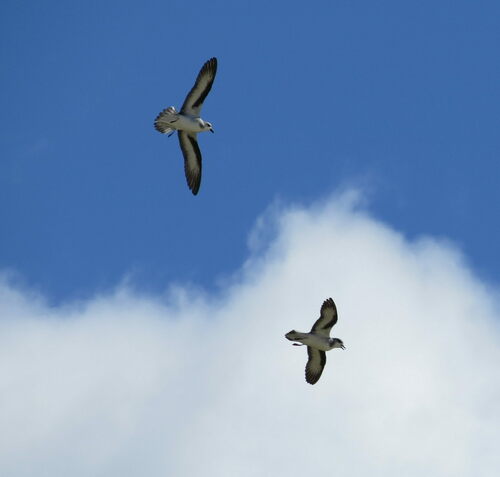 Petrel Alinegro
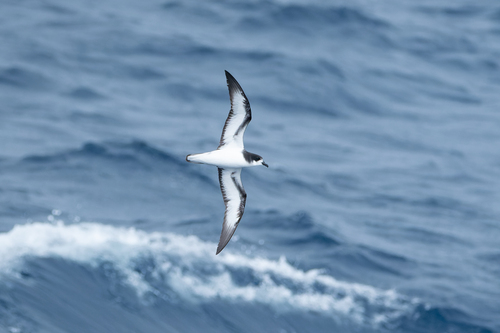 Petrel Aliblanco
En breve
La marca de campo más confiable entre el Petrel Alinegro y el Petrel Aliblanco es el patrón del ala superior en vuelo: el Petrel Aliblanco muestra una distintiva forma oscura de 'M' o 'W' a través de las alas superiores, mientras que el Petrel Alinegro carece de esta marca y, en cambio, tiene un ala superior de un gris pálido más uniforme con bordes oscuros. Ambos son petreles pequeños y de alas largas con partes inferiores blancas, pero el Petrel Aliblanco tiene una cabeza notablemente más oscura con una frente y cara blancas, mientras que el Petrel Alinegro tiene una gorra y nuca gris pálido con mejillas blancas y un collar oscuro. Las diferencias estructurales son sutiles, pero el Petrel Aliblanco tiende a ser ligeramente más grande y pesado. Prestar atención cuidadosa al patrón del ala y las marcas de la cabeza, especialmente en vuelo, es clave para separar estas dos especies.
Consejos de identificación
- Busca la 'M' o 'W' oscura en las alas superiores en vuelo: El Petrel Aliblanco (todas las edades) muestra un patrón oscuro audaz a través de las alas superiores, mientras que el Petrel Alinegro carece de esto y, en cambio, tiene un ala superior de un gris pálido más uniforme con bordes oscuros. Esta es la marca más confiable en vuelo.
- Revisa el patrón de la cabeza: El Petrel Aliblanco tiene una cabeza notablemente oscura con una frente y cara blancas, creando un fuerte contraste. La cabeza del Petrel Alinegro es más pálida, con una gorra y nuca gris pálido, mejillas blancas y un collar oscuro, lo que resulta en un aspecto más suave y menos contrastante.
- Evalúa el ala inferior: El Petrel Alinegro tiene bordes exteriores negros en el ala inferior, mientras que el Petrel Aliblanco (especialmente la subespecie de Nueva Caledonia) puede mostrar una pigmentación reducida aquí, pero esto es sutil y variable.
- Forma y patrón de la cola: El Petrel Alinegro tiene una cola cuadrada y barrada en negro y blanco. La cola del Petrel Aliblanco es más corta y redondeada, y algunas subespecies muestran plumas internas blancas o principalmente blancas en las plumas exteriores de la cola.
- Estructura y apariencia: Ambas especies son de alas largas y esbeltas, pero el Petrel Aliblanco puede parecer ligeramente más robusto y tiene una cola más corta y redondeada. Estas diferencias son sutiles y se utilizan mejor en comparación directa.
- Tamaño: El Petrel Aliblanco es marginalmente más grande y pesado, pero esto rara vez es evidente a menos que los pájaros estén uno al lado del otro.
- Sexo y edad: Los machos del Petrel Aliblanco son ligeramente más grandes, pero las diferencias de sexo no son útiles en el campo. Ambas especies muestran plumaje similar a través de las edades, excepto por el patrón diagnóstico del ala superior en el Petrel Aliblanco.
- Trampas de plumaje: Ambas especies son blancas por debajo y oscuras por arriba, lo que puede llevar a confusión a distancia. Concéntrate en el patrón del ala superior y el contraste de la cabeza en lugar del color general.
- Hábitat y contexto: Si se ven reproduciéndose, nota la ubicación: el Petrel Aliblanco se reproduce principalmente frente a la costa este de Australia y Nueva Caledonia, mientras que el Petrel Alinegro tiene un rango más amplio en el Pacífico. En el mar, la superposición de rangos es posible.
- Comportamiento: El comportamiento de alimentación es similar y no es diagnóstico; ambos pueden ser vistos deslizándose o picoteando en la superficie.
- Voz: No se notan diferencias vocales diagnósticas en las fuentes disponibles.
- Temporada: Ambas son pelágicas fuera de la temporada de reproducción; el momento y la ubicación de la reproducción pueden ayudar si se conocen, pero no son visibles en el campo.
- Variación de subespecies: Algunas subespecies del Petrel Aliblanco (por ejemplo, la de Nueva Caledonia) son más pálidas por encima y tienen más blanco en la cola, pero la 'M' del ala superior sigue siendo la marca clave.
- Cuando tengas dudas: Prioriza el patrón del ala superior en vuelo y el contraste de la cabeza/cara cuando estén posados o en el agua.
- Trampas comunes: No confíes en el tamaño general o la oscuridad general por encima; estos son demasiado variables y se superponen entre las especies.
Tamaño
Petrel Aliblanco is marginally larger, measuring about 30 cm in length with a 70 cm wingspan and weighing 180–200 g, while Petrel Alinegro averages 29 cm in length, 67 cm wingspan, and 167 g in mass. These differences are slight and not always apparent in the field, so size alone is not a reliable separator. Both species are small, slender petrels with long, narrow wings, but Petrel Aliblanco may appear a touch bulkier, especially in direct comparison.
Plumaje
- Immature and adult flight views: Petrel Aliblanco of all ages shows a bold dark 'M' or 'W' pattern across the upperwings, formed by the dark brown and grey coloration typical of the Cookilaria group. This mark is visible in both juveniles and adults and is the single best field mark in flight. Petrel Alinegro lacks this 'M' pattern; instead, its upperwings are pale grey near the base with dark greyish-black along the outer edge, giving a more uniform and less patterned look.
- Head and face: Petrel Aliblanco has a noticeably dark head with a white forehead and face, creating a strong contrast. Petrel Alinegro has a pale grey cap and nape, white cheeks, and a dark grey collar, resulting in a less contrasting and more softly blended facial pattern.
- Underparts: Both species are white below, but Petrel Aliblanco's underwing may show less pigmentation in some subspecies (notably the New Caledonian form), while Petrel Alinegro has black outer edges to the underwing.
- Tail: Petrel Alinegro's tail is square-cut and barred black and white; Petrel Aliblanco has a short, rounded tail, and in some subspecies, the outer tail feathers have white or mostly white inner vanes.
- Sex/age variation: Males of Petrel Aliblanco are slightly larger, but plumage differences between sexes are minimal and not a reliable field mark.
Comportamiento
Ambas especies son pelágicas y pasan la mayor parte de sus vidas en el mar, solo viniendo a tierra para reproducirse. El Petrel Alinegro es conocido por deslizarse y picotear en la superficie del agua al alimentarse, a menudo asociándose con otros Procellariiformes. El comportamiento del Petrel Aliblanco es similar, sin diferencias de comportamiento importantes notadas en las fuentes que los separarían de manera confiable en el mar o en tierra.
Hábitat
Ambas especies se reproducen en islas oceánicas en el suroeste del Pacífico, con cierta superposición en el rango de reproducción (por ejemplo, Isla Lord Howe, Nueva Caledonia). El Petrel Alinegro tiene un rango no reproductivo más amplio, migrando más al norte hacia el Pacífico central (entre Perú y Hawái), mientras que el Petrel Aliblanco es más localizado, reproduciéndose principalmente frente a la costa este de Australia y Nueva Caledonia. Sin embargo, en el mar, sus hábitats son similares y no son un fuerte separador en el campo.