

Rousserolle à gros bec vs Hypolaïs rama
Arundinax aedon contre Iduna rama
Faire un quiz avec Rousserolle à gros bec et Hypolaïs rama
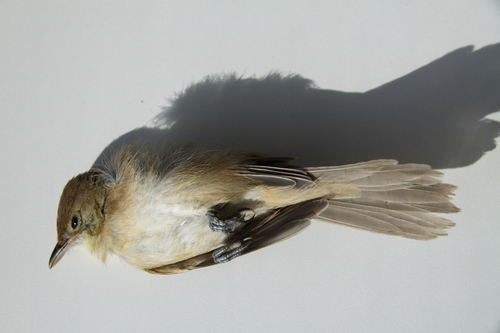 Rousserolle à gros bec
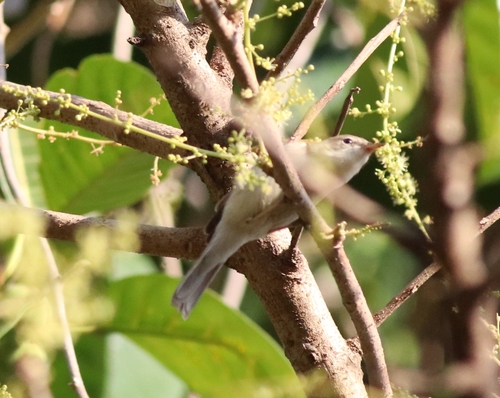 Hypolaïs rama
En bref
The most reliable field mark to separate Thick-billed Warbler from Sykes's Warbler is overall size and structure: Thick-billed is a notably larger, bulkier bird with a distinctly rounded forehead and a short, thick bill, while Sykes's is smaller, slimmer, and more delicate, with a pointed bill and a pale supercilium. Both species are rather plain brown above and pale below, but Thick-billed lacks the obvious supercilium and has a more uniform, unstreaked look. Juvenile Thick-billed Warblers are richer buff below, which can cause confusion with Sykes's, but the size and structure differences remain clear. In the field, focus on bill shape, head profile, and overall bulk, especially when plumage is not distinctive.
Conseils d’identification
- Size and bulk: Thick-billed Warbler is much larger and heavier than Sykes's Warbler. If the bird appears nearly as big as a Great Reed Warbler, it's Thick-billed; Sykes's is always smaller and slimmer.
- Bill shape: Thick-billed has a short, thick, and pointed bill, giving a strong, blunt look. Sykes's has a strong but more pointed bill, less thick at the base.
- Head profile: Thick-billed Warbler shows a distinctly rounded forehead, making the head appear large and domed. Sykes's has a flatter crown and a less pronounced forehead.
- Supercilium: Sykes's Warbler shows a short, pale supercilium (eyebrow line), which is usually visible in good light. Thick-billed lacks a strong supercilium, with a more uniform face.
- Plumage tone: Thick-billed is unstreaked brown above and buff below, with little contrast or pattern. Sykes's is paler brown above, whitish below, and has buff flanks, giving a slightly more contrasting look.
- Juvenile underparts: Young Thick-billed Warblers are richer buff below, which can overlap with Sykes's, but structure and bill shape still separate them.
- Tail pattern: Sykes's Warbler has pale edges to the outer tail feathers, which can be seen in good views or in flight. Thick-billed's tail is plain.
- Sex differences: Both species are sexually monomorphic; do not rely on sex for identification.
- Flight jizz: Thick-billed Warbler appears heavier and less agile in flight, while Sykes's is lighter and more fluttery.
- Habitat: Both use dense vegetation, but Thick-billed is a rare vagrant in western Europe; Sykes's is more regular in its range.
- Voice: If you hear a loud, fast, mimicry-rich song with acrocephaline whistles, suspect Thick-billed. Sykes's song is not described here.
- Context: If you are in the core breeding range, Sykes's is more likely unless you have clear evidence for Thick-billed's larger size and structure.
- Pitfalls: Do not rely solely on underpart color in juveniles; always check size, bill, and head shape.
- No distinctive wing pattern: Neither species shows a diagnostic upperwing or flight mark, so focus on structure and facial pattern.
- Direct comparison: If both species are present, the size and bulk difference is immediately obvious; if alone, use a mental comparison to Reed or Booted Warbler for scale.
Taille
Thick-billed Warbler is substantially larger (16–17.5 cm in length, body mass about 22 g) and nearly as big as a Great Reed Warbler. Sykes's Warbler is much smaller and lighter, with a more delicate build. In direct comparison, Thick-billed appears bulkier and heavier, with a proportionally bigger head and stouter bill. Sykes's is noticeably slimmer and more agile in appearance.
Plumage
- Juveniles: Young Thick-billed Warblers are richer buff on the underparts, which can overlap with the buff flanks of Sykes's, but Thick-billed still lacks a strong supercilium and remains plainer above. Sykes's juveniles are not described in detail, but adults are pale brown above and whitish below with buff flanks.
- Adults: Thick-billed Warbler has an unstreaked brown back and buff underparts, with very few distinctive plumage features. The forehead is rounded, and there is no strong supercilium. Sykes's Warbler is paler brown above, whitish below with buff flanks, and shows a short, pale supercilium. The outer tail feathers of Sykes's have pale edges, which can be visible in good views. Both species are rather plain, but Sykes's is subtly greyer and shows more contrast between upperparts and underparts.
- Wing pattern: No distinctive upperwing or flight marks are described for either species, so separation relies on overall color, head pattern, and structure.
Comportement
Both species are typically found in dense vegetation and can be skulking, but Thick-billed Warbler, due to its larger size, often appears more robust and less agile in movement. Sykes's Warbler, being smaller and slimmer, tends to move more nimbly through reeds and bushes. In flight, Thick-billed Warbler may look heavier and less buoyant compared to the lighter, more fluttery Sykes's.
Habitat
Thick-billed Warbler breeds in dense vegetation such as reeds, bushes, and thick undergrowth in the temperate east Palearctic, and is a rare vagrant to western Europe. Sykes's Warbler breeds from northeast Arabia to west China and Afghanistan, often in similar dense, shrubby habitats. In areas of overlap, habitat is not a reliable separator, but Thick-billed is much rarer in the west.
Voix
Thick-billed Warbler has a fast, loud song with mimicry and acrocephaline whistles, similar to Marsh Warbler. Sykes's Warbler's song is not described in the provided notes, so vocalization is not a reliable separator here unless Thick-billed's mimicry and volume are noted.
Rousserolle à gros bec · Hypolaïs rama · Mes oiseaux difficiles