

Goéland railleur vs Mouette atricille
Chroicocephalus genei contre Leucophaeus atricilla
Faire un quiz avec Goéland railleur et Mouette atricille
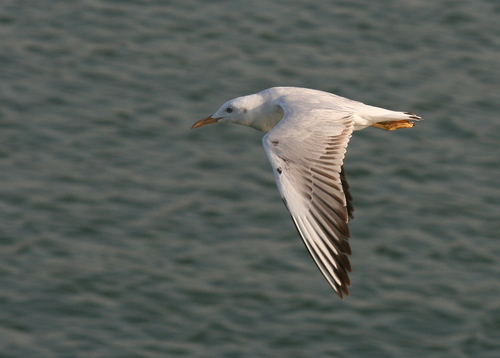 Goéland railleur
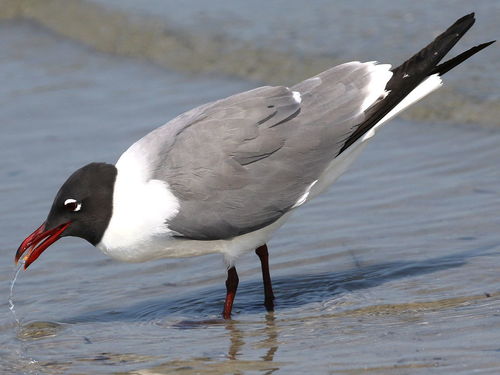 Mouette atricille
En bref
The most reliable field mark between Slender-billed Gull and Laughing Gull is the presence or absence of a black hood in breeding adults: Laughing Gull has a full black hood in summer, while Slender-billed Gull never does. For immatures and non-breeding birds, focus on the tail and wing pattern: first-year Laughing Gulls have an all-black tail and darker underparts, while first-year Slender-billed Gulls show a black tail band and paler overall look. Structurally, Slender-billed Gull appears more elongated with a long, thin bill and neck, while Laughing Gull is chunkier with a heavier, shorter bill. Both species can be confused in flight or at a distance, especially among immatures, but careful attention to head, bill, and tail patterns will separate them.
Conseils d’identification
- Breeding adult head pattern: Laughing Gull has a full black hood in summer; Slender-billed Gull always has a white head, sometimes with a faint pinkish wash on the breast.
- Bill shape and color: Slender-billed Gull has a long, slender, dark red bill with a tapered look; Laughing Gull's bill is also long and red but appears heavier and less tapered.
- Neck and jizz: Slender-billed Gull looks long-necked and elongated, especially when perched or swimming; Laughing Gull is more compact and thick-necked.
- First-year tail pattern: First-year Laughing Gulls have an all-black tail; first-year Slender-billed Gulls have a black terminal tail band with the rest of the tail pale.
- Immature underparts: Laughing Gull immatures are darker below than Slender-billed, which appear paler and cleaner.
- Second-year wing pattern: Second-year Laughing Gulls may show more extensive black on the primary coverts and some black in the tail; Slender-billed second-years are paler and lose most of the tail band.
- Adult upperparts: Laughing Gull has a dark gray back and wings, noticeably darker than Slender-billed Gull's pale gray upperparts.
- Wingtip pattern: Both have black wingtips, but Laughing Gull's wings are overall much darker gray; Slender-billed Gull's are paler with black only at the tips.
- Leg color: Both species have dark red legs, but this is not a strong separator.
- Eye color: Slender-billed Gull has a yellow iris; Laughing Gull's iris color is not specified as diagnostic.
- Non-breeding head: In winter, Laughing Gull loses most of the hood but may retain a dark ear spot; Slender-billed Gull remains white-headed.
- Size and bulk: Laughing Gull is slightly larger and bulkier, but this is subtle and best used in direct comparison.
- Habitat context: Slender-billed Gull is expected around Mediterranean lagoons and lakes; Laughing Gull is coastal in the Americas and often found at landfills and beaches.
- Vocalization: A laughing, raucous call is diagnostic for Laughing Gull; Slender-billed Gull is quieter and less distinctive vocally.
- Geographic range: Use range as a supporting clue—Slender-billed is rare in the Americas, Laughing Gull is rare in Europe, but vagrants do occur.
Taille
Laughing Gull is slightly larger and heavier than Slender-billed Gull, with a mean body mass of 300 g versus 255.5 g. Their lengths and wingspans overlap (Slender-billed: 37–40 cm, 90–102 cm wingspan; Laughing: 36–41 cm, 98–110 cm wingspan), but Laughing Gull tends to look bulkier and more robust, especially in direct comparison. In the field, this size difference is subtle and not always reliable for single birds.
Plumage
Juvenile and first-year birds are best separated by tail and wing pattern: first-year Laughing Gulls have an all-black tail, while first-year Slender-billed Gulls show a black terminal tail band with the rest of the tail pale. Both have dark areas on the wings, but Laughing Gull immatures are overall darker below and have paler heads compared to Franklin's Gull, but are darker than Slender-billed. Second-year Laughing Gulls may retain some black in the tail and have more extensive black on the primary coverts, while Slender-billed second-years lose most of the tail band and look paler. In adults, breeding Laughing Gulls have a full black hood, dark gray mantle and wings, and a long red bill; Slender-billed Gulls have a white head (never hooded), pale gray upperparts, and a long, slender dark red bill. In winter, Laughing Gulls lose most of the hood but retain a darker ear spot, while Slender-billed remains white-headed. Both species have black wingtips, but Laughing Gull's wings are a much darker gray overall.
Comportement
Both species are gregarious and often found in flocks, especially outside the breeding season. Slender-billed Gull is less likely to be seen far from land and often forages by diving for fish or probing mud for invertebrates. Laughing Gull is an opportunistic scavenger, commonly seen at landfills, beaches, and following boats. In flight, Slender-billed Gull appears more graceful and elongated, with a long neck and bill, while Laughing Gull looks chunkier and more direct.
Habitat
Slender-billed Gull is a local breeder around the Mediterranean and northwestern Indian Ocean, favoring coastal lagoons, islands, and lakes, and winters in estuaries and bays. Laughing Gull is found along the Atlantic coasts of North and South America, the Caribbean, and breeds in large colonies on low-lying coastal islands. It is more likely to be found inland at landfills or following human activity. Vagrants of both species can occur in each other's range, but context usually helps: Slender-billed is rare in the Americas, Laughing Gull is rare in Europe.
Voix
Laughing Gull is named for its distinctive, raucous, laugh-like call ('ha... ha... ha...'), which is a strong clue if heard. Slender-billed Gull's calls are not described as diagnostic in the notes and are less likely to draw attention by sound alone.
Goéland railleur · Mouette atricille · Mes oiseaux difficiles