

Motmot

Chevêchette naine vs Chevêchette du Costa Rica

Glaucidium gnoma contre Glaucidium costaricanum

Faire un quiz avec Chevêchette naine et Chevêchette du Costa Rica
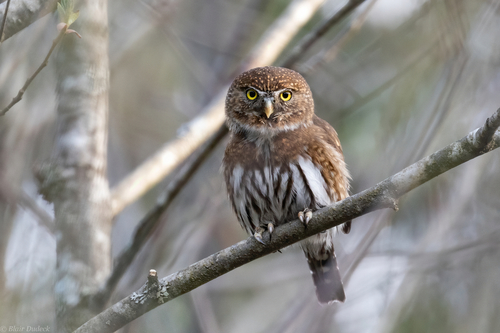
Chevêchette naine (Glaucidium gnoma) Chevêchette naine
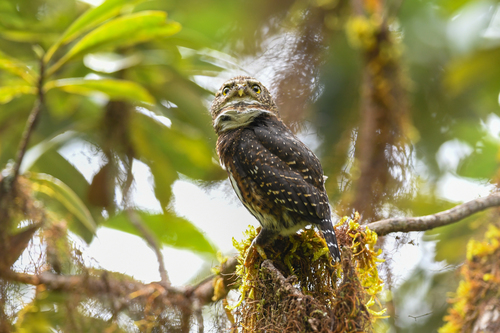
Chevêchette du Costa Rica (Glaucidium costaricanum) Chevêchette du Costa Rica

Médias

Chargement…

En bref

The most reliable separation between Northern Pygmy-Owl and Costa Rican Pygmy-Owl is geography: Northern Pygmy-Owl is found in western North America, while Costa Rican Pygmy-Owl is limited to Costa Rica and Panama. In direct field views, both are small, round-headed owls with yellow eyes and prominent black nape 'eyespots,' but subtle differences in tail pattern, underpart streaking, and facial markings can help. Northern Pygmy-Owl tends to show strong vertical streaking on the underparts and a longer tail, while Costa Rican Pygmy-Owl has a banded tail with a white tip and less prominent streaking. Both species have brown and rufous morphs, so color alone is not diagnostic. Voice, behavior, and habitat context can also assist, but visual marks are subtle and require careful study.

Conseils d’identification

  1. Range is the most decisive mark: Northern Pygmy-Owl occurs only in western North America, while Costa Rican Pygmy-Owl is found only in Costa Rica and Panama. If you are outside the range of one, the ID is clear.
  2. Tail pattern: Costa Rican Pygmy-Owl shows a distinctly banded tail with four white bars and a white tip, visible when perched or in flight. Northern Pygmy-Owl's tail is long and dark, lacking strong white banding, and may appear proportionally longer.
  3. Underpart streaking: Northern Pygmy-Owl has strong, dark vertical streaks on a white breast and belly, especially pronounced from the upper breast down. Costa Rican Pygmy-Owl's underparts are white, but the flanks are colored like the upperparts and streaking is less prominent.
  4. Facial disc: Costa Rican Pygmy-Owl's facial disc is the base color (brown or rufous) with narrow buff and white marks, giving a more patterned face. Northern Pygmy-Owl's facial disc is weakly defined and less contrasting.
  5. Nape 'eyespots': Both species have black nape spots bordered in white, so this is not a separator.
  6. Head spotting: Both have white-spotted heads, but this is not a reliable separator between the two.
  7. Bill color: Both have yellowish bills, but Costa Rican Pygmy-Owl's mandible is light brown with a yellow tip; this is subtle and rarely visible in the field.
  8. Legs and feet: Both have yellow feet and feathered legs; not a separator.
  9. Color morphs: Both species show brown and rufous morphs; do not use overall color alone for ID.
  10. Perching behavior: Northern Pygmy-Owl often perches high atop conifers, especially when calling; Costa Rican Pygmy-Owl tends to hunt from lower, denser perches.
  11. Flight sound: Northern Pygmy-Owl's flight is not silent and may produce a buzzing or whirring sound, but this is rarely diagnostic in the field.
  12. Habitat context: Northern Pygmy-Owl is found in temperate forests, often at higher elevations in coniferous woods. Costa Rican Pygmy-Owl is found in tropical montane or foothill forests.
  13. Activity: Costa Rican Pygmy-Owl is known to hunt both day and night, while Northern Pygmy-Owl is more often diurnal or crepuscular.
  14. Size and structure: Both are similar in size, but Northern Pygmy-Owl may look slightly longer-tailed; this is subtle and best used in direct comparison.
  15. Juvenile/immature plumage: No distinctive age-specific upperwing or flight pattern marks are described for either species, so focus on the above marks for all ages.

Taille

Both species are very similar in size, with overlapping length ranges: Northern Pygmy-Owl measures 15–17 cm in length, while Costa Rican Pygmy-Owl is 14.5–17 cm. Males of Costa Rican Pygmy-Owl weigh 53–70 g, females up to 99 g, but weight is rarely useful in the field. Structurally, Northern Pygmy-Owl may appear slightly longer-tailed, but this is subtle and best judged in direct comparison.

Plumage

No age-specific upperwing or flight pattern marks are described for either species, so focus is on perched birds. Both species have two black nape spots bordered in white ('eyespots'), yellow eyes, and similar color morphs (brown or rufous). Northern Pygmy-Owl shows a round, white-spotted head, weakly defined facial disc, and a long, dark tail. Its underparts are white with strong, dark vertical streaking from the upper breast down. Costa Rican Pygmy-Owl also has a spotted head and 'eyespots,' but its tail is distinctly banded with four white bars and a white tip, and the underparts are white with the flanks matching the upperparts' color. The facial disc of Costa Rican Pygmy-Owl is the base color with narrow buff and white marks, while Northern Pygmy-Owl's facial disc is less distinct. Both have yellowish bills, but Costa Rican Pygmy-Owl's mandible is light brown with a yellow tip.

Comportement

Northern Pygmy-Owl often perches conspicuously atop tall conifers to call, making it easier to spot in open or sloped terrain, but its small size and cryptic color make it hard to see. Its flight is not silent, producing a buzzing or whirring sound. Costa Rican Pygmy-Owl typically hunts from low perches in dense foliage and is active both day and night. Both species may swish their tails when agitated, and both use tree cavities for nesting. Northern Pygmy-Owl's tendency to perch high and call may make it more visible than the more secretive Costa Rican Pygmy-Owl.

Habitat

Northern Pygmy-Owl is found in a wide range of wooded habitats in western North America, often in coniferous forests. Costa Rican Pygmy-Owl is restricted to Costa Rica and Panama, typically in montane or foothill forests. If you are outside the range of one species, that alone is diagnostic. Both species use tree cavities for nesting, but the habitat context (temperate vs. tropical montane forest) is a strong clue.

Envoyer une meilleure description

Utilise les mêmes sections que la comparaison. Ton texte est publié tout de suite.

The most reliable separation between Northern Pygmy-Owl and Costa Rican Pygmy-Owl is geography: Northern Pygmy-Owl is found in western North America, while Costa Rican Pygmy-Owl is limited to Costa Rica and Panama. In direct field views, both are small, round-headed owls with yellow eyes and prominent black nape 'eyespots,' but subtle differences in tail pattern, underpart streaking, and facial markings can help. Northern Pygmy-Owl tends to show strong vertical streaking on the underparts and a longer tail, while Costa Rican Pygmy-Owl has a banded tail with a white tip and less prominent streaking. Both species have brown and rufous morphs, so color alone is not diagnostic. Voice, behavior, and habitat context can also assist, but visual marks are subtle and require careful study.

  1. Range is the most decisive mark: Northern Pygmy-Owl occurs only in western North America, while Costa Rican Pygmy-Owl is found only in Costa Rica and Panama. If you are outside the range of one, the ID is clear.
  2. Tail pattern: Costa Rican Pygmy-Owl shows a distinctly banded tail with four white bars and a white tip, visible when perched or in flight. Northern Pygmy-Owl's tail is long and dark, lacking strong white banding, and may appear proportionally longer.
  3. Underpart streaking: Northern Pygmy-Owl has strong, dark vertical streaks on a white breast and belly, especially pronounced from the upper breast down. Costa Rican Pygmy-Owl's underparts are white, but the flanks are colored like the upperparts and streaking is less prominent.
  4. Facial disc: Costa Rican Pygmy-Owl's facial disc is the base color (brown or rufous) with narrow buff and white marks, giving a more patterned face. Northern Pygmy-Owl's facial disc is weakly defined and less contrasting.
  5. Nape 'eyespots': Both species have black nape spots bordered in white, so this is not a separator.
  6. Head spotting: Both have white-spotted heads, but this is not a reliable separator between the two.
  7. Bill color: Both have yellowish bills, but Costa Rican Pygmy-Owl's mandible is light brown with a yellow tip; this is subtle and rarely visible in the field.
  8. Legs and feet: Both have yellow feet and feathered legs; not a separator.
  9. Color morphs: Both species show brown and rufous morphs; do not use overall color alone for ID.
  10. Perching behavior: Northern Pygmy-Owl often perches high atop conifers, especially when calling; Costa Rican Pygmy-Owl tends to hunt from lower, denser perches.
  11. Flight sound: Northern Pygmy-Owl's flight is not silent and may produce a buzzing or whirring sound, but this is rarely diagnostic in the field.
  12. Habitat context: Northern Pygmy-Owl is found in temperate forests, often at higher elevations in coniferous woods. Costa Rican Pygmy-Owl is found in tropical montane or foothill forests.
  13. Activity: Costa Rican Pygmy-Owl is known to hunt both day and night, while Northern Pygmy-Owl is more often diurnal or crepuscular.
  14. Size and structure: Both are similar in size, but Northern Pygmy-Owl may look slightly longer-tailed; this is subtle and best used in direct comparison.
  15. Juvenile/immature plumage: No distinctive age-specific upperwing or flight pattern marks are described for either species, so focus on the above marks for all ages.

Both species are very similar in size, with overlapping length ranges: Northern Pygmy-Owl measures 15–17 cm in length, while Costa Rican Pygmy-Owl is 14.5–17 cm. Males of Costa Rican Pygmy-Owl weigh 53–70 g, females up to 99 g, but weight is rarely useful in the field. Structurally, Northern Pygmy-Owl may appear slightly longer-tailed, but this is subtle and best judged in direct comparison.

No age-specific upperwing or flight pattern marks are described for either species, so focus is on perched birds. Both species have two black nape spots bordered in white ('eyespots'), yellow eyes, and similar color morphs (brown or rufous). Northern Pygmy-Owl shows a round, white-spotted head, weakly defined facial disc, and a long, dark tail. Its underparts are white with strong, dark vertical streaking from the upper breast down. Costa Rican Pygmy-Owl also has a spotted head and 'eyespots,' but its tail is distinctly banded with four white bars and a white tip, and the underparts are white with the flanks matching the upperparts' color. The facial disc of Costa Rican Pygmy-Owl is the base color with narrow buff and white marks, while Northern Pygmy-Owl's facial disc is less distinct. Both have yellowish bills, but Costa Rican Pygmy-Owl's mandible is light brown with a yellow tip.

Northern Pygmy-Owl often perches conspicuously atop tall conifers to call, making it easier to spot in open or sloped terrain, but its small size and cryptic color make it hard to see. Its flight is not silent, producing a buzzing or whirring sound. Costa Rican Pygmy-Owl typically hunts from low perches in dense foliage and is active both day and night. Both species may swish their tails when agitated, and both use tree cavities for nesting. Northern Pygmy-Owl's tendency to perch high and call may make it more visible than the more secretive Costa Rican Pygmy-Owl.

Northern Pygmy-Owl is found in a wide range of wooded habitats in western North America, often in coniferous forests. Costa Rican Pygmy-Owl is restricted to Costa Rica and Panama, typically in montane or foothill forests. If you are outside the range of one species, that alone is diagnostic. Both species use tree cavities for nesting, but the habitat context (temperate vs. tropical montane forest) is a strong clue.

Abandonner tes modifications ?

Tu as des modifications non enregistrées. Si tu pars maintenant, elles seront perdues.

Chevêchette naine · Chevêchette du Costa Rica · Mes oiseaux difficiles