

Alouette pispolette vs Alouette des champs
Alaudala rufescens contre Alauda arvensis
Faire un quiz avec Alouette pispolette et Alouette des champs
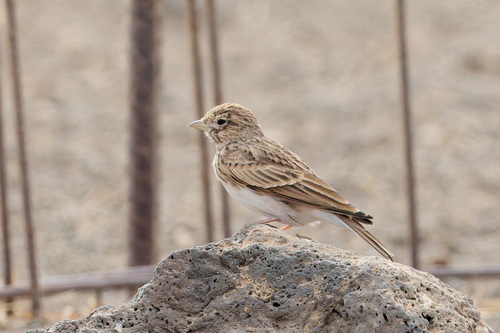 Alouette pispolette
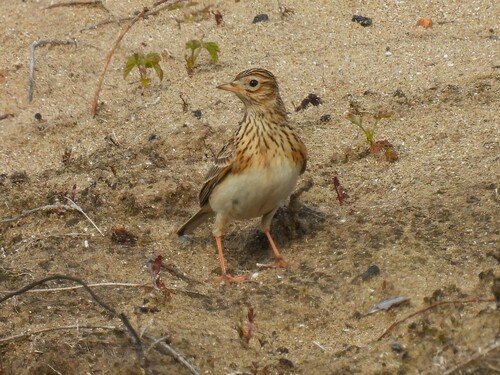 Alouette des champs
En bref
The most reliable field mark between Mediterranean Short-toed Lark and Eurasian Skylark is size and structure: Skylark is distinctly larger, with a longer tail, broader wings, and often shows a short, blunt crest, while Mediterranean Short-toed Lark is smaller, more compact, and lacks a crest. In flight, Skylark shows obvious white edges to the tail and rear wing, especially when flying away, which are absent in Mediterranean Short-toed Lark. Bill shape and head proportions also differ: Mediterranean Short-toed Lark has a shorter, less conical bill and a more rounded, smaller head. Breast streaking is finer and more extensive in Mediterranean Short-toed Lark, whereas Skylark is paler below with less streaking. Both species can be drab brown above and pale below, so structure and flight marks are key.
Conseils d’identification
- Size is a primary separator: Eurasian Skylark is much larger and bulkier than Mediterranean Short-toed Lark. If you see both together, the difference is striking.
- Tail and wing pattern in flight: Skylark shows obvious white edges to the tail and rear wing, especially when flying away. Mediterranean Short-toed Lark lacks these white edges entirely.
- Crest presence: Skylark has a short, blunt crest that is often raised when alert or singing; Mediterranean Short-toed Lark never shows a crest, and its head is more rounded.
- Bill shape: Mediterranean Short-toed Lark has a shorter, less conical bill, while Skylark's bill is longer and more conical. This is subtle but visible at close range.
- Head and supercilium: Mediterranean Short-toed Lark has a smaller, rounder head with a pale supercilium, but this is less prominent than in Skylark due to the overall head shape and lack of crest.
- Breast streaking: Mediterranean Short-toed Lark has fine, extensive streaking across the breast, while Skylark is paler below with less streaking and a more uniform belly.
- Song and display: Skylark's song is delivered in a long, continuous stream during high, hovering flight (often just a dot in the sky). Mediterranean Short-toed Lark sings from lower perches or short flights, with a richer, more varied and imitative song.
- Posture on the ground: Skylark often stands upright and may raise its crest, while Mediterranean Short-toed Lark is more horizontal and compact, never showing a crest.
- Habitat context: In arid, sparsely vegetated habitats around the Mediterranean, Mediterranean Short-toed Lark is more likely. In lush grassland or farmland, Skylark is more probable.
- Sex and age: Both species are similar between sexes, but male Skylarks have broader wings for hovering. No strong age-related differences in field marks are described for Mediterranean Short-toed Lark; Skylark's white tail/wing edges are present at all ages.
- Pitfall – overall color: Both species are brown above and pale below, so color alone is unreliable. Focus on structure and flight marks.
- Pitfall – streaking: While breast streaking is finer in Mediterranean Short-toed Lark, heavy wear or poor views can make this hard to judge. Use in combination with other marks.
- Pitfall – song quality: The richer, more varied song of Mediterranean Short-toed Lark can be hard to appreciate without experience. Song delivery style (high, hovering for Skylark vs. lower for Mediterranean Short-toed Lark) is more reliable.
- Flight style: Skylark's flight is strong and undulating, with long glides and hovering; Mediterranean Short-toed Lark is more fluttery and direct, rarely hovering high.
- Geographical overlap: If you are outside the Mediterranean Basin, Skylark is far more likely; within arid Mediterranean habitats, check all structural and flight marks carefully.
Taille
Eurasian Skylark is substantially larger, measuring 18–19 cm in length, compared to the Mediterranean Short-toed Lark's 13–14 cm. This size difference is obvious in the field, with Skylark appearing bulkier, longer-bodied, and longer-tailed. Mediterranean Short-toed Lark is noticeably more compact and smaller overall. Sexes are similar in both species, but male Skylarks have broader wings than females, which is not a feature in Mediterranean Short-toed Lark.
Plumage
- Juvenile/immature/first-winter birds: No specific age-related upperwing or flight pattern differences are described for Mediterranean Short-toed Lark, but Skylark of all ages shows white edges to the tail and rear wing, visible when flying away. This white is absent in Mediterranean Short-toed Lark at all ages.
- Adults: Mediterranean Short-toed Lark is dark-streaked greyish-brown above and white below, with fine streaking across the breast. Skylark is also brown above and paler below, but with a less streaked, more uniform underpart and a short, blunt crest that can be raised or lowered. Skylark's tail and rear wing edges are white in flight, while Mediterranean Short-toed Lark lacks these white edges. Both have pale supercilia, but Mediterranean Short-toed Lark's is generally less prominent due to its smaller, rounder head.
Comportement
Skylark is famous for its display flight: males hover high in the air (50–100 m) while delivering a long, continuous song, sometimes for several minutes. Mediterranean Short-toed Lark does not hover at such heights and its song is delivered from lower perches or short flights. On the ground, Skylark often appears upright and may raise its crest, while Mediterranean Short-toed Lark is more compact, with a lower, horizontal stance and no crest. Both species forage on open ground, but Skylark's display flight is a strong behavioral clue.
Habitat
Mediterranean Short-toed Lark is found in and around the Mediterranean Basin, favoring dry, open habitats such as steppe, semi-desert, and sandy fields. Eurasian Skylark is widespread across Europe and the Palearctic, preferring open farmland, heath, and grassland. While their habitats can overlap in open country, Skylark is more associated with lush grassland and agricultural fields, whereas Mediterranean Short-toed Lark is more typical of arid, sparsely vegetated areas.
Voix
Skylark's song is a long, bubbling warble delivered in a continuous stream during high, hovering flight, often lasting several minutes. Mediterranean Short-toed Lark's song is richer, more varied, and imitative, but is not delivered from such high or prolonged hovering. The difference in song delivery (high, sustained hovering for Skylark vs. lower, shorter flights or perches for Mediterranean Short-toed Lark) is often more useful than the song quality itself.
Alouette pispolette · Alouette des champs · Mes oiseaux difficiles