

Motmot

Pétrel du Magenta vs Puffin fouquet

Pterodroma magentae contre Ardenna pacifica

Faire un quiz avec Pétrel du Magenta et Puffin fouquet

Pétrel du Magenta (Pterodroma magentae) Pétrel du Magenta
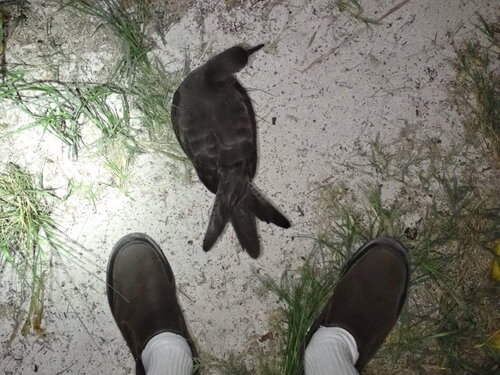
Puffin fouquet (Ardenna pacifica) Puffin fouquet

Médias

Chargement…

En bref

The most reliable field mark between Magenta Petrel and Wedge-tailed Shearwater is the tail shape: Magenta Petrel has a normal, rounded tail, while Wedge-tailed Shearwater shows a distinctly long, wedge-shaped tail, especially noticeable in flight. Both are medium-sized, dark-headed seabirds with white underparts, but Magenta Petrel has a brownish-grey head and breast with brown underwings, while Wedge-tailed Shearwater varies from all-dark to pale morphs but always shows a wedge-shaped tail and more uniformly colored underwings. Bill and leg color also differ subtly, but these are rarely diagnostic at a distance. Context and range are crucial: Magenta Petrel is restricted to Chatham Island, while Wedge-tailed Shearwater is widespread across tropical oceans.

Conseils d’identification

  1. Tail shape is the single best field mark: Wedge-tailed Shearwater has a long, wedge-shaped tail that is obvious in flight and when perched; Magenta Petrel's tail is normal and rounded. This is visible in all ages and morphs.
  2. Underwing color: Magenta Petrel shows brown underwings contrasting with white underparts; Wedge-tailed Shearwater's underwing is not described as contrasting, so expect a more uniform look, especially in pale morphs.
  3. Head and breast color: Magenta Petrel has a brownish-grey head, neck, and upper breast, which contrasts with its white belly; Wedge-tailed Shearwater (pale morph) has a similar but less sharply demarcated grey-brown head and upperparts, while the dark morph is uniformly dark.
  4. Bill color: Both species have dark bills, but Magenta Petrel's is described as black, while Wedge-tailed Shearwater's is dark but may appear slightly less intense. This is rarely useful at a distance.
  5. Leg color: Both have pinkish legs (Magenta Petrel: pink; Wedge-tailed Shearwater: salmon pink), but this is only visible at close range and is not a strong field mark.
  6. Plumage morphs: Wedge-tailed Shearwater comes in two morphs—pale and dark. The dark morph can appear uniformly dark and may be confused with Magenta Petrel in poor light, but the wedge-shaped tail remains diagnostic.
  7. Flight style and structure: Wedge-tailed Shearwater may appear longer-tailed and more streamlined in flight due to its tail shape. Magenta Petrel has a more typical petrel jizz with a rounded tail.
  8. Range and context: If observed outside Chatham Island, it is almost certainly a Wedge-tailed Shearwater. Magenta Petrel is restricted to Chatham Island and is extremely rare.
  9. Colony behavior: Wedge-tailed Shearwater is often seen in large colonies or flocks; Magenta Petrel is solitary and secretive.
  10. Vocalizations: If you hear a long, moaning call with inhaling and exhaling notes, it is Wedge-tailed Shearwater. Magenta Petrel's call is not described, so silence does not help.
  11. Breeding habitat: Magenta Petrel breeds in dense forest burrows; Wedge-tailed Shearwater nests in burrows or under cover, often on open islands.
  12. Seasonality: Both species breed in the southern hemisphere spring-summer, but Wedge-tailed Shearwater's breeding season may overlap with other tropical shearwaters.
  13. Pitfall—dark morph confusion: Dark morph Wedge-tailed Shearwater may look similar to Magenta Petrel in poor light, but always check the tail shape.
  14. Pitfall—underwing in flight: If you see a brown underwing contrasting with white underparts, lean toward Magenta Petrel; a uniform underwing is more likely Wedge-tailed Shearwater.
  15. No reliable size difference: Both species are similar in mass and bulk; do not rely on size for separation.

Taille

Both species are nearly identical in body mass, averaging around 465 g. In the field, they appear similar in bulk and length, so size alone is not a reliable separator. Both are medium-sized seabirds, and neither is notably larger or smaller than the other.

Plumage

No age-specific upperwing or juvenile pattern is described for either species that is diagnostic in flight. Adult Magenta Petrel shows a brownish-grey head, neck, and upper breast, with white underparts and brown underwings. The bill is black, and the legs are pink. Wedge-tailed Shearwater comes in two morphs: pale morphs have grey-brown upperparts and head with white underparts, while dark morphs are dark grey-brown all over. Both morphs have dark bills and salmon-pink legs. The underwing of Wedge-tailed Shearwater is not described as contrasting or patterned, so it may appear more uniform compared to the brown underwing of Magenta Petrel. The most striking difference is the tail: Magenta Petrel has a normal, rounded tail, while Wedge-tailed Shearwater has a long, wedge-shaped tail that is obvious when the bird is flying or gliding.

Comportement

Both species are pelagic and nest in burrows, often under cover. Magenta Petrel is extremely rare and secretive, only found on Chatham Island, and is unlikely to be seen away from its breeding grounds. Wedge-tailed Shearwater is much more common, often seen in large flocks over tropical oceans, and attends colonies nocturnally. Both species are monogamous and share incubation duties, but Wedge-tailed Shearwater is more likely to be seen loafing on the water or flying in groups, while Magenta Petrel is solitary and elusive.

Habitat

Habitat is a strong clue: Magenta Petrel is endemic to Chatham Island, New Zealand, and breeds in dense forest burrows. It is not found elsewhere. Wedge-tailed Shearwater is widespread across the tropical Pacific and Indian Oceans, breeding on islands and coastal areas, often in large colonies. If seen outside Chatham Island, the bird is almost certainly a Wedge-tailed Shearwater.

Voix

Wedge-tailed Shearwater is known for its long, moaning call with inhaling (OOO) and exhaling (err) components, especially at colonies. No distinctive vocalization is described for Magenta Petrel in the provided notes, so voice is only useful for confirming Wedge-tailed Shearwater if heard.

Envoyer une meilleure description

Utilise les mêmes sections que la comparaison. Ton texte est publié tout de suite.

The most reliable field mark between Magenta Petrel and Wedge-tailed Shearwater is the tail shape: Magenta Petrel has a normal, rounded tail, while Wedge-tailed Shearwater shows a distinctly long, wedge-shaped tail, especially noticeable in flight. Both are medium-sized, dark-headed seabirds with white underparts, but Magenta Petrel has a brownish-grey head and breast with brown underwings, while Wedge-tailed Shearwater varies from all-dark to pale morphs but always shows a wedge-shaped tail and more uniformly colored underwings. Bill and leg color also differ subtly, but these are rarely diagnostic at a distance. Context and range are crucial: Magenta Petrel is restricted to Chatham Island, while Wedge-tailed Shearwater is widespread across tropical oceans.

  1. Tail shape is the single best field mark: Wedge-tailed Shearwater has a long, wedge-shaped tail that is obvious in flight and when perched; Magenta Petrel's tail is normal and rounded. This is visible in all ages and morphs.
  2. Underwing color: Magenta Petrel shows brown underwings contrasting with white underparts; Wedge-tailed Shearwater's underwing is not described as contrasting, so expect a more uniform look, especially in pale morphs.
  3. Head and breast color: Magenta Petrel has a brownish-grey head, neck, and upper breast, which contrasts with its white belly; Wedge-tailed Shearwater (pale morph) has a similar but less sharply demarcated grey-brown head and upperparts, while the dark morph is uniformly dark.
  4. Bill color: Both species have dark bills, but Magenta Petrel's is described as black, while Wedge-tailed Shearwater's is dark but may appear slightly less intense. This is rarely useful at a distance.
  5. Leg color: Both have pinkish legs (Magenta Petrel: pink; Wedge-tailed Shearwater: salmon pink), but this is only visible at close range and is not a strong field mark.
  6. Plumage morphs: Wedge-tailed Shearwater comes in two morphs—pale and dark. The dark morph can appear uniformly dark and may be confused with Magenta Petrel in poor light, but the wedge-shaped tail remains diagnostic.
  7. Flight style and structure: Wedge-tailed Shearwater may appear longer-tailed and more streamlined in flight due to its tail shape. Magenta Petrel has a more typical petrel jizz with a rounded tail.
  8. Range and context: If observed outside Chatham Island, it is almost certainly a Wedge-tailed Shearwater. Magenta Petrel is restricted to Chatham Island and is extremely rare.
  9. Colony behavior: Wedge-tailed Shearwater is often seen in large colonies or flocks; Magenta Petrel is solitary and secretive.
  10. Vocalizations: If you hear a long, moaning call with inhaling and exhaling notes, it is Wedge-tailed Shearwater. Magenta Petrel's call is not described, so silence does not help.
  11. Breeding habitat: Magenta Petrel breeds in dense forest burrows; Wedge-tailed Shearwater nests in burrows or under cover, often on open islands.
  12. Seasonality: Both species breed in the southern hemisphere spring-summer, but Wedge-tailed Shearwater's breeding season may overlap with other tropical shearwaters.
  13. Pitfall—dark morph confusion: Dark morph Wedge-tailed Shearwater may look similar to Magenta Petrel in poor light, but always check the tail shape.
  14. Pitfall—underwing in flight: If you see a brown underwing contrasting with white underparts, lean toward Magenta Petrel; a uniform underwing is more likely Wedge-tailed Shearwater.
  15. No reliable size difference: Both species are similar in mass and bulk; do not rely on size for separation.

Both species are nearly identical in body mass, averaging around 465 g. In the field, they appear similar in bulk and length, so size alone is not a reliable separator. Both are medium-sized seabirds, and neither is notably larger or smaller than the other.

No age-specific upperwing or juvenile pattern is described for either species that is diagnostic in flight. Adult Magenta Petrel shows a brownish-grey head, neck, and upper breast, with white underparts and brown underwings. The bill is black, and the legs are pink. Wedge-tailed Shearwater comes in two morphs: pale morphs have grey-brown upperparts and head with white underparts, while dark morphs are dark grey-brown all over. Both morphs have dark bills and salmon-pink legs. The underwing of Wedge-tailed Shearwater is not described as contrasting or patterned, so it may appear more uniform compared to the brown underwing of Magenta Petrel. The most striking difference is the tail: Magenta Petrel has a normal, rounded tail, while Wedge-tailed Shearwater has a long, wedge-shaped tail that is obvious when the bird is flying or gliding.

Both species are pelagic and nest in burrows, often under cover. Magenta Petrel is extremely rare and secretive, only found on Chatham Island, and is unlikely to be seen away from its breeding grounds. Wedge-tailed Shearwater is much more common, often seen in large flocks over tropical oceans, and attends colonies nocturnally. Both species are monogamous and share incubation duties, but Wedge-tailed Shearwater is more likely to be seen loafing on the water or flying in groups, while Magenta Petrel is solitary and elusive.

Habitat is a strong clue: Magenta Petrel is endemic to Chatham Island, New Zealand, and breeds in dense forest burrows. It is not found elsewhere. Wedge-tailed Shearwater is widespread across the tropical Pacific and Indian Oceans, breeding on islands and coastal areas, often in large colonies. If seen outside Chatham Island, the bird is almost certainly a Wedge-tailed Shearwater.

Wedge-tailed Shearwater is known for its long, moaning call with inhaling (OOO) and exhaling (err) components, especially at colonies. No distinctive vocalization is described for Magenta Petrel in the provided notes, so voice is only useful for confirming Wedge-tailed Shearwater if heard.

Abandonner tes modifications ?

Tu as des modifications non enregistrées. Si tu pars maintenant, elles seront perdues.

Pétrel du Magenta · Puffin fouquet · Mes oiseaux difficiles