

Viréo de Hutton vs Carouge de Californie
Vireo huttoni contre Agelaius tricolor
Faire un quiz avec Viréo de Hutton et Carouge de Californie
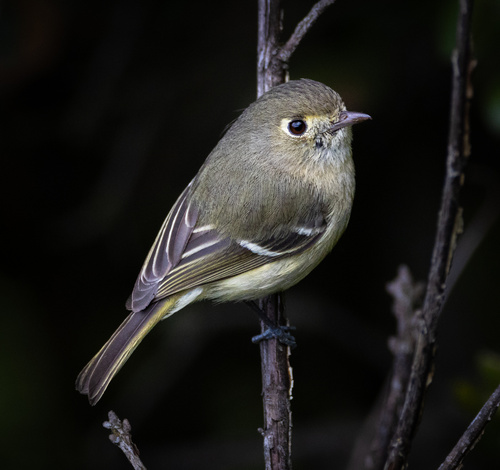 Viréo de Hutton
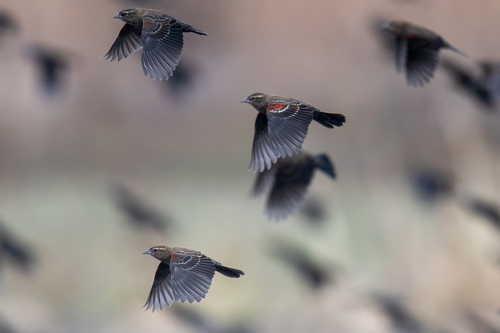 Carouge de Californie
En bref
The most reliable way to separate Hutton's Vireo from Tricolored Blackbird is by overall structure and plumage: Hutton's Vireo is a small, compact, olive-green songbird with two pale wingbars and a broken eye-ring, while Tricolored Blackbird is a much larger, lanky blackbird with glossy black plumage (males) or streaky brown (females/immatures) and a distinctive red-and-white shoulder patch (adult males). If you see a bird with a short, thick bill, olive tones, and wingbars, it's Hutton's Vireo; a long-legged, long-tailed black bird in a flock, especially with a red shoulder, is Tricolored Blackbird. Juvenile and immature plumages are not described in detail for either species in these notes, but the vireo's small size and wingbars are always present, while the blackbird's size, flocking, and lack of wingbars are constant. Habitat and behavior also help: vireos are solitary or in mixed flocks in woodland canopy, blackbirds are gregarious and often in open fields or marshes.
Conseils d’identification
- Size is a primary clue: Hutton's Vireo is tiny and compact (sparrow-sized), while Tricolored Blackbird is much larger and bulkier (closer to a starling or small crow).
- Wingbars and eye-ring: Hutton's Vireo always shows two pale wingbars and a broken, pale eye-ring, regardless of age or season. Tricolored Blackbird never shows wingbars or an eye-ring at any age.
- Bill shape: The vireo has a short, thick, slightly hooked bill, suited for picking insects; the blackbird has a longer, pointed bill typical of icterids, suited for seeds and insects.
- Plumage color: Hutton's Vireo is olive-green above with pale underparts and subtle yellowish wash; Tricolored Blackbird males are glossy black with a red-and-white shoulder patch, females/immatures are brownish and streaked but lack olive tones.
- Sexual dimorphism: Hutton's Vireo sexes are identical; Tricolored Blackbird males and females look very different (males black with red/white shoulder, females brown and streaky).
- Flocking: Vireos are solitary or in small groups, often with other small birds; Tricolored Blackbirds are almost always in large, noisy flocks, especially outside the breeding season.
- Habitat: Vireos are in woodland or forest canopy; blackbirds are in open fields, marshes, or agricultural areas.
- Perched posture: Hutton's Vireo perches upright, often hidden among leaves; Tricolored Blackbird perches more horizontally, often exposed on reeds, wires, or fences.
- Flight style: Vireo flight is short, weak, and fluttery; blackbird flight is stronger, with deeper wingbeats and longer glides.
- Vocalization: Vireo sings a nasal, repetitive song; blackbird gives harsh, metallic calls and does not sing like a vireo.
- Juvenile/immature confusion: Even in juvenile or immature plumages, the vireo's wingbars and eye-ring are present, while the blackbird's young are streaky brown but never show wingbars or eye-rings.
- Context: If you see a small olive bird alone in a tree, think vireo; if you see a large black or brown bird in a flock in a field, think blackbird.
- Subspecies variation: Hutton's Vireo varies in olive/yellow intensity by region, but always keeps the same basic pattern; Tricolored Blackbird does not vary much regionally in field marks.
- Leg color: Vireo has blue-gray to dark gray legs; blackbird's legs are dark, but this is rarely a useful field mark due to size and context differences.
- Mistaken identity: The most common mix-up is a dull vireo vs. a female/immature blackbird; remember the vireo's wingbars and eye-ring are never present on blackbirds.
Taille
Hutton's Vireo is much smaller, measuring 10–12 cm in length and weighing 9–15 g [wikipedia]. Tricolored Blackbird is significantly larger, with typical blackbird proportions (exact measurements not given here, but visually much bigger and heavier than any vireo). In the field, the vireo looks compact and sparrow-sized, while the blackbird is closer to a starling or small crow in size. This size difference is obvious even at a distance.
Plumage
For all ages, Hutton's Vireo shows olive upperparts, two pale yellowish wingbars, a broken pale eye-ring, and pale underparts with a yellowish wash. These features are consistent across subspecies, though the intensity of olive and yellow varies geographically. Tricolored Blackbird adult males are glossy black with a bright red shoulder patch bordered below by white; females and immatures are brownish and streaked, lacking wingbars or eye-rings. No detailed juvenile or first-winter upperwing pattern is provided for either species, but the vireo's wingbars and eye-ring are present year-round and in all plumages, while the blackbird never shows wingbars or an eye-ring. In flight, the vireo's small, rounded wings and short tail contrast with the blackbird's longer, broader wings and longer tail.
Comportement
Hutton's Vireo forages slowly and methodically in the subcanopy or canopy, often alone or in small mixed-species flocks, moving deliberately among leaves and branches. It is rarely seen on the ground and is generally quiet in its movements. Tricolored Blackbird is highly gregarious, often seen in large, noisy flocks, especially during the breeding season. It feeds in open fields, marshes, or agricultural areas, often on the ground or in low vegetation, and is much more conspicuous and active. The blackbird's flocking behavior and tendency to perch on reeds or wires is a strong behavioral clue.
Habitat
Hutton's Vireo is found in woodland and forested habitats, especially in oak and mixed evergreen forests, from southwestern Canada to Guatemala. It prefers the subcanopy and canopy, rarely venturing into open fields or marshes. Tricolored Blackbird is limited to the Pacific coastal region, mainly California, and is strongly associated with open habitats such as marshes, agricultural fields, and dairy farms. It nests in colonies in dense vegetation or crops and is rarely found in forests or woodlands. Thus, a small olive bird in trees is likely a vireo, while a blackbird in open country is almost certainly a Tricolored Blackbird.
Voix
Hutton's Vireo sings a monotonous, nasal, wheezy two-syllable song ("zu-wee... zu-wee..."), sometimes with descending or mixed phrases, and gives hoarse, scolding calls. The song is variable but always has the vireo's unmusical, nasal quality. Tricolored Blackbird's vocalizations are not described in these notes, but as a blackbird, it typically gives harsh, metallic, or chattering calls, very different from the vireo's song. If you hear a repeated, nasal, vireo-like song from a hidden perch in woodland, it's Hutton's Vireo; a noisy, chattering flock in a field is Tricolored Blackbird.
Viréo de Hutton · Carouge de Californie · Mes oiseaux difficiles