

Corneille mantelée vs Corbeau pie
Corvus cornix contre Corvus albus
Faire un quiz avec Corneille mantelée et Corbeau pie
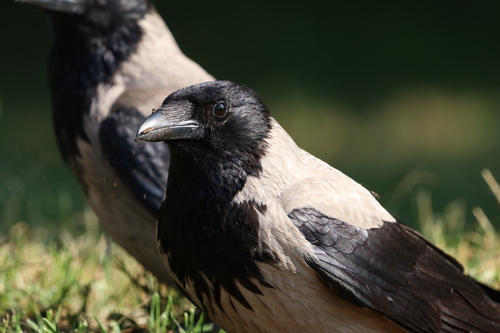 Corneille mantelée
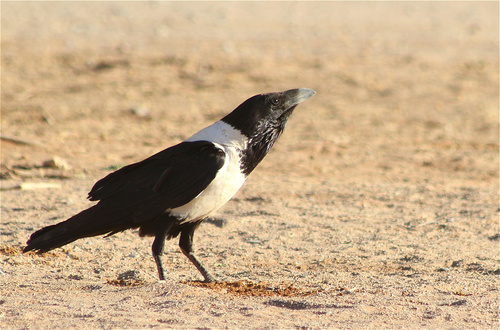 Corbeau pie
En bref
The most reliable way to separate Hooded Crow from Pied Crow is by the color and extent of pale body plumage: Hooded Crow shows a cold ashy-grey body with sharply contrasting black head, wings, tail, and thighs, while Pied Crow has a striking white patch from the shoulders down to the lower breast, with the rest of the bird glossy black. Juvenile and immature birds of both species may show some variation, but the pattern of pale vs dark is always diagnostic. Bill size and shape also differ: Pied Crow has a proportionately larger and heavier bill, as well as longer legs and tail. Flight style and structure can help, but plumage pattern is usually enough for confident ID, even at a distance.
Conseils d’identification
- Body color is the key mark: Hooded Crow has a cold ashy-grey body with black head, wings, tail, and thighs; Pied Crow has a bold white patch from the shoulders to lower breast, with the rest glossy black. This is reliable in all ages except very young juveniles, which are rarely seen away from the nest.
- White vs grey: Pied Crow's white is always pure and extensive, never greyish or streaked; Hooded Crow's pale areas are always grey, never white.
- Head and neck pattern: Hooded Crow's black is confined to the head, throat, wings, tail, and thighs, with a sharp cutoff to the grey body. Pied Crow's black head is interrupted by the white 'bib' wrapping around the neck and chest.
- Bill size and shape: Pied Crow has a noticeably larger, heavier bill than Hooded Crow, giving it a more raven-like profile, especially when seen side-by-side or at close range.
- Legs and tail: Pied Crow's legs and tail are longer relative to body size, contributing to a rangier, more elongated look when perched or in flight.
- Juvenile confusion: Hooded Crow juveniles are duller and blacker overall but never show white on the body; Pied Crow immatures may have some black mixed into the white, but the white patch is always present.
- Flight views: In flight, Hooded Crow shows a grey body with black wings and tail; Pied Crow flashes a white breast and underparts against black wings and tail. No distinctive upperwing panels or age-specific flight marks are noted for either species.
- Perched birds: The extent and color of the pale area is easiest to judge when the bird is perched and fully visible; look for the clean white 'bib' of Pied Crow vs the uniform grey of Hooded Crow.
- Habitat and range: If seen in Europe or the Middle East, a grey-bodied crow is almost certainly Hooded Crow; in sub-Saharan Africa, a crow with a white breast is Pied Crow.
- Sex and season: Both species are similar in appearance between sexes and across seasons; only size (males slightly larger) varies, but this is not useful in the field.
- Iris, bill, and legs: Both species have black bills and legs and dark brown eyes; these features are not helpful for separation.
- Voice: No diagnostic differences in voice are noted in the available sources; both are typical crows in sound.
- Behavior: Both are intelligent, opportunistic, and may cache food; behavior alone is not diagnostic, but Pied Crow may appear more raven-like in structure and movement.
- Pitfalls: Do not confuse the duller, blacker juveniles of Hooded Crow for Pied Crow; check for the presence or absence of white vs grey on the body, not just overall darkness.
- Hybrid confusion: Pied Crow can hybridize with Somali Crow, but not with Hooded Crow; hybrids are not a concern in the ranges of these two species.
Taille
Both species are similar in overall length (Hooded Crow: 48–52 cm; Pied Crow: 46–52 cm), but Pied Crow tends to be slightly heavier (average 520 g vs 510 g) and has a proportionately larger bill, longer tail, and longer legs. Wing length is also a bit greater in Pied Crow (328–388 mm). These differences are subtle in the field, but Pied Crow often appears rangier and more raven-like, especially when perched.
Plumage
- Juveniles/Immatures: Hooded Crow juveniles are much blacker than adults, with duller overall plumage and bluish or greyish eyes; their body is still never white, but the contrast with black is less stark. Pied Crow immatures may have white plumage mixed with black, but always show some white from shoulder to lower breast, never the uniform ashy-grey of Hooded Crow.
- Adults: Hooded Crow is ashy-grey on the body, with sharply defined glossy black on the head, throat, wings, tail, and thighs. Pied Crow is glossy black overall except for a large, pure white patch from the shoulders down the lower breast, forming a white 'bib' that wraps around the neck and chest. The white of Pied Crow is always clean and extensive, never greyish or streaked. Both species have black bills, legs, and dark brown eyes.
- Flight views: In flight, the Hooded Crow's grey body and contrasting black wings/tail are obvious, while Pied Crow's white breast and underparts flash against the otherwise black plumage. No distinctive age-specific upperwing marks are noted for either species.
Comportement
Both species are opportunistic omnivores and scavengers, often seen foraging in pairs or small groups. Pied Crow may gather in larger numbers at abundant food sources and is noted for mobbing raptors in some areas. Hooded Crow is also highly intelligent, known for caching food and using tools. Both species have slow, heavy, and usually straight flight, but Pied Crow may appear more raven-like in structure and movement due to its longer tail and legs.
Habitat
Hooded Crow is found across Northern, Eastern, and Southeastern Europe, and parts of the Middle East, often in open countryside, coastal areas, and urban settings. Pied Crow is widespread in sub-Saharan Africa, favoring open habitats, towns, and villages. There is little range overlap, so context can be a strong clue: a crow with white on the body in Africa is almost certainly Pied Crow, while a grey-bodied crow in Europe is Hooded Crow.