

Martinet à ventre blanc vs Martinet des maisons
Tachymarptis melba contre Apus affinis
Faire un quiz avec Martinet à ventre blanc et Martinet des maisons
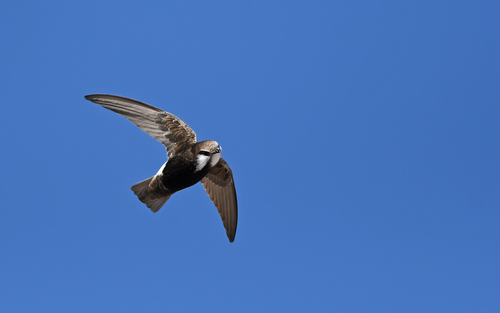
 Martinet à ventre blanc
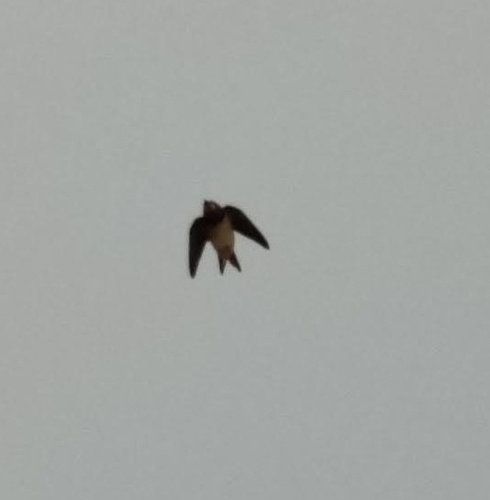
 Martinet des maisons
En bref
The most reliable field mark to separate Alpine Swift from Little Swift is the underpart pattern: Alpine Swift shows a striking white belly and throat separated by a dark breast band, while Little Swift is blackish overall with only a small white throat and a bold white rump patch. In flight, Alpine Swift is much larger and longer-winged, with a deep, slow, powerful flight, whereas Little Swift is compact, with a short square tail and a fluttery, rapid wingbeat. Juvenile Alpine Swifts resemble adults but have pale-edged feathers, while Little Swift immatures do not show this feature. Both species can be seen in urban and cliff habitats, but size and underpart contrast are the best field clues.
Conseils d’identification
- Underpart pattern (all ages): Alpine Swift shows a bold white belly and throat, separated by a dark breast band; Little Swift is dark below except for a small white throat patch.
- White rump patch (all ages): Little Swift has a prominent white rump patch extending onto the flanks, visible in flight and at rest; Alpine Swift lacks any white on the rump.
- Size and structure: Alpine Swift is much larger and heavier-bodied, with a long wingspan and broad, crescent-shaped wings; Little Swift is small, compact, and short-tailed.
- Tail shape: Alpine Swift has a short, shallowly forked tail; Little Swift's tail is short and square, with all feathers rounded at the tip.
- Wing shape: Alpine Swift's wings are long, swept-back, and boomerang-shaped; Little Swift's wings are shorter and less pointed, giving a more triangular look in flight.
- Flight style: Alpine Swift flies with deep, slow, powerful wingbeats and often soars; Little Swift has a rapid, fluttery, house martin-like flight.
- Juvenile Alpine Swift: Look for pale feather edges on the upperparts, giving a slightly scaled appearance; Little Swift juveniles do not show this.
- Plumage tone: Alpine Swift is olive-brown above with blacker wingtips; Little Swift is glossy black except for white patches.
- Breast band: Alpine Swift's dark breast band is diagnostic and separates the white throat from the white belly; Little Swift never shows a breast band.
- Habitat context: Both can be found in towns and cliffs, but Alpine Swift is more likely in mountainous regions, Little Swift in a wider range of lowland and urban habitats.
- Voice: Alpine Swift's call is a drawn-out twitter, Little Swift's is a high twitter; use only as supporting evidence.
- Perched views: Alpine Swift appears much larger and bulkier when perched, with a longer body and wings; Little Swift is small and compact.
- Confusion risk: At distance, Little Swift's white rump can be mistaken for Alpine Swift's belly patch, but Alpine Swift never shows a white rump, and Little Swift never shows a white belly.
- Flock composition: Mixed flocks are possible in overlap zones; compare directly for size and underpart pattern.
- Season/age: Both species' key field marks are present year-round and in all plumages, but juvenile Alpine Swift's pale feather edges are a bonus clue in late summer/autumn.
Taille
Alpine Swift is dramatically larger, with a body mass around 96 g and a length of 20–23 cm, compared to the much smaller Little Swift (wingspan only 33 cm, length not stated but much less). Alpine Swift's wingspan is about 54–60 cm, nearly double that of Little Swift. In the field, Alpine Swift will appear bulkier, longer-winged, and swallow-like in silhouette, while Little Swift is noticeably smaller and more compact.
Plumage
- Juvenile/immature Alpine Swift: Similar to adults but with pale-edged feathers, especially on the upperparts, which can give a slightly scaled look in fresh plumage. This pale edging is not present in Little Swift.
- Adult Alpine Swift: Shows a distinctive white belly and throat, separated by a dark breast band and flanked by olive-brown sides and undertail-coverts. The upperparts are olive-brown with blacker wing-tips. The white underparts are oval and highly visible in flight.
- Little Swift (all ages): Plumage is black except for a small white throat and a bold white rump patch that wraps onto the flanks. Underparts are otherwise dark. The tail is short and square, with all rectrices round-tipped. No pale feather edges or underpart patches as in Alpine Swift.
- Key contrast: Alpine Swift's white belly and throat with a dark band is unique and never shown by Little Swift, which instead has a white rump patch and otherwise dark plumage.
Comportement
Alpine Swift has a slower, more powerful flight, with deep wingbeats and a tendency to soar or glide on long, crescent-shaped wings. Its flight is often described as reminiscent of a large swallow or martin. Little Swift, in contrast, has a fluttery, rapid wingbeat and a more erratic, house martin-like flight. Both species spend most of their time on the wing, catching insects, and both drink and roost on vertical surfaces, but Alpine Swift's flight is noticeably more robust and less fluttery.
Habitat
Both species can be found in urban areas and at rocky cliffs, sometimes nesting in old buildings. Alpine Swift is more strictly associated with mountainous regions from southern Europe to the Himalayas, while Little Swift is widespread in Africa and southwestern Asia, with only local breeding or vagrancy into southern Europe. Overlap is possible in southern Europe and North Africa, especially near human settlements or cliffs.
Voix
Alpine Swift gives a drawn-out twittering call, while Little Swift has a high twittering call. Both are somewhat similar, but Alpine Swift's call is longer and more drawn out, matching its slower, more powerful flight. Vocal differences are subtle and not the most reliable field mark for separation.
Martinet à ventre blanc · Martinet des maisons · Mes oiseaux difficiles