

Charrán Maorí vs Abanico Maorí
Sterna striata frente a Rhipidura fuliginosa
Juega un quiz con Charrán Maorí y Abanico Maorí
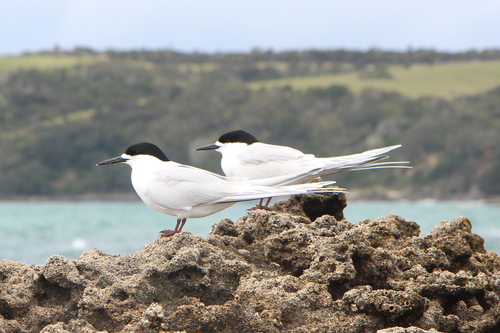 Charrán Maorí
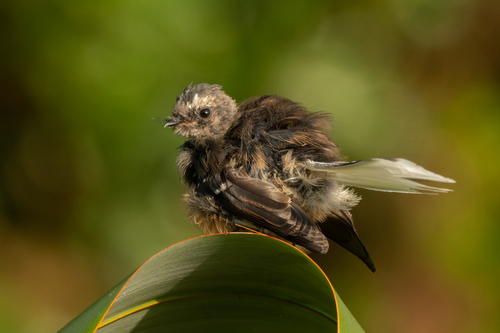 Abanico Maorí
En breve
The most reliable field mark separating White-fronted Tern from New Zealand Fantail is overall structure and flight style: terns are sleek, long-winged seabirds with deeply forked tails and all-white underparts, while fantails are tiny, restless songbirds with a short, broad-based fan-shaped tail and a strong face pattern. Juvenile White-fronted Terns show brownish and grey flecking above, but even then, their slim, pointed wings and forked tail are unlike the compact, rounded wings and constantly fanned tail of a fantail. If you see a bird sallying for insects in woodland or gardens, it's a fantail; if it's flying over the sea or beaches with graceful glides, it's a tern. Size, bill shape, and behavior are all dramatically different.
Consejos de identificación
- Size: White-fronted Tern is much larger than New Zealand Fantail; if you see both together, the difference is unmistakable. Use this as a first check, but beware of distant or lone birds.
- Bill Shape: Tern has a long, slender, black bill; fantail has a short, thin bill suited for catching insects. Bill is diagnostic at close range.
- Tail Shape: Tern's tail is long and deeply forked (especially in flight or breeding season), while fantail's tail is broad, rounded, and fanned, often held open.
- Flight Style: Terns glide and soar with long, pointed wings; fantails flit and sally with rapid, erratic wingbeats and frequent tail fanning.
- Juvenile Plumage: Juvenile White-fronted Terns have brownish and grey flecks above and a mottled, incomplete black cap; fantail juveniles are browner but lack any cap or strong face pattern. This is most useful for separating young birds in late summer/autumn.
- Adult Head Pattern: Breeding terns have a full black cap with a narrow white forehead band; fantails have a white throat, dark chest band, and bold white eyebrow (except black morphs). Non-breeding terns lose some cap intensity and the black recedes, but still lack the fantail's face pattern.
- Underparts: Terns are all white below (sometimes with faint pink in breeding season); fantails are yellowish/orange below with a dark band across the chest.
- Wing Pattern: Tern upperwings are pale silvery-grey with dark wingtips; fantail wings are darker above, with no pale panels or silvery hue.
- Legs: Tern legs are short and dark burgundy-black; fantail legs are thin and dark, but much less obvious due to their small size.
- Habitat: Tern is coastal, rarely inland; fantail is terrestrial, never at sea. If seen in a garden or forest, it's a fantail.
- Behavior: Tern perches in flocks on rocks or beaches, flies over water; fantail is solitary or in small groups, always active and fanning its tail.
- Voice: Fantail gives a metallic 'cheek' or chattering call; terns do not make this sound.
- Black Morph Fantail: Entirely dark except for a white spot behind the eye; never confused with terns, which are never all-dark.
- Context: If the bird is following you along a path or foraging near people, it's a fantail. If it's flying out over the surf or diving for fish, it's a tern.
- Seasonal Variation: Tern's black cap recedes in non-breeding season but never forms a face pattern like the fantail. Juvenile tern's upperwing flecks are unique among these two.
Tamaño
White-fronted Tern is vastly larger, weighing about 128 g and measuring 35–43 cm in length with a wingspan up to 82 cm. In contrast, New Zealand Fantail is tiny, only 7.2 g and about 16 cm long (half of which is tail). In the field, the tern is a medium-sized seabird, much larger than any songbird, while the fantail is one of New Zealand's smallest birds and appears delicate and fluttery.
Plumaje
Juvenile and immature White-fronted Terns have upperparts and wings flecked with light to dark grey and warm browns, and a mottled, incomplete black cap with dark marks around the eyes. These marks are never as bold or as patterned as the fantail's face. Fantail juveniles are browner overall, with indistinct body markings and no cap. Adult White-fronted Terns are mostly white below and on the underwing, with a pale silvery-grey mantle and upperwing, a black cap (breeding), and a narrow white forehead band. Fantails (except rare black morphs) have a dark band below a white throat, yellowish/orange underparts, white supercilium, and a tail with white outer feathers and dark central feathers, often fanned. The black morph fantail is dark all over except for a white spot behind the eye, which is never seen in terns. Tern tails are long and deeply forked; fantail tails are broad, rounded, and fan-shaped.
Comportamiento
White-fronted Terns are usually seen in flocks along coastlines, flying over water or perched on rocks, often feeding by plunge-diving for fish. Their flight is buoyant and direct, with long glides and shallow wingbeats. New Zealand Fantails are almost never still, constantly flitting, fanning their tails, and making short, erratic flights to catch insects, often close to people. They are typically solitary or in small groups, rarely in large flocks, and are most often seen in forests, gardens, or parks rather than open coasts.
Hábitat
White-fronted Tern is strictly coastal, found along beaches, rocky shores, and offshore islands, rarely venturing inland. It breeds in dense colonies on sand, shingle, or rocky substrates near the sea. New Zealand Fantail is a land bird, common in forests, shrublands, gardens, and parks, and is not found at sea or on open beaches. If the bird is in a woodland or urban setting, it is almost certainly a fantail.
Voz
White-fronted Tern's calls are not described in the notes, but terns generally have harsh, sharp, or rasping calls. New Zealand Fantail gives a metallic 'cheek' call, often repeated in a chattering sequence. If you hear a rapid, metallic chattering in the bush, it's a fantail; terns are usually silent away from colonies and do not produce similar sounds.