

Piojito Tiquitiqui/Ventriblanco vs Piojito de Straneck
Serpophaga subcristata frente a Serpophaga griseicapilla
Juega un quiz con Piojito Tiquitiqui/Ventriblanco y Piojito de Straneck
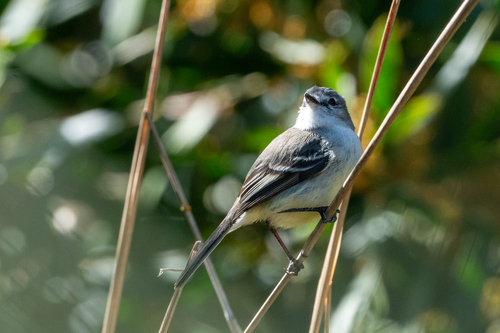 Piojito Tiquitiqui/Ventriblanco
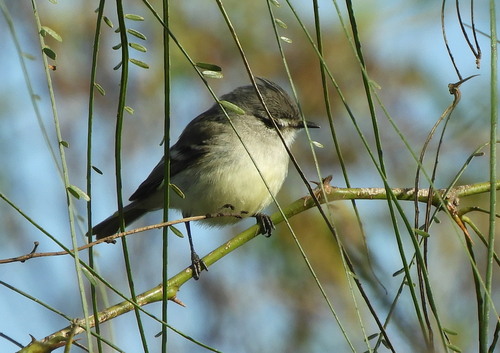 Piojito de Straneck
En breve
The most reliable field mark between White-crested Tyrannulet and Straneck's Tyrannulet is the color and prominence of the crown and wing bars, especially in adults. White-crested Tyrannulet often shows a hidden but sometimes raised white crest, while Straneck's Tyrannulet has only a small, less obvious patch of white on some black central crown feathers. Wing bars also differ: White-crested's are whitish to pale buffy, while Straneck's can be cinnamon to whitish. Both species are very similar in size and general shape, and both sexes look alike, so careful attention to subtle plumage differences is essential. Juvenile and immature birds are especially tricky, but the overall tone of the upperparts and the color of the wing bars can help separate them.
Consejos de identificación
- Crown color and crest (adults): White-crested Tyrannulet can show a white crest when raised, which is usually hidden but sometimes visible. Straneck's Tyrannulet has only a small, less obvious white patch on some black central crown feathers. Look for any sign of a raised white crest in perched birds.
- Crown color (all ages): Both have gray crowns, but Straneck's is often described as gray-crowned or gray-naped, sometimes appearing slightly darker due to the black central feathers.
- Supercilium and eye-ring: Both species have a thin white supercilium, but Straneck's also shows a white crescent under the eye, which is less pronounced in White-crested.
- Facial pattern: White-crested has a dusky line through the eye; Straneck's has a darker gray line. Both have grayish white faces, but Straneck's may look slightly more contrasting due to the crescent.
- Upperparts color: White-crested is grayish olive above, while Straneck's is olivaceous brown—slightly warmer and browner. In good light, this can be a subtle but useful clue.
- Wing bars (adults): White-crested's are whitish to pale buffy; Straneck's can be cinnamon to whitish. Cinnamon tones on the wing bars suggest Straneck's, but beware of wear and light conditions.
- Wing bars (juveniles): Juvenile White-crested has buff wing bars; Straneck's can be cinnamon to whitish. This is subtle and variable, but in a direct comparison, cinnamon tones favor Straneck's.
- Tail color: Both have dusky or dark gray-brown tails with whitish edges on the outer feathers. This is not a strong separator.
- Underparts: Both have white throats and grayish breasts, with pale yellow bellies. S. s. straminea (White-crested) has a brighter yellow belly, but most subspecies overlap in tone.
- Iris color: Both species have dark irises, but Straneck's can be hazel-brown to dark brown. This is not reliable in the field.
- Bill and legs: Both have black bills; White-crested has gray legs and feet, while Straneck's has black legs and feet. This is subtle and rarely diagnostic in the field.
- Size: White-crested averages slightly heavier, but size overlap is nearly complete and not useful in the field.
- Behavior: Both are active, restless foragers in similar habitats. Behavior is not a separator.
- Habitat and range: Both species occur together in much of their range and habitat, so do not rely on location.
- Voice: If you know the calls, use them—they are the most reliable separator, but details are not provided here.
In summary, focus on the presence or absence of a white crest, the color and prominence of the wing bars (cinnamon in Straneck's), and subtle differences in upperpart tones and facial markings. When in doubt, voice is best, but plumage clues can help with careful, close observation.
Tamaño
Both species are very small flycatchers and overlap in length (White-crested Tyrannulet: about 11 cm, Straneck's Tyrannulet: 9–11 cm). White-crested Tyrannulet averages slightly heavier (7.0 g) than Straneck's (4.4–7.5 g), but this is not a reliable field mark. In hand, White-crested may feel a touch more robust, but in the field, size is not a safe separator.
Plumaje
- Juveniles/immatures: Both species have buff or pale wing bars, but White-crested Tyrannulet juveniles have little or no white on the crown, while Straneck's shows a hidden bit of white on some black central crown feathers. Juvenile White-crested's wing bars are buff, while Straneck's can be cinnamon to whitish.
- Adults: White-crested Tyrannulet adults have a gray crown with a hidden white crest that can be raised, a thin white supercilium, and a dusky line through the eye. The upperparts are grayish olive, and the wings have dusky to blackish feathers with pale buffy edges and two whitish to pale buffy wing bars. The tail is dusky with whitish edges. Underparts are white on the chin and throat, gray on the breast, and pale yellow on the belly.
Straneck's Tyrannulet adults have a gray crown and nape with a small, hidden white patch on black central crown feathers, a thin white supercilium, a white crescent under the eye, and a dark gray line through the eye. The upperparts are olivaceous brown (warmer than White-crested), and the wings are dusky brownish gray with lighter edges and two cinnamon to whitish wing bars. The tail is dark gray-brown with whitish edges. Underparts are white with a grayish wash on the throat, grayish breast, and pale yellow belly. - Iris color: White-crested has a dark brown iris; Straneck's ranges from hazel-brown to dark brown, not a strong field mark.
Comportamiento
Both species are active foragers in scrubby vegetation, gleaning insects from foliage and sometimes hovering briefly. Their foraging style and general 'jizz' are very similar, so behavior is not a reliable separator in the field.
Hábitat
Both species are found in similar habitats across Argentina, Bolivia, Brazil, Paraguay, and Uruguay. They overlap broadly in range and habitat, so context is not helpful for separation.
Voz
The main taxonomic separation between these species is based on their very different vocalizations, but no specific descriptions are provided in the notes. In practice, voice is the best separator if you know the calls, but details are not available here.
Piojito Tiquitiqui/Ventriblanco · Piojito de Straneck · Mis aves difíciles