

Ánade Gargantillo vs Ánade Piquirrojo
Anas bahamensis frente a Anas erythrorhyncha
Juega un quiz con Ánade Gargantillo y Ánade Piquirrojo
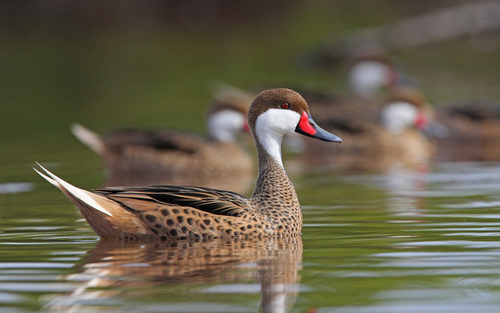 Ánade Gargantillo
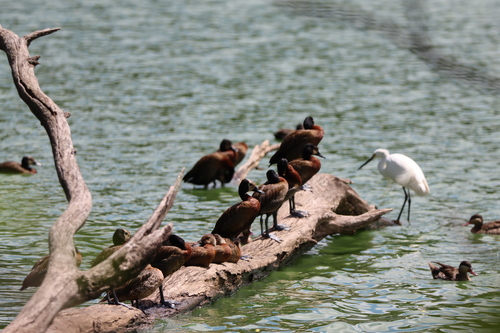 Ánade Piquirrojo
En breve
To separate White-cheeked Pintail from Red-billed Duck, focus first on the head and bill: White-cheeked Pintail always shows crisp white cheeks and a red-based grey bill, while Red-billed Duck has a pale face with a solidly bright red bill and a dark cap. In flight, White-cheeked Pintail shows an iridescent green speculum, whereas Red-billed Duck reveals buff secondaries with a black stripe. Both species are brown ducks with similar structure, but the head and bill pattern are the most reliable field marks at all ages. Juveniles of both are duller but retain these key contrasts. Tail shape and wing pattern are secondary but useful in good views.
Consejos de identificación
- White cheeks vs. pale face: White-cheeked Pintail always has crisp white cheeks, while Red-billed Duck shows a pale face but with a contrasting dark cap. This is visible at all ages and is the quickest field check.
- Bill color and pattern: White-cheeked Pintail has a red-based grey bill (red at the base, grey elsewhere), while Red-billed Duck's bill is bright red throughout. Juveniles of both have duller bills, but the pattern holds.
- Cap and nape: Red-billed Duck has a blackish cap and nape, contrasting with its pale face; White-cheeked Pintail lacks this dark cap, making the head appear cleaner.
- Speculum and wing pattern in flight: White-cheeked Pintail shows an iridescent green speculum on the wing (all ages). Red-billed Duck lacks green; instead, it has buff secondaries with a black stripe—look for this in flight or when preening.
- Tail shape: White-cheeked Pintail has a slender, pointed tail, though less so than Northern Pintail. Red-billed Duck's tail is not especially pointed and appears more typical for a dabbling duck.
- Body pattern: Both are brown with fine pale markings, but White-cheeked Pintail may appear slightly cleaner due to the white cheeks. Red-billed Duck is scalloped with white on the body, giving a subtly different texture.
- Sex and age: Both sexes are similar in each species; females and juveniles are duller but retain the key head and bill contrasts. Do not rely on sex to separate them.
- Voice: Only Red-billed Duck is described as vocal, with a 'whzzt' call from males and a soft quack from females. White-cheeked Pintail is not noted for distinctive calls.
- Habitat and range: If seen in the wild, White-cheeked Pintail is expected in the Caribbean and South America, Red-billed Duck in southern/eastern Africa. Escapees can occur, so do not rely solely on location in collections or parks.
- Flock size: Red-billed Duck often forms large flocks outside breeding season, while White-cheeked Pintail is usually in smaller groups or pairs.
- Behavior: Both dabble, but Red-billed Duck may be more likely to forage on land in the evening or at night.
- Pitfalls: In poor light, the pale face of Red-billed Duck can look whitish, but the dark cap and all-red bill remain distinctive. Juvenile White-cheeked Pintails may have less contrast, but the white cheek patch is still visible.
- When marks fail: If the head is obscured, try to see the speculum in flight or tail shape. If only the body is visible, separation is difficult—wait for a better view.
- Seasonal variation: No strong seasonal plumage change in either species, so marks are reliable year-round.
- Summary check: Head pattern (white cheek vs. pale face with dark cap) and bill color (red-based grey vs. all red) are the fastest and most reliable separators at all ages and seasons.
Tamaño
Both species are similar in size, with Red-billed Duck at 43–48 cm length and White-cheeked Pintail varying by subspecies but generally comparable. Females of both are slightly smaller and duller than males, but size alone is not a reliable separator in the field.
Plumaje
- Juvenile and Immature: Both species have duller versions of adult plumage, but the head and bill pattern remain diagnostic. Juvenile White-cheeked Pintail has white cheeks and a duller red-based bill; juvenile Red-billed Duck has a pale face, dark cap, and a duller but still red bill.
- Adult (all seasons): White-cheeked Pintail is mainly brown with crisp white cheeks and a red-based grey bill. Its wing shows an iridescent green speculum in flight. Red-billed Duck is also brown, but with a blackish cap, pale face, and a bright red bill. In flight, the Red-billed Duck's secondaries are buff with a black stripe, lacking the green iridescence. Both sexes are similar in each species, with females slightly duller.
- Tail: White-cheeked Pintail has a slender, pointed tail (less extreme than Northern Pintail), while Red-billed Duck's tail is not noted as especially pointed.
Comportamiento
Both are dabbling ducks, feeding mainly by dabbling for plant material and small aquatic creatures. White-cheeked Pintail may be seen in smaller, patchy populations, while Red-billed Duck is highly gregarious outside the breeding season and forms large flocks. Both nest on the ground near water and feed in shallow wetlands.
Hábitat
White-cheeked Pintail is found in patchy distributions across South America and the Caribbean, often in brackish or freshwater wetlands. Red-billed Duck is abundant in southern and eastern Africa, typically south of 10° S, and prefers freshwater habitats in open country. Their ranges do not overlap, so location is a strong clue unless dealing with escapees.
Voz
Red-billed Duck is generally quiet but the displaying male gives a 'whzzt' call and the female a soft mallard-like quack. No distinctive vocalizations are noted for White-cheeked Pintail in the sources, so voice is not a reliable separator.