

Saltarín Coroniazul (velutina/minuscula) vs Saltarín Cabecirrojo Norteño
Lepidothrix velutina frente a Ceratopipra mentalis
Juega un quiz con Saltarín Coroniazul (velutina/minuscula) y Saltarín Cabecirrojo Norteño
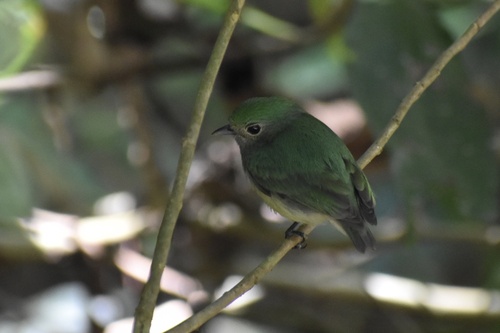 Saltarín Coroniazul (velutina/minuscula)
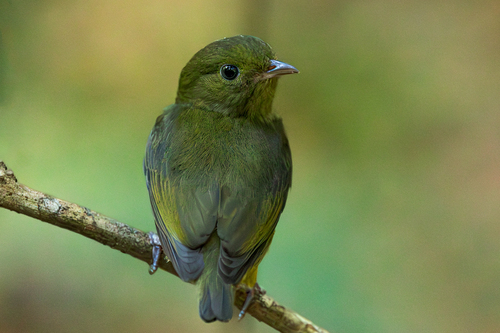 Saltarín Cabecirrojo Norteño
En breve
The most reliable field mark between Velvety Manakin and Red-capped Manakin is the color and pattern of the adult male's crown: Velvety has a bright blue crown, while Red-capped shows a vivid red cap and nape. Females and immatures are more challenging, but Velvety females are a brighter grass-green above, whereas Red-capped females are duller olive-green. Both species are small, black-and-green manakins, but the Red-capped male also shows bright yellow thighs and a pale yellow chin, which Velvety lacks. Careful attention to head color, underpart tone, and leg color is essential, especially for non-males or birds in poor light.
Consejos de identificación
- Adult male head color is the fastest separator: Velvety Manakin males have a bright blue crown and upper nape; Red-capped Manakin males have a vivid red cap and nape. This is diagnostic in all lighting.
- Yellow thighs and chin in Red-capped male: Only Red-capped Manakin males show bright yellow thighs and a pale yellow chin and wing linings. Velvety males are entirely black below the blue crown, with no yellow.
- Female upperpart tone: Female Velvety Manakin is grass-green above, especially bright on the rump, while Red-capped female is olive green above with paler, more yellow-green underparts. In direct comparison, Velvety is noticeably brighter and greener.
- Underpart color in females: Velvety females have a grayish-green face and throat, dull green breast/flanks, and olive-grayish belly with a yellowish tinge. Red-capped females are more uniformly pale yellow-green below, lacking the grayish or olive tones.
- Iris color in adult males: Velvety Manakin males have reddish brown or deep red irides; Red-capped Manakin males have white irides. In females and immatures, both species have brown irides, so this is only useful for adult males at close range.
- Leg color: Velvety Manakin has black or dark gray legs with brownish soles; Red-capped Manakin has dull brown legs. This is subtle and best used in hand or close-up photos.
- No distinctive wing or flight marks: Neither species shows unique upperwing patterns or flight marks at any age, so flight views rely on overall color and structure.
- Juvenile/immature confusion: Immatures resemble their respective females. If the bird is very dull olive with no bright green, suspect Red-capped. If brighter green above, especially on the rump, suspect Velvety.
- No structural differences described: Bill shape, tail, and wing formula are not highlighted as diagnostic between these two.
- Behavior is not a separator: Both species forage similarly, joining mixed flocks and sallying for fruit and insects.
- Habitat overlap: Both can be found in lowland humid forest and second growth in Costa Rica and Panama; range is not a reliable separator unless outside Velvety's restricted area.
- Sexual dimorphism: Only males are reliably separated at a distance by head color; females and immatures require careful study of green/olive tones and underpart color.
- Contextual clues: If seen with mixed-species flocks, consider Velvety (females/immatures join these more often), but this is not exclusive.
- Lighting pitfalls: In poor light, the blue crown of Velvety or the red cap of Red-capped may appear dark; look for yellow thighs or chin (Red-capped) or overall green tone (Velvety female) as backup.
- Do not rely on size: Both are equally small and compact; size is not a field mark.
Tamaño
Both species are very similar in size, with Velvety Manakin ranging from 8–11 cm in length and Red-capped Manakin about 10 cm. The Red-capped Manakin averages 17.6 g in mass [wikidata], which is typical for small manakins. Structural differences are not highlighted in the sources, so size alone is not a reliable separator in the field.
Plumaje
- Adult males: Velvety Manakin males are deep, lustrous black with a bright blue crown and upper nape, sometimes with a purplish-blue wash on the rump. Red-capped Manakin males are also velvety black, but have a bright red head and nape, bright yellow thighs, and a pale yellow chin and wing linings. The Velvety never shows red or yellow in these areas.
- Adult females: Velvety females are grass-green above, brightest on the rump, with a grayish-green face and throat, dull green breast/flanks, and olive-grayish belly with a yellowish tinge. Red-capped females are olive green above with paler, more yellow-green underparts. Velvety females are distinctly brighter green than the olive Red-capped females.
- Immatures: Both species' young resemble their respective females. Red-capped immatures have brown irides, as do Velvety, but the overall tone is more olive in Red-capped. No distinctive upperwing or flight marks are described for either species at any age.
- Iris color: Male Velvety has a reddish brown or deep red iris; male Red-capped has white irides. Females and young of both have brown irides.
- Leg color: Velvety has black or dark gray legs with brownish soles; Red-capped has dull brown legs in both sexes.
Comportamiento
Both species feed mainly on fruit and occasionally on insects. Velvety Manakin females and juveniles often join mixed-species flocks, and both species sally from perches to take food. Red-capped Manakin is noted for rapid fruit processing and sometimes migrates locally in response to fruit availability. No major behavioral differences are described that are diagnostic in the field.
Hábitat
Both species occur in humid lowland forests and second growth, often overlapping in Costa Rica and Panama. Red-capped Manakin has a broader range, extending north to Mexico and south to Peru, and is typically found below 400–500 m but can reach up to 900 m. Velvety Manakin is more restricted to Costa Rica, Panama, and the Chocó–Magdalena region. Habitat alone is not a strong separator where both occur.
Saltarín Coroniazul (velutina/minuscula) · Saltarín Cabecirrojo Norteño · Mis aves difíciles