

Pito Culigualdo vs Pito Verdoso
Picus xanthopygaeus frente a Picus viridanus
Juega un quiz con Pito Culigualdo y Pito Verdoso
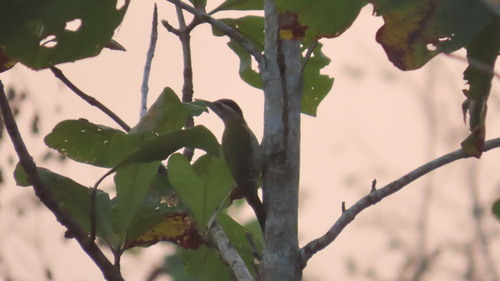 Pito Culigualdo
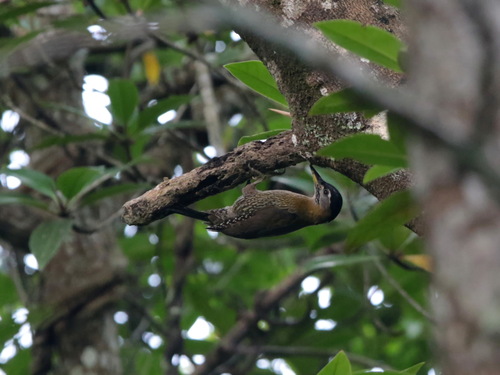 Pito Verdoso
En breve
The most reliable field mark to separate Streak-throated from Streak-breasted Woodpecker is the pattern and density of streaking on the underparts: Streak-breasted has denser, more extensive streaking below, along with a thinner pale moustache stripe and noticeably pale eyes. In contrast, Streak-throated shows a streaked throat but scaly (not streaked) whitish underparts, a broader pale moustache, and dark eyes. Both are medium-sized green woodpeckers, but careful attention to head and underpart pattern is key. Habitat can also help: Streak-throated favors drier woodland in the Indian subcontinent, while Streak-breasted is tied to moister forests and mangroves from SE Bangladesh through the Malay Peninsula.
Consejos de identificación
- Underpart streaking: Streak-breasted Woodpecker always has denser, more extensive streaking across the entire underparts, while Streak-throated has a streaked throat but the rest of the underparts are whitish and appear scaly, not streaked. This is the most consistent field mark for all ages and sexes.
- Facial pattern – moustache stripe: Streak-throated shows a broader, pale moustache stripe; Streak-breasted's pale moustache is thinner and less obvious. This is best seen at close range or in good light.
- Eye color: Streak-breasted has noticeably pale eyes, which can stand out in the field, especially in adults. Streak-throated has dark eyes. Eye color is often visible in good light or photographs.
- Throat pattern: Both species have streaked throats, but only Streak-throated has the streaking sharply confined to the throat, with the rest of the underparts scaly. Streak-breasted's streaking continues well below the throat.
- Crown color (sex differences): Males of both species have a red crown, females a blackish crown. This does not help separate the two species, but helps with sexing.
- Upperparts and rump: Both are green above with a yellowish rump; this is not useful for separation.
- Tail and bill: Both have a dark, plain tail and a smallish, dark bill. These features are similar and not diagnostic.
- Habitat context: If seen in dry woodland or foothills in India, Streak-throated is expected. If in moist lowland forest or mangroves from SE Bangladesh to the Malay Peninsula, Streak-breasted is more likely. Use with caution in overlap zones.
- Geographic range: Streak-throated is found throughout the Indian subcontinent, while Streak-breasted is limited to SE Bangladesh through the Malay Peninsula. Always consider location when identifying.
- No diagnostic flight/wing pattern: There are no documented differences in upperwing or flight pattern for immatures or adults between these two species, so do not rely on in-flight views for separation.
- Plumage pitfalls: Beware of variable lighting and wear, which can obscure the density of underpart streaking or the width of the moustache stripe. Always try to confirm with multiple field marks.
- Age/sex confusion: No specific juvenile or immature marks are noted for either species, so the main marks apply to all ages and sexes.
- Voice: No vocal differences are documented in the sources, so do not use voice for separation.
- Community tip: If you are uncertain, prioritize a clear view of the underparts and the eye color, as these are the most reliable and least variable marks.
- Photographic review: When possible, use photos to check the density of underpart streaking and eye color, especially in areas of potential range overlap or for tricky individuals.
Tamaño
Streak-breasted Woodpecker is slightly heavier on average (105 g vs 97 g for Streak-throated), but this difference is subtle and unlikely to be apparent in the field. Both are medium-sized Picus woodpeckers with similar structure and proportions, so size should not be relied on for separation.
Plumaje
For all ages, focus on the underpart and facial pattern. Streak-throated Woodpecker has a streaked throat but the rest of the underparts are whitish and appear scaly rather than streaked. Its moustache stripe is broader and pale, and the eyes are dark. In contrast, Streak-breasted Woodpecker shows denser streaking across the entire underparts (not just the throat), a much thinner pale moustache stripe, and pale eyes. Both species are green above with a yellowish rump, and males have a red crown (females blackish). Tail is dark and plain in both. No age-specific upperwing or flight pattern differences are documented in the sources, so these marks are best used on perched or foraging birds.
Comportamiento
Both species behave as typical Picus woodpeckers, foraging on trunks and branches in wooded habitats. There are no behavioral differences noted in the sources that reliably separate these two species in the field.
Hábitat
Streak-throated Woodpecker is found in drier woodland habitats, from lowlands up into foothills, across the Indian subcontinent. Streak-breasted Woodpecker, on the other hand, is restricted to subtropical or tropical moist lowland forests and mangroves, ranging from far southeastern Bangladesh to the central Malay Peninsula. If you are in dry woodland in India, Streak-throated is expected; in mangroves or moist forests in the Malay Peninsula, Streak-breasted is the likely species. However, in overlapping areas (e.g., southeastern Bangladesh), careful attention to plumage is needed.