

Minivet Chico vs Minivet Gorjigrís
Pericrocotus cinnamomeus frente a Pericrocotus solaris
Juega un quiz con Minivet Chico y Minivet Gorjigrís
 Minivet Chico
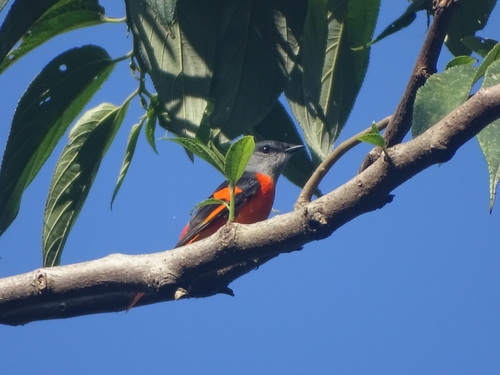 Minivet Gorjigrís
En breve
The most reliable field mark between Small Minivet and Grey-chinned Minivet is the color and extent of the underparts and head: Small Minivet males have a grey head and orange underparts fading to yellow, while Grey-chinned Minivet males show a dark grey head with a distinct pale grey chin and orange-yellow throat. Females of both are grey above and yellow below, but Small Minivet females have yellow on the face as well. Juveniles of Grey-chinned Minivet can show yellow-olive bars on the back, which Small Minivet lacks. Habitat and elevation are also useful: Small Minivet is a lowland species, while Grey-chinned Minivet prefers montane forests. Size is similar, but Grey-chinned Minivet is slightly longer and heavier.
Consejos de identificación
- Juvenile/immature plumage: Look for yellow-olive bars on the back in immature Grey-chinned Minivet; this is absent in all ages of Small Minivet. This is the best mark for separating young birds.
- Male head and chin: Male Small Minivet has a plain grey head, while Grey-chinned Minivet male has a darker grey head with a contrasting pale grey chin and orange-yellow throat. The pale chin is a key field mark for Grey-chinned.
- Male underparts: Small Minivet males have orange underparts that fade to yellow on the belly, whereas Grey-chinned Minivet males have more uniformly orange underparts and lower back, with the throat being orange-yellow.
- Female face and underparts: Female Small Minivet is grey above with yellow underparts, including the face, while Grey-chinned Minivet female is grey above and bright yellow below, but the yellow is less extensive on the face.
- Wing and tail patches: Both species have colored patches on the tail edges, rump, and wings, but Small Minivet's are orange (male) or yellow (female), while Grey-chinned's are orange (male) or bright yellow (female). The difference is subtle and best used with other marks.
- Racial variation in Small Minivet: Be aware of regional plumage variation—northwest Indian birds (P. c. pallidus) are paler with less orange, while southern (P. c. malabaricus) are darker and more extensively scarlet below. This can cause confusion with Grey-chinned, especially in duller individuals.
- Habitat and elevation: Small Minivet is a lowland species, often in open woodland or gardens; Grey-chinned Minivet is found in montane forests at 1,000–2,000 m. Use habitat and elevation as strong supporting clues.
- Size: Grey-chinned Minivet is slightly larger and heavier, but this is not easily judged in the field unless both species are present together.
- Bill and structure: Both have strong, dark bills and similar overall structure; these are not reliable for separation.
- Sexual dimorphism: Both species are sexually dimorphic, but the color contrasts (especially on the face and chin) are more pronounced in Grey-chinned Minivet.
- Perched vs. flight views: No distinctive upperwing or flight pattern differences are noted in the sources; focus on head, chin, and underparts color in all views.
- Pitfalls: Female and immature birds are the most likely to be confused, especially in poor light or at a distance. Use the combination of face color, back barring (in immatures), and habitat for best results.
- Do not rely on voice: No vocal differences are described in the available sources; do not use song or call for separation.
- Context: If you are in lowland scrub or gardens, Small Minivet is more likely; in mid-elevation forest, expect Grey-chinned Minivet.
- When in doubt: If the chin is distinctly pale and the bird is in montane forest, favor Grey-chinned Minivet; if the face is yellow and the bird is in lowland open country, favor Small Minivet.
Tamaño
Grey-chinned Minivet is marginally larger, measuring 17–19 cm in length and weighing 11–17 g (mean 14 g) [wikidata], compared to Small Minivet at 16 cm (no mass given) [wikipedia]. In the field, this size difference is subtle and unlikely to be diagnostic unless both species are seen side by side. Structure (bill, tail, wing) is similar between the two and does not offer a clear separation.
Plumaje
Juvenile and immature Grey-chinned Minivets can be separated by the presence of yellow-olive bars on the back, a feature not found in Small Minivet of any age. In adult males, Small Minivet shows a grey (not black) head and upperparts, with orange underparts fading to yellow on the belly, and orange on the tail edges, rump, and wing patches. Grey-chinned Minivet males have a darker grey head and mantle, a contrasting pale grey chin, orange-yellow throat, blackish wings, and orange underparts, lower back, and greater covert tips. Females of both species are grey above and yellow below, but Small Minivet females have yellow on the face, tail edges, rump, and wing patches, while Grey-chinned Minivet females have bright yellow replacing the male's orange areas. Racial variation in Small Minivet can cause paler or more extensive coloration, especially in the northwest (paler) and southern India (brighter).
Comportamiento
Both species are active, arboreal, and often forage in small flocks. There is no clear behavioral difference noted in the sources that would reliably separate them in the field.
Hábitat
Small Minivet is found in tropical lowland regions of southern Asia, from the Indian subcontinent east to Indonesia, favoring open woodland, scrub, and gardens at lower elevations [wikipedia]. Grey-chinned Minivet is a bird of montane forests, typically found from the Himalayas through China, Taiwan, and Southeast Asia, at elevations of 1,000–2,000 m [wikipedia]. Thus, elevation and forest type are strong context clues: a minivet in lowland open country is more likely Small, while one in mid-elevation forest is likely Grey-chinned.