

Tirahojas Mexicano vs Trepatroncos Oliváceo
Sclerurus mexicanus frente a Sittasomus griseicapillus
Juega un quiz con Tirahojas Mexicano y Trepatroncos Oliváceo
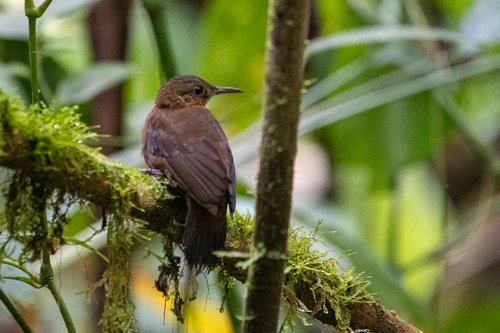 Tirahojas Mexicano
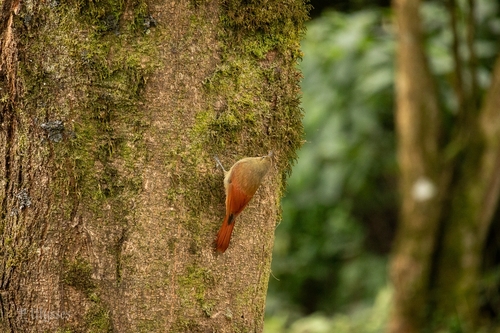 Trepatroncos Oliváceo
En breve
The most reliable field mark to separate Middle American Leaftosser from Olivaceous Woodcreeper is behavior and structure: leaftosser is a ground-dwelling, chunky bird with a decurved bill, while woodcreeper is slim, climbs tree trunks, and has a straight, short bill. In plumage, leaftosser is overall dark reddish to chestnut brown with a tawny throat, whereas woodcreeper is mostly olive to olive-brown with rufous wings and tail. Juvenile leaftossers show pale streaks on the throat and breast, a feature not present in woodcreeper. Both species can appear similar in poor light, but their foraging style and posture are usually decisive.
Consejos de identificación
- Foraging substrate is decisive: Leaftosser is always on the ground, tossing leaves and probing litter; woodcreeper is almost never on the ground, instead hitching up trunks and branches. If you see the bird's feet on bark above ground, it's a woodcreeper.
- Structure and posture: Leaftosser is chunky with a relatively long, slightly decurved bill and a short tail; woodcreeper is slim, with a short, straight bill and a longer, rufous tail. The leaftosser's bill is noticeably more downcurved when seen in profile.
- Plumage uniformity: Leaftosser is overall dark reddish to chestnut brown, with little contrast between back, wings, and tail. Woodcreeper is more contrasting, with olive or brown upperparts, a rufous tail and flight feathers, and sometimes a visible wing band in flight.
- Juvenile marks: Juvenile leaftosser shows pale streaks on the throat and breast, absent in woodcreeper of any age.
- Wing and tail in flight: Woodcreeper shows a rufous or tawny wing band and rufous tail in flight, especially in the 'grayish' and 'Pacific' groups; leaftosser is more uniform, with no wing band and a chestnut tail that does not contrast as much.
- Bill color: Both have dark maxillae, but leaftosser has a bicolored mandible (dark with pale base), while woodcreeper's mandible is black to light gray, sometimes with a darker tip.
- Leg color: Both have dark legs, but leaftosser's are dark brownish gray, woodcreeper's can be gray, bluish gray, or black.
- Eye color: Both have dark irises; not a useful separation.
- Sexes: Both species are sexually monomorphic in plumage; size difference in woodcreeper (females smaller) is not field-diagnostic.
- Mixed flocks: Woodcreeper often joins mixed-species flocks or follows ant swarms; leaftosser does not join flocks and is usually alone or in pairs.
- Habitat within forest: Leaftosser is restricted to the ground layer; woodcreeper is usually above ground, from understory to subcanopy.
- Pitfalls: In poor light, leaftosser can look dull brown and woodcreeper can appear darker, but the foraging behavior and bill shape are reliable. Beware of subspecific variation in woodcreeper, which can make some individuals browner or more olive, but the rufous tail and climbing behavior remain good clues.
- Vocalizations: Not covered in the notes; do not rely on song or call for separation here.
- Season and molt: No seasonal plumage changes are noted for either species; age-related marks (streaked throat in juvenile leaftosser) are the only age-specific feature.
- Context: If you flush a bird from the ground in deep leaf litter, suspect leaftosser; if you see a bird moving vertically on a trunk, it's a woodcreeper.
Tamaño
Middle American Leaftosser is heavier and more robust, with a body mass around 25 g [wikidata], and measures 15–17 cm in length. Olivaceous Woodcreeper is smaller and lighter, with males weighing 9–18 g and females 8.6–16 g, and a length range of 13.1–19.3 cm depending on subspecies [wikipedia]. Despite some overlap in length, the leaftosser is noticeably bulkier and more solid, while the woodcreeper is slender and lightweight.
Plumaje
Juvenile Middle American Leaftosser can be told by its overall duller brown coloration and pale streaks on the throat and breast, which are absent in Olivaceous Woodcreeper. Adult leaftosser is uniform dark reddish to chestnut brown above, with a tawny-rufous throat and chest, and darker brown wings. Its tail and rump are chestnut. In contrast, Olivaceous Woodcreeper adults are mostly olive to olive-brown, with a rufous rump, tail, and flight feathers, and a tawny or whitish wing band visible in flight in some subspecies. The woodcreeper lacks any streaking or spotting and has a more contrasting wing and tail pattern, especially in flight, while the leaftosser is more uniform. Subspecific variation in woodcreeper can cause the back to be browner or more olive, but the rufous tail and flight feathers are consistent. The leaftosser’s bill is longer and slightly decurved, while the woodcreeper’s is short and straight.
Comportamiento
Middle American Leaftosser forages exclusively on the ground, flipping leaves and probing in leaf litter, always hopping rather than walking, and never climbing trunks. It is typically solitary or in pairs and does not join mixed-species flocks. Olivaceous Woodcreeper, in contrast, forages by hitching up tree trunks, branches, and vines, rarely coming to the ground. It often joins mixed-species feeding flocks, sometimes forming their core, and may follow army ant swarms or even foraging monkeys. These differences in foraging behavior and substrate are usually obvious in the field.
Hábitat
Both species can occur in similar tropical and subtropical forests from Mexico to Panama, but their microhabitat preferences differ. Leaftosser is always on or near the forest floor, in dense leaf litter, while woodcreeper is found from the understory to the subcanopy, rarely on the ground. If you see a bird climbing a trunk or branch, it is a woodcreeper; if it is tossing leaves on the ground, it is a leaftosser.
Tirahojas Mexicano · Trepatroncos Oliváceo · Mis aves difíciles