

Witwenpfeifgans vs Schmuckzwergente
Dendrocygna viduata gegen Nettapus auritus
Ein Quiz mit Witwenpfeifgans und Schmuckzwergente spielen
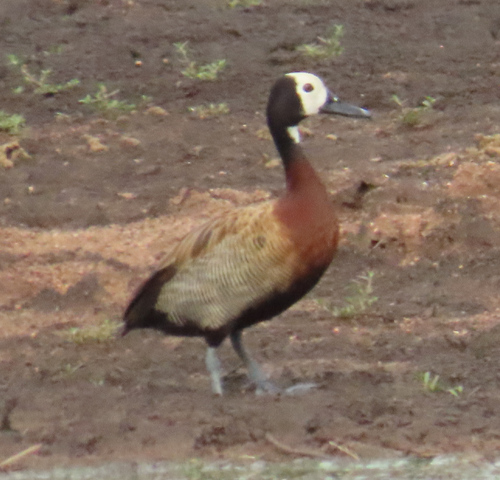 Witwenpfeifgans
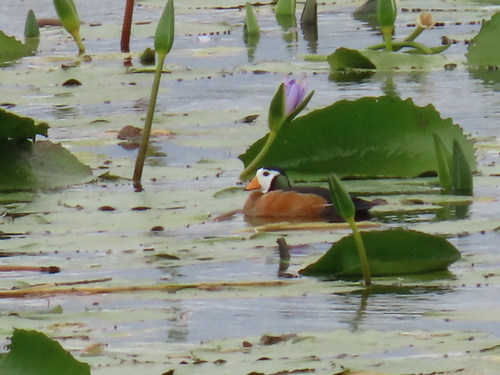 Schmuckzwergente
Kurz gesagt
The most reliable field mark to separate White-faced Whistling-Duck from African Pygmy-Goose is overall size and structure: the whistling-duck is much larger, lankier, and long-necked, while the pygmy-goose is tiny, compact, and short-necked. In all plumages, the whistling-duck shows a distinctive white face with a black head and neck, while the pygmy-goose (male) has a white face with green and black patches, and the female has a gray face with dark smudges. In flight or at rest, the pygmy-goose’s metallic green and white wing pattern contrasts with the whistling-duck’s plain dark wings. Juvenile whistling-ducks lack strong head contrast, which can cause confusion, but the pygmy-goose’s small size and bill shape remain distinctive. Both species may be seen together on African wetlands, but their structure and plumage differences are clear with good views.
Bestimmungstipps
- Size and structure: The whistling-duck is much larger and longer-necked than the pygmy-goose. If you see both together, the pygmy-goose looks tiny and compact.
- Bill shape: Whistling-duck has a long, grey bill; pygmy-goose has a short, stubby bill that rises up the forehead, giving a 'goose-like' look.
- Head and face pattern (adults): Whistling-duck shows a crisp white face with a black head and neck; male pygmy-goose has a white face with black eye patches and green ear patches, while the female has a gray face with brown smudges and a dark eye stripe.
- Juvenile confusion: Juvenile whistling-ducks have a less contrasted face, but still show a long neck and large body. Juvenile pygmy-geese have a white face with a black crown and eye patch, but are always much smaller and shorter-necked.
- Neck color: Whistling-duck’s neck is chestnut on the sides, black in front; pygmy-goose has a white upper neck (male) or dark brown (female), with no chestnut collar.
- Flank and underpart pattern: Whistling-duck has black underparts with fine white barring on the flanks; pygmy-goose has chestnut flanks and a white belly.
- Back and wing color: Whistling-duck’s back and wings are dark brown to black; pygmy-goose’s back is metallic green, and in flight shows a white bar on the wing (distal secondaries) and iridescent green coverts.
- Tail: Pygmy-goose has a short, black tail; whistling-duck’s tail is less prominent and blends with the dark back.
- Legs: Whistling-duck has longish legs, often visible when standing; pygmy-goose has short legs, usually hidden in floating vegetation.
- Flight style: Whistling-duck flies with slow, steady wingbeats and extended neck; pygmy-goose has rapid wingbeats and a compact, short-necked profile.
- Flock size: Large, noisy flocks are almost always whistling-ducks; pygmy-geese are in pairs or small groups.
- Habitat preference: Whistling-ducks use open water and large wetlands; pygmy-geese prefer small, lily-covered ponds and quiet backwaters.
- Voice: A clear, repeated three-note whistle is diagnostic of whistling-duck; pygmy-goose is generally silent.
- Sex differences: Whistling-ducks are not sexually dimorphic; pygmy-goose males and females differ in face pattern and coloration.
- Seasonal changes: Both species are resident or nomadic; plumage does not vary much by season, but juvenile whistling-ducks may lack strong facial contrast.
Größe
White-faced Whistling-Duck is much heavier (674g) and visibly larger than African Pygmy-Goose (male ~285g, female ~260g). The whistling-duck is long-necked, long-legged, and has a proportionally long body and bill. In contrast, the pygmy-goose is one of Africa’s smallest waterfowl, with a short neck, compact body, and short, stubby bill. Even at a distance or in mixed flocks, the size gap is striking: pygmy-geese appear about half the length and far less than half the bulk of whistling-ducks.
Gefieder
- Juvenile/immature plumage: Juvenile White-faced Whistling-Ducks resemble adults but with a less contrasted head pattern, making the white face less obvious and potentially confusing with female or immature pygmy-geese. However, the pygmy-goose juvenile still shows a white face with a black crown and eye patch, and a compact shape. Juvenile pygmy-geese have a V-shaped black crown and white face, but their small size and short bill remain distinctive.
- Adult males: White-faced Whistling-Duck has a striking white face, black head and neck, chestnut neck sides, dark brown to black back and wings, and black underparts with fine white barring on the flanks. African Pygmy-Goose males have a white face with black eye patches, green ear patches, black crown and nape, white upper neck, chestnut breast and flanks, metallic green back, and a yellow bill with a black tip. The pygmy-goose’s wing coverts are metallic green with a white bar on the distal secondaries, and the belly is white.
- Adult females: Female pygmy-geese have a gray face with a dark brown eye stripe and smudged brown patches, dark brown crown and nape, and chestnut flanks. Female whistling-ducks are similar to males, with no strong sexual dimorphism.
- In flight: Pygmy-goose shows a white bar on the wing and metallic green coverts, while whistling-duck’s wings are plain dark brown to black. The pygmy-goose’s compact shape and rapid wingbeats contrast with the whistling-duck’s more languid flight.
Verhalten
White-faced Whistling-Ducks are highly gregarious, often forming flocks of hundreds or thousands, especially at dawn. They are noisy, conspicuous, and usually swim or stand upright with long necks extended. African Pygmy-Geese are typically seen in pairs or small groups, rarely in large flocks. They perch on floating vegetation or low branches, feed mainly on water lily seeds, and are less vocal and showy than whistling-ducks. Pygmy-geese are more likely to be seen dabbling among water lilies or making short, rapid flights over water.
Lebensraum
Both species can occur on inland wetlands in sub-Saharan Africa, but White-faced Whistling-Ducks favor open water, lakes, and large marshes, often in large flocks. African Pygmy-Geese are more closely tied to slow-flowing or stagnant water with abundant water lilies and floating vegetation, including small ponds and quiet river pools. Pygmy-geese are more likely in habitats with dense floating plant cover, while whistling-ducks tolerate more open water.
Stimme
White-faced Whistling-Ducks are notably noisy, giving a clear three-note whistling call, especially in flight or when alarmed. African Pygmy-Geese are much quieter and less vocal in general. If you hear a loud, repeated whistling chorus, it is almost certainly the whistling-duck.
Witwenpfeifgans · Schmuckzwergente · Meine schwierigen Vögel