
Temminckstrandläufer vs Rotkehl-Strandläufer
Calidris temminckii gegen Calidris ruficollis
Ein Quiz mit Temminckstrandläufer und Rotkehl-Strandläufer spielen
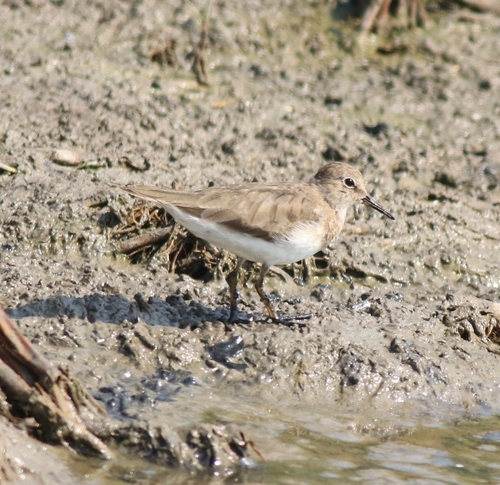 Temminckstrandläufer
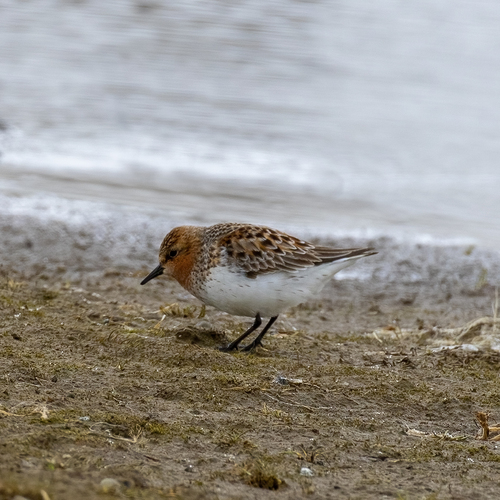 Rotkehl-Strandläufer
Kurz gesagt
The most reliable field mark to separate Temminck's Stint from Red-necked Stint is leg color: Temminck's has dull yellowish or brown legs, while Red-necked Stint has dark legs. In flight or at rest, Temminck's also shows white outer tail feathers, compared to the darker outer tail of Red-necked. Both are tiny, plain sandpipers, but Temminck's is drabber overall and lacks the brighter rufous or orange tones of Red-necked in breeding plumage. Juvenile and winter birds can be especially tricky, but leg and tail color remain dependable. Structure and behavior offer additional clues, but are more subtle.
Bestimmungstipps
- Leg color is the most reliable field mark: Temminck's Stint always has dull yellowish or brown legs, while Red-necked Stint has dark (blackish) legs. This works in all ages and seasons, but beware of mud or lighting that can obscure leg color.
- Tail color in flight or when preening: Temminck's shows white outer tail feathers; Red-necked's outer tail feathers are grey/dark. This is visible when the tail is fanned or in flight, and is a strong separator in all plumages.
- Breeding plumage brightness: Red-necked Stint in breeding plumage has a bright orange (rufous) unstreaked breast and a white V on the back, bordered below by dark marks. Temminck's is much plainer, with only some rufous or blackish mantle feathers and a generally drab brown appearance.
- Juvenile/immature mantle pattern: Red-necked juveniles have more contrasting mantle feathers and weaker white lines down the back than Temminck's, which is plainer and less patterned. This is subtle and best used with other marks.
- Bill structure: Both have fine, straight bills, but Red-necked is described as having a particularly fine bill tip. This is a minor point and not always visible at a distance.
- Primary projection and structure: Both are described as shorter-legged and longer-winged than Little Stint, but not reliably different from each other in these notes. Do not rely on wing length or leg length between these two.
- Underpart color: Temminck's has white underparts with a darker breast, but Red-necked in breeding has a clear orange breast. In winter, both are duller and this is not reliable.
- Behavior: Red-necked Stint is more likely to be seen in tight, active flocks with other small waders, and may move more quickly. Temminck's is less gregarious. Use this only as supporting context.
- Voice: If you hear a hoarse 'stit' call, it points to Red-necked Stint, but silence or generic peeping is not useful for Temminck's.
- Habitat and range: In Europe, Africa, and western Asia, a stint with yellowish legs is almost certainly Temminck's. In Southeast Asia and Australasia, Red-necked is the default. In East Asia, both can occur, so use structural and plumage marks.
- Pitfalls: Mud can obscure leg color, and lighting can make brown legs look dark. Always check multiple features if possible.
- Size: Both are essentially identical in size and mass; do not use size for separation.
- Sex and age: No sexual dimorphism is described; all marks above work for both sexes. Juvenile and winter birds are hardest, but leg and tail color remain reliable.
- Perched vs. in flight: Tail color is best checked in flight or when the bird is preening. Leg color is best seen when the bird is standing or walking.
- Summary for quick check: If you see a tiny stint with yellowish legs and white outer tail, it's Temminck's; if the legs are black and the outer tail is not white, it's Red-necked.
Größe
Both species are extremely similar in size and mass, with Temminck's Stint averaging 26.05g and Red-necked Stint 26.0g. Length overlaps: Temminck's is 13.5–15 cm, Red-necked 13–17 cm. In the field, neither is noticeably larger or smaller than the other, and size alone is not a safe separator.
Gefieder
- Juvenile/first-winter/immature: No distinctive upperwing pattern differences are described for these ages between the two species. Both are rather plain above, but Temminck's is generally drabber brown, while Red-necked juveniles have more contrasting mantle feathers and weaker white lines down the back.
- Adult breeding: Temminck's is plain brown above with some rufous or blackish mantle feathers, but overall dull; Red-necked shows a clear orange (rufous) unstreaked breast and a white V on the back, bordered below by dark marks—much brighter and more patterned than Temminck's.
- Adult non-breeding/winter: Both become duller, but Temminck's remains plainer, with grey to greenish-grey or brownish-grey upperparts and a darker breast; Red-necked is still a bit more contrasting, but identification is difficult in this plumage.
- Tail: Temminck's always shows white outer tail feathers, Red-necked has darker (grey) outer tail feathers.
- Legs: Temminck's legs are dull yellowish or brown; Red-necked's are dark (blackish).
Verhalten
Red-necked Stint is noted for quicker movements and is often highly gregarious, forming flocks with other small Calidris waders. Temminck's Stint is not described as especially gregarious and may appear more solitary or in small groups. In direct comparison, Red-necked may seem more active and social, but this is subtle and not always diagnostic.
Lebensraum
Both species are migratory waders, but their main non-breeding ranges do not overlap much: Temminck's is native to the Old World (Europe, Asia, Africa), while Red-necked breeds in northeast Russia and winters in Southeast Asia and Australasia. In areas of overlap (e.g., East Asia on migration), both may be found on muddy or sandy shores, but context is only a weak clue.
Stimme
Red-necked Stint gives a hoarse 'stit' call. No distinctive vocalization is described for Temminck's Stint in the provided notes, so voice is not a reliable separator unless the 'stit' call is heard and confidently attributed.
Temminckstrandläufer · Rotkehl-Strandläufer · Meine schwierigen Vögel