

Guineataube vs Olivkopfweber
Columba guinea gegen Ploceus olivaceiceps
Ein Quiz mit Guineataube und Olivkopfweber spielen
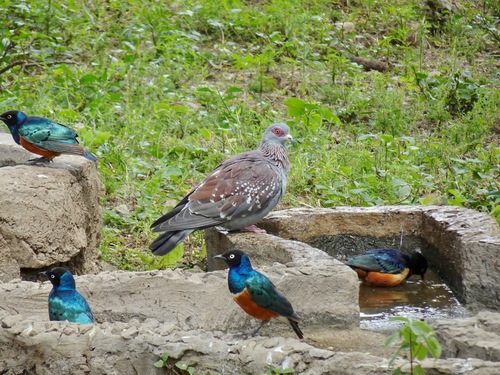 Guineataube
 Olivkopfweber
Kurz gesagt
The most reliable way to separate Speckled Pigeon from Olive-headed Weaver is by their dramatic size difference and overall structure: Speckled Pigeon is a large, heavy-bodied pigeon with rufous wings speckled white, while Olive-headed Weaver is a small, slender songbird with a plain olive-toned head and much finer bill. Immature Speckled Pigeons lack the adult's red eye patch but are still much larger and browner than any weaver. In flight or perched, the pigeon's broad, rounded wings and red bare skin around the eye (in adults) are unique. Habitat can help: pigeons are often seen in open areas and around buildings, while weavers stick to dry forests. Even at a distance, the pigeon's size and shape are unmistakable compared to the tiny, active weaver.
Bestimmungstipps
- Size is decisive: Speckled Pigeon is over 15 times heavier than Olive-headed Weaver. If the bird looks pigeon-sized or larger than a dove, it cannot be the weaver (all ages).
- Structure and jizz: Pigeon has a thick neck, broad chest, and large, rounded wings; weaver is slender, with a fine bill and short, pointed wings (all ages).
- Bill shape: Pigeon’s bill is thick and blunt, suited for seeds; weaver’s bill is thin, pointed, and conical (all ages).
- Wing pattern in flight: Speckled Pigeon (adult and immature) shows rufous wings with prominent white speckling; weaver’s wings are plain and unmarked.
- Head pattern: Adult pigeon has a grey head with a striking red bare patch around the eye; immatures lack the red but are still grey-headed and much larger than any weaver.
- Neck and breast: Pigeon’s neck is brownish with white streaks; weaver’s plumage is more uniform and lacks streaking or contrasting patches.
- Leg color: Pigeon has red legs, visible when perched; weaver’s legs are not described as distinctive in the notes.
- Plumage contrast: Pigeon’s plumage is boldly patterned with rufous, white, grey, and brown; weaver is plain olive-headed and lacks strong contrasts.
- Behavior: Pigeon often walks on the ground or perches on buildings and rocks; weaver is active in trees and shrubs, rarely on the ground.
- Habitat: Pigeon is common in open country, cities, and farmland; weaver is restricted to dry forests and avoids urban areas.
- Flocking: Pigeon can gather in large flocks, especially near grain or food sources; weaver is more likely in small groups or pairs in trees.
- Voice: A deep, repetitive 'doo-doo-doo' call indicates pigeon; weaver’s calls are likely higher-pitched and less resonant.
- Immature confusion: Young pigeons lack the red eye patch but remain much larger and browner than any weaver; the speckled wings are still visible.
- Perched posture: Pigeon sits upright and bulky; weaver perches more horizontally and appears delicate.
- Geographic overlap: If outside Malawi, Mozambique, Tanzania, or Zambia, the weaver is unlikely; pigeon is widespread in sub-Saharan Africa but with some gaps.
Größe
Size is the most immediate separator: Speckled Pigeon averages 328 g, making it over 15 times heavier than Olive-headed Weaver at just under 21 g [wikidata]. The pigeon is a medium-sized bird, 32–35 cm long, similar to a Rock Dove, with a bulky body and broad wings. The weaver is a small, sparrow-sized bird, much more delicate and compact. Even without direct comparison, the pigeon’s size and mass are obvious in the field, especially when perched or in flight.
Gefieder
Plumage differences are stark at all ages. Adult Speckled Pigeon shows rufous back and wings heavily speckled with white, blue-grey upperparts and underparts, a grey head with conspicuous red bare skin around the eye, and a brownish, white-streaked neck. Immatures are browner overall and lack the red eye patch, but still show the distinctive speckled wing pattern. Olive-headed Weaver, by contrast, has a plain olive-toned head and generally lacks any bold patterning or speckling. Its plumage is much more uniform and lacks the pigeon's contrasting colors and markings. The pigeon's red legs and bare eye skin are never matched by the weaver. In flight, the pigeon's broad, rounded wings and white speckling are obvious, while the weaver's wings are short, pointed, and unmarked.
Verhalten
Speckled Pigeon is often seen walking on the ground, perching on rooftops or rocky outcrops, and gathering in flocks where food is abundant, especially near human habitation. Its flight is strong and direct, with regular wingbeats and occasional sharp flicks. Olive-headed Weaver is much more active and agile, typically foraging in trees and shrubs, rarely on the ground, and often seen moving quickly through foliage. The weaver’s behavior is more typical of small passerines: restless, acrobatic, and often in small groups.
Lebensraum
Speckled Pigeon prefers open habitats, including urban areas, agricultural fields, and rocky outcrops, and is frequently found near human settlements across much of sub-Saharan Africa [wikipedia]. Olive-headed Weaver is restricted to subtropical or tropical dry forests in Malawi, Mozambique, Tanzania, and Zambia, and avoids open or urban habitats. If the bird is seen in a city, on a roof, or in open farmland, it is almost certainly a Speckled Pigeon; if in a dry forest canopy, the weaver is more likely.
Stimme
Speckled Pigeon gives a loud, repetitive 'doo-doo-doo' call, typical of pigeons [wikipedia]. Olive-headed Weaver’s vocalizations are not described in the provided notes, but as a weaver, it is likely to give higher-pitched, more complex or chattering calls, very different from the deep, resonant pigeon coo. If you hear a classic pigeon call, it is not the weaver.