

Zimtkehlschwalbe vs Fuchsschwalbe
Stelgidopteryx ruficollis gegen Alopochelidon fucata
Ein Quiz mit Zimtkehlschwalbe und Fuchsschwalbe spielen
 Zimtkehlschwalbe
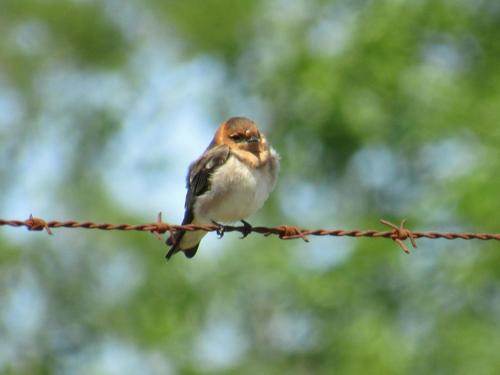 Fuchsschwalbe
Kurz gesagt
The most reliable field mark between Southern Rough-winged Swallow and Tawny-headed Swallow is the color and extent of rufous or tawny on the head and throat: Tawny-headed Swallow shows a broad, rich tawny-rufous wash across the entire crown, forehead, eyebrow, and throat, while Southern Rough-winged Swallow has a more limited cinnamon throat with a darker gray-brown crown. Juveniles of both species are duller, but Tawny-headed still shows a buffy head. Both are similar in size and shape, with square tails and brownish upperparts, but careful attention to head and throat color—especially in perched birds—will separate them. In flight, both are fairly plain below, but Tawny-headed Swallow's head and breast color can stand out in good light.
Bestimmungstipps
- Head and throat color (all ages): Tawny-headed Swallow shows a broad, rich tawny-rufous wash across the entire crown, forehead, eyebrow, hindcrown, ear coverts, throat, and breast. Southern Rough-winged Swallow is darker gray-brown on the crown and face, with rufous limited to the throat.
- Juvenile head pattern: Juvenile Tawny-headed Swallow has a buff (not rufous) head and buff-tinged feathers, still paler than the rest of the upperparts. Juvenile Southern Rough-winged Swallow is more uniformly gray-brown above, with a duller throat and pale feather edges on the back.
- Upperparts: Both species have gray-brown upperparts and a paler rump, but Southern Rough-winged Swallow may show a slightly paler or even whitish rump in some subspecies (notably S. r. uropygialis), which can be a pitfall.
- Underparts: Tawny-headed Swallow has dull white underparts with pale gray-brown sides, while Southern Rough-winged Swallow is yellowish gray-brown below with white undertail coverts. This is subtle and best used in good light.
- Tail shape: Both have square or nearly square tails; tail shape is not a reliable separator.
- Wing features: No distinctive upperwing pattern or flight mark separates these species in any age; both are plain dark brown above in flight.
- Sex differences: Both species are sexually monomorphic in plumage, though male Southern Rough-winged Swallow has stiff recurved barbs on the outer primaries (not visible in the field).
- Bill: Both have black bills of similar shape and size; bill color and structure are not diagnostic.
- Size: Southern Rough-winged Swallow is slightly larger on average, but the difference is too small to be useful in the field.
- Habitat context: In open grassland or savanna, especially in southern South America, Tawny-headed Swallow is more likely. Near water, forest clearings, or at higher elevations, Southern Rough-winged Swallow is more likely, but check head color carefully.
- Flocking: Southern Rough-winged Swallow may form large flocks outside the breeding season; Tawny-headed is usually seen in smaller groups.
- Voice: If you hear a soft, trilled 'treeeeb' call, this points to Tawny-headed Swallow. Southern Rough-winged's call is not distinctive in the notes.
- Pitfalls: Beware of paler-rumped Southern Rough-winged Swallow subspecies, which can look superficially similar to Tawny-headed in poor light. Always check the extent and intensity of tawny/rufous on the head and throat.
- Perched birds: Focus on the face and throat color—Tawny-headed's broad tawny wash is diagnostic at rest.
- In flight: Head and throat color can be seen in good light, but otherwise, these species are very similar in flight silhouette and pattern.
Größe
Southern Rough-winged Swallow is slightly larger, averaging about 13 cm and 14–18 g, while Tawny-headed Swallow is around 12 cm and 13–15 g. This difference is subtle and not usually helpful in the field, as their proportions and jizz are very similar. Both have square or nearly square tails and similar wing lengths, so size alone is not a reliable separator.
Gefieder
- Juvenile/immature birds: Both species have duller plumage as juveniles, but Tawny-headed Swallow juveniles have a buff (not rufous) head and buff-tinged feathers, while Southern Rough-winged Swallow juveniles show a duller throat and pale edges to the back feathers. The head of juvenile Tawny-headed is still distinctly paler than the rest of the upperparts, while juvenile Southern Rough-winged is more uniform gray-brown above with less contrast.
- Adults: Tawny-headed Swallow adults have a prominent tawny-rufous wash across the forehead, eyebrow, hindcrown, ear coverts, throat, and breast, contrasting with gray-brown upperparts and a paler rump. Southern Rough-winged Swallow adults have a cinnamon throat but a mostly dark gray-brown crown and upperparts, with less extensive rufous and a more uniform dark face. Both have dark wings and square tails, but Southern Rough-winged Swallow may show a slightly paler rump in some subspecies. Underparts are pale in both, but Tawny-headed has a dull white belly with pale gray-brown sides, while Southern Rough-winged is yellowish gray-brown below with white undertail coverts.
Verhalten
Both species feed on insects in flight, often low over open areas or water. Southern Rough-winged Swallow is known to forage in small flocks with slow, low flight, and forms large flocks outside the breeding season. Tawny-headed Swallow's foraging behavior is similar, but it is more closely associated with open grasslands and savannas. Both perch on wires or exposed branches, and their flight styles are not distinctly different in the field.
Lebensraum
Southern Rough-winged Swallow is found in a wide range of open habitats, especially near water, from lowlands up to high elevations (occasionally up to 3,600 m), and is widespread across Central and South America except Chile. Tawny-headed Swallow is more restricted to dry savanna and seasonally wet or flooded lowland grassland, especially in southern South America, and is less likely to be found in forest clearings or at higher elevations. Overlap is possible in open country, but Tawny-headed is more tied to grassland and pampas habitats.
Stimme
Tawny-headed Swallow gives a soft, trilled 'treeeeb' flight call. No distinctive vocalization is described for Southern Rough-winged Swallow in the provided notes, so voice is unlikely to be a reliable separator unless the Tawny-headed's call is heard distinctly.