

Orangelappenvogel vs Huialappenvogel
Callaeas cinereus gegen Heteralocha acutirostris
Ein Quiz mit Orangelappenvogel und Huialappenvogel spielen
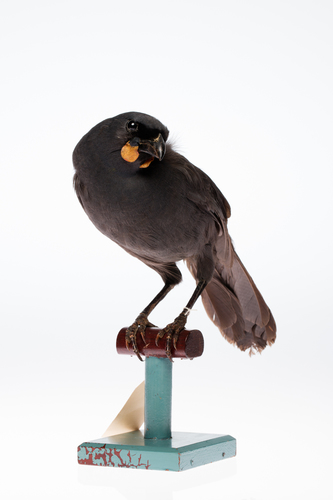 Orangelappenvogel
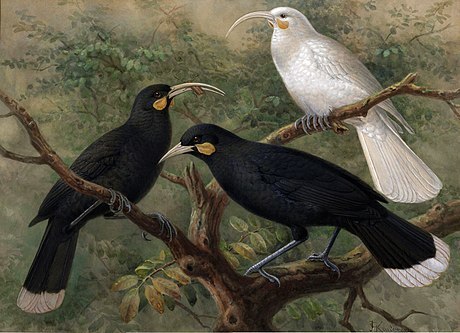 Huialappenvogel
Kurz gesagt
The most reliable way to separate South Island Kokako from Huia is by looking at the wattles and tail: South Island Kokako has mainly orange wattles with a blue base and a plain, slate-grey tail, while Huia shows bright orange wattles and a striking long black tail with bold white tips. In flight or perched, Huia’s tail pattern is unique and visible even on immatures. Bill shape is also diagnostic: Huia shows extreme sexual dimorphism, with the female’s long, decurved ivory bill and the male’s much shorter, slightly arched bill, while South Island Kokako’s bill is short and dark. Both are extinct or nearly so, but confusion can arise in historical records or rare sighting claims. Immature Huia can be told by their smaller pale wattles and brown-flecked plumage, but even then, the tail pattern remains a key mark.
Bestimmungstipps
- Tail pattern is the most reliable field mark: Huia of all ages has a long black tail with broad white tips (2.5–3 cm), visible in flight and when perched. South Island Kokako’s tail is plain slate-grey with no white.
- Wattle color and shape: South Island Kokako has mostly orange wattles with a small blue base, while Huia’s wattles are bright orange and rounded. Young Kokako have paler wattles; young Huia have small pale wattles.
- Bill shape (especially in Huia): Huia shows extreme sexual dimorphism: females have a long, slender, decurved ivory bill; males have a shorter, slightly curved bill. South Island Kokako’s bill is short, dark, and never decurved. If you see a bird with a long, downcurved ivory bill, it is a female Huia.
- Plumage color: South Island Kokako is a paler, slate-grey bird with a small black mask; Huia is glossy black with a greenish sheen. Immature Huia is duller, flecked with brown, but still blackish overall.
- Immature/juvenile marks: Young Huia have brown-flecked, duller plumage and a reddish-buff tinge to the white tail tips, but the tail pattern is always present. Young Kokako have lighter wattles but otherwise resemble adults.
- Size and structure: Huia is larger and more elongated, with a much longer tail and, in females, a long decurved bill. Kokako is more compact, with a shorter tail and legs.
- Flight and jizz: In flight, Huia’s long white-tipped tail is obvious; Kokako appears more compact and plain.
- Habitat and range: South Island Kokako was only found in South Island/Stewart Island forests; Huia was strictly North Island, in specific mountain ranges. Any sighting outside these areas is almost certainly not valid.
- Behavior: Kokako spent more time on the ground; Huia was more arboreal and specialized in probing wood.
- Voice: If heard, Kokako’s mellow, organ-like duets are distinctive; Huia’s call is less well known.
- Sexual dimorphism: Only Huia shows extreme bill dimorphism; both sexes of Kokako look similar.
- Pitfalls: In poor light, Kokako’s paler grey can look dark, but the lack of a white tail tip and the wattle color remain diagnostic.
- Historical context: Both are extinct or nearly so; modern sightings are unconfirmed and should be scrutinized for these marks.
- Confusion with North Island Kokako: South Island Kokako is slightly paler and has different wattle color than its North Island relative, but neither can be confused with Huia due to tail and bill.
- Photographic evidence: For any claimed sighting, insist on a clear view of the tail and bill to confirm identity.
Größe
Huia was the larger of the two, with males reaching about 45 cm and females up to 48 cm in length, and a notably long tail (about 20 cm). South Island Kokako was smaller and more compact, with an average weight of 230g but no direct length given; it was less elongated overall. Huia’s wingspan (20–22 cm) is not much greater than Kokako’s body, but the tail adds to its long, elegant appearance. Kokako is more robust and shorter-tailed in comparison.
Gefieder
Juvenile and immature Huia are easily separated from South Island Kokako by their tail: even young Huia show a long black tail with broad white tips, sometimes with a reddish-buff tinge, while Kokako’s tail is plain slate-grey. Immature Huia also have small pale wattles and brown-flecked, duller plumage, but the tail pattern is always present. Adult South Island Kokako is overall paler slate-grey (slightly lighter than North Island Kokako), with a small black mask and distinctive orange wattles with a blue base; young Kokako have much paler wattles. Adult Huia is glossy black with a greenish sheen, prominent orange wattles, and the unmistakable white-tipped tail. Huia also shows sexual dimorphism in bill shape, but both sexes share the same plumage and tail pattern. In summary, tail pattern (Huia) and wattle color (Kokako) are the best age-independent marks.
Verhalten
South Island Kokako was more terrestrial than its North Island relative, often foraging and nesting close to the ground but was a better flier. Huia, in contrast, was arboreal and specialized in probing wood for invertebrates, with the sexes using different foraging techniques due to their bill shapes. Kokako’s behavior included more time on the ground, while Huia was more often seen in trees or on trunks. Both could move quietly through dense forest, but Huia’s foraging was often more methodical and specialized.
Lebensraum
South Island Kokako was found in mature, dense forests of the South Island and Stewart Island, often in wetter, more intact tracts. Huia was confined to southern North Island mountain forests, especially in the Ruahine, Tararua, Rēmutaka, and Kaimanawa ranges. Both required old-growth forest, but their ranges never overlapped. Any modern report outside these historical ranges is highly suspect.
Stimme
South Island Kokako was known for its organ- and flute-like duets, with mellow, sweet, and few notes. Huia’s voice is not described in detail in these notes, but is not known for similar duetting. Kokako’s song would be more musical and distinctive if heard, but in practice, vocalizations are unlikely to be a field mark due to both species’ rarity/extinction.
Orangelappenvogel · Huialappenvogel · Meine schwierigen Vögel