

Motmot

Rotschwanz-Glanzvogel vs Riesenglanzvogel

Galbula ruficauda gegen Jacamerops aureus

Ein Quiz mit Rotschwanz-Glanzvogel und Riesenglanzvogel spielen
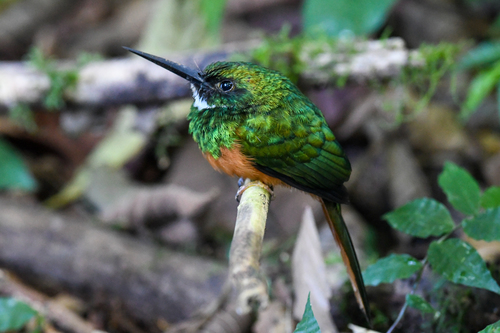
Rotschwanz-Glanzvogel (Galbula ruficauda) Rotschwanz-Glanzvogel
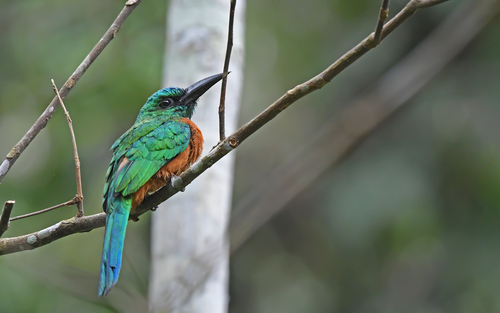
Riesenglanzvogel (Jacamerops aureus) Riesenglanzvogel

Medien

Laden…

Kurz gesagt

The most reliable field mark between Rufous-tailed Jacamar and Great Jacamar is overall size and bulk: Great Jacamar is noticeably larger and heavier-bodied, with a deeper bill and a more robust appearance. Both species share a metallic green upperpart and rufous underparts, but Great Jacamar has a darker, blue-black tail and a richer, deeper rufous belly, while Rufous-tailed Jacamar's tail is bright rufous and matches the belly. Sexes differ subtly in both, but the white throat patch in males is more sharply defined in Great Jacamar. In perched or flight views, focus on tail color and overall size for the quickest separation.

Bestimmungstipps

  1. Size and bulk: Great Jacamar is much heavier-bodied and larger overall; if the bird looks chunky and robust, suspect Great Jacamar. Rufous-tailed Jacamar is slim and delicate.
  2. Tail color: Rufous-tailed Jacamar has a bright rufous tail matching its belly; Great Jacamar's tail is blue-black, contrasting with the rufous belly. This is often visible in both perched and flight views.
  3. Belly and undertail: Rufous-tailed Jacamar's underparts and undertail are both rufous, with a green breast band. Great Jacamar's belly is a deeper, richer rufous, and the undertail is dark.
  4. Back and upperparts: Both are metallic green above, but Great Jacamar may show gold, blueish, or purple-copper tones, especially on the back and tail.
  5. Throat patch (sex-specific): Male Rufous-tailed Jacamar has a broad white throat; female's is buff. Great Jacamar male has a smaller, sharply defined white lower throat; female lacks any white on the throat. If the throat is buff or pale, check for other marks to confirm species and sex.
  6. Bill shape and length: Great Jacamar's bill is deeper and heavier, fitting its bulkier head. Rufous-tailed Jacamar's bill is long, thin, and straight, accentuating its slender look.
  7. Perching posture: Rufous-tailed Jacamar often sits upright with bill tilted up, usually in open or edge habitats. Great Jacamar perches more horizontally and deeper in the forest.
  8. Habitat context: In open woodland, clearings, or forest edge, Rufous-tailed Jacamar is far more likely. In shaded, humid lowland rainforest, especially mid-canopy, expect Great Jacamar.
  9. Flight style: Great Jacamar flies with slower, heavier wingbeats and appears less agile. Rufous-tailed Jacamar is quicker and more graceful in flight.
  10. Sex differences: Female Rufous-tailed Jacamar has a buff throat and paler underparts; female Great Jacamar lacks the white throat spot entirely but otherwise resembles the male.
  11. No age-specific wing pattern: Neither species shows distinctive juvenile or immature upperwing marks, so do not rely on wing pattern in flight for separation.
  12. Vocalizations: If you hear a sharp 'pee-op' or high, trilling song, it supports Rufous-tailed Jacamar, but absence of song is not diagnostic for Great Jacamar.
  13. Bill length in subspecies: Rufous-tailed Jacamar subspecies G. r. brevirostris has a shorter bill, but still appears slimmer than Great Jacamar.
  14. Tail vs. body contrast: If the tail is as bright as the belly, it's Rufous-tailed; if the tail is much darker than the belly, it's Great Jacamar.
  15. Contextual clues: If you are in Central America or at the northern edge of the range, Rufous-tailed Jacamar is more likely; Great Jacamar is more restricted to humid Amazonian and adjacent forests.

Größe

Great Jacamar is the largest jacamar, measuring 25–30 cm in length and weighing 57–70 g ([wikidata]), making it significantly bulkier than Rufous-tailed Jacamar, which averages about 25 cm in length but is much lighter-bodied (no precise mass available, but visibly slimmer). In the field, Great Jacamar looks chunky and heavy-billed, while Rufous-tailed Jacamar is slender and more delicate. If both are seen together or compared to familiar species, the difference in mass and overall presence is striking.

Gefieder

No age-specific juvenile or immature wing pattern differences are described for either species, so separation relies on adult plumage and structure. Rufous-tailed Jacamar is metallic green above with a bright rufous belly and undertail, and a green breast band. Males have a white throat, females a buff throat and paler underparts. Great Jacamar is also metallic green above, but with gold and blueish overtones, a blue-black tail, and a deep, rich rufous belly. The male has a sharply defined white lower throat (smaller than in Rufous-tailed), and the female lacks this white spot. The back of Great Jacamar can show purple-copper tones, and the tail is always darker than the belly, unlike the matching rufous tail of Rufous-tailed Jacamar. No seasonal or age-based changes are noted for either species, so these marks are reliable year-round.

Verhalten

Both species hunt insects by sallying from perches, but Great Jacamar tends to favor higher, more shaded mid-canopy perches and may also take small vertebrates like lizards. Rufous-tailed Jacamar is more often seen at forest edges or open areas, perching conspicuously with bill tilted up. Both beat prey against branches before swallowing. In flight, Great Jacamar appears heavier and less agile, while Rufous-tailed is quicker and more graceful.

Lebensraum

Rufous-tailed Jacamar is widespread from southern Mexico through Central America into much of South America, favoring open woodland, forest edges, and clearings. Great Jacamar is more strictly a bird of humid lowland rainforest, typically found in the mid-levels of the canopy or shaded forest edges, rarely venturing into open spaces. If seen in deep forest, especially at mid-canopy, Great Jacamar is more likely; Rufous-tailed Jacamar is more typical of sunlit edges and secondary growth.

Stimme

Rufous-tailed Jacamar gives a sharp 'pee-op' call and a high, thin, trilling song. Great Jacamar's vocalizations are not described in the provided notes, so voice is not a reliable separator here.

Eine bessere Beschreibung senden

Nutze dieselben Abschnitte wie der Vergleich. Dein Text ist sofort veröffentlicht.

The most reliable field mark between Rufous-tailed Jacamar and Great Jacamar is overall size and bulk: Great Jacamar is noticeably larger and heavier-bodied, with a deeper bill and a more robust appearance. Both species share a metallic green upperpart and rufous underparts, but Great Jacamar has a darker, blue-black tail and a richer, deeper rufous belly, while Rufous-tailed Jacamar's tail is bright rufous and matches the belly. Sexes differ subtly in both, but the white throat patch in males is more sharply defined in Great Jacamar. In perched or flight views, focus on tail color and overall size for the quickest separation.

  1. Size and bulk: Great Jacamar is much heavier-bodied and larger overall; if the bird looks chunky and robust, suspect Great Jacamar. Rufous-tailed Jacamar is slim and delicate.
  2. Tail color: Rufous-tailed Jacamar has a bright rufous tail matching its belly; Great Jacamar's tail is blue-black, contrasting with the rufous belly. This is often visible in both perched and flight views.
  3. Belly and undertail: Rufous-tailed Jacamar's underparts and undertail are both rufous, with a green breast band. Great Jacamar's belly is a deeper, richer rufous, and the undertail is dark.
  4. Back and upperparts: Both are metallic green above, but Great Jacamar may show gold, blueish, or purple-copper tones, especially on the back and tail.
  5. Throat patch (sex-specific): Male Rufous-tailed Jacamar has a broad white throat; female's is buff. Great Jacamar male has a smaller, sharply defined white lower throat; female lacks any white on the throat. If the throat is buff or pale, check for other marks to confirm species and sex.
  6. Bill shape and length: Great Jacamar's bill is deeper and heavier, fitting its bulkier head. Rufous-tailed Jacamar's bill is long, thin, and straight, accentuating its slender look.
  7. Perching posture: Rufous-tailed Jacamar often sits upright with bill tilted up, usually in open or edge habitats. Great Jacamar perches more horizontally and deeper in the forest.
  8. Habitat context: In open woodland, clearings, or forest edge, Rufous-tailed Jacamar is far more likely. In shaded, humid lowland rainforest, especially mid-canopy, expect Great Jacamar.
  9. Flight style: Great Jacamar flies with slower, heavier wingbeats and appears less agile. Rufous-tailed Jacamar is quicker and more graceful in flight.
  10. Sex differences: Female Rufous-tailed Jacamar has a buff throat and paler underparts; female Great Jacamar lacks the white throat spot entirely but otherwise resembles the male.
  11. No age-specific wing pattern: Neither species shows distinctive juvenile or immature upperwing marks, so do not rely on wing pattern in flight for separation.
  12. Vocalizations: If you hear a sharp 'pee-op' or high, trilling song, it supports Rufous-tailed Jacamar, but absence of song is not diagnostic for Great Jacamar.
  13. Bill length in subspecies: Rufous-tailed Jacamar subspecies G. r. brevirostris has a shorter bill, but still appears slimmer than Great Jacamar.
  14. Tail vs. body contrast: If the tail is as bright as the belly, it's Rufous-tailed; if the tail is much darker than the belly, it's Great Jacamar.
  15. Contextual clues: If you are in Central America or at the northern edge of the range, Rufous-tailed Jacamar is more likely; Great Jacamar is more restricted to humid Amazonian and adjacent forests.

Great Jacamar is the largest jacamar, measuring 25–30 cm in length and weighing 57–70 g ([wikidata]), making it significantly bulkier than Rufous-tailed Jacamar, which averages about 25 cm in length but is much lighter-bodied (no precise mass available, but visibly slimmer). In the field, Great Jacamar looks chunky and heavy-billed, while Rufous-tailed Jacamar is slender and more delicate. If both are seen together or compared to familiar species, the difference in mass and overall presence is striking.

No age-specific juvenile or immature wing pattern differences are described for either species, so separation relies on adult plumage and structure. Rufous-tailed Jacamar is metallic green above with a bright rufous belly and undertail, and a green breast band. Males have a white throat, females a buff throat and paler underparts. Great Jacamar is also metallic green above, but with gold and blueish overtones, a blue-black tail, and a deep, rich rufous belly. The male has a sharply defined white lower throat (smaller than in Rufous-tailed), and the female lacks this white spot. The back of Great Jacamar can show purple-copper tones, and the tail is always darker than the belly, unlike the matching rufous tail of Rufous-tailed Jacamar. No seasonal or age-based changes are noted for either species, so these marks are reliable year-round.

Both species hunt insects by sallying from perches, but Great Jacamar tends to favor higher, more shaded mid-canopy perches and may also take small vertebrates like lizards. Rufous-tailed Jacamar is more often seen at forest edges or open areas, perching conspicuously with bill tilted up. Both beat prey against branches before swallowing. In flight, Great Jacamar appears heavier and less agile, while Rufous-tailed is quicker and more graceful.

Rufous-tailed Jacamar is widespread from southern Mexico through Central America into much of South America, favoring open woodland, forest edges, and clearings. Great Jacamar is more strictly a bird of humid lowland rainforest, typically found in the mid-levels of the canopy or shaded forest edges, rarely venturing into open spaces. If seen in deep forest, especially at mid-canopy, Great Jacamar is more likely; Rufous-tailed Jacamar is more typical of sunlit edges and secondary growth.

Rufous-tailed Jacamar gives a sharp 'pee-op' call and a high, thin, trilling song. Great Jacamar's vocalizations are not described in the provided notes, so voice is not a reliable separator here.

Änderungen verwerfen?

Du hast ungespeicherte Änderungen. Wenn du jetzt gehst, gehen sie verloren.

Rotschwanz-Glanzvogel · Riesenglanzvogel · Meine schwierigen Vögel