

Weißnackenbekarde vs Buntkehlsaltator
Tityra semifasciata gegen Saltator maximus
Ein Quiz mit Weißnackenbekarde und Buntkehlsaltator spielen
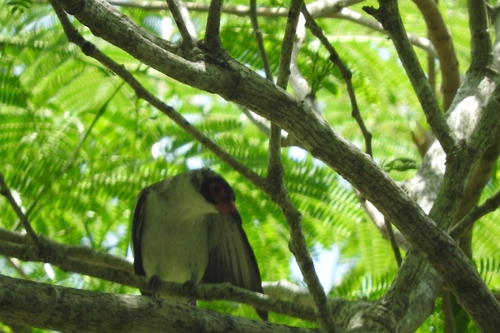 Weißnackenbekarde
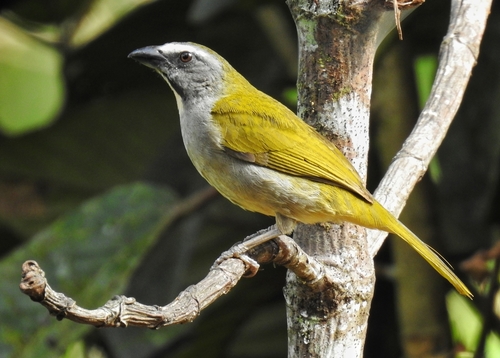 Buntkehlsaltator
Kurz gesagt
The most reliable field mark to separate Masked Tityra from Buff-throated Saltator is the tityra’s striking bare rosy red facial skin and black mask (in males), versus the saltator’s plain grayish head with a short white eyebrow and no bare skin. Masked Tityra is bulkier and heavier-bodied, with a thicker, slightly hooked rosy red and black bill, while Buff-throated Saltator is slimmer and has a thick, all-black bill. In perched views, note the tityra’s pale grayish upperparts and blackish wings and tail band, contrasting with the saltator’s olive-green back and wings and distinctive buffy throat bordered by black lines. Both species can overlap in range and perch at mid-levels, so careful attention to face, bill, and overall color is essential.
Bestimmungstipps
- Facial Skin and Mask: Masked Tityra (all sexes and ages) shows bare rosy red skin from the bill to around the eye; males add a bold black mask. Buff-throated Saltator never shows bare facial skin or a black mask—its face is plain gray with a short white eyebrow.
- Bill Structure and Color: Tityra’s bill is thick, slightly hooked, and rosy red with a black tip; saltator’s bill is thick, conical, and all black. Bill color is a reliable mark at close range.
- Size and Bulk: Tityra is much heavier and bulkier (80 g vs. 47 g), with a robust, big-headed appearance. Saltator is slimmer and more elongated, though both are similar in length.
- Upperparts Color: Tityra has pale grayish upperparts with a pearly cast (male) or darker gray with brown streaks (female). Saltator has olive-green upperparts and wings, never gray.
- Head Pattern: Tityra males have a black forecrown and mask; females have a uniform smoky gray head. Saltator has a greenish gray crown, gray face, and a short white supercilium—never a mask or bare skin.
- Throat and Underparts: Tityra’s throat and underparts are whitish (male) or dingy pale grayish (female). Saltator has a white chin/upper throat, buffy lower throat with black borders, gray breast and belly, and buffy undertail coverts—look for the buff throat and black lines.
- Tail Pattern: Tityra’s tail is grayish white with a wide black band near the end. Saltator’s tail is olive-green, matching the back, with no black band.
- Iris Color: Tityra’s iris is reddish brown to brick-red; saltator’s is brown. This is subtle but can help at close range.
- Legs and Feet: Both have dark legs, not a useful separator.
- Flight and Perched Jizz: Tityra perches upright and openly, often high; saltator is more likely to skulk or move through dense foliage at lower levels.
- Juvenile/Immature Marks: No distinctive wing patterns or age-specific flight marks are noted for either species; separation relies on adult-like features even in young birds.
- Vocalizations: Tityra’s calls are buzzy, nasal, and mechanical; saltator’s are musical, chatty, or mewing. If you hear a mellow caroling or electric chatter, it’s saltator; harsh croaks or grunts point to tityra.
- Habitat Context: If the bird is in a dense thicket or low bush, saltator is more likely; if high and exposed, tityra is favored, but both can overlap.
- Sexual Dimorphism: Only tityra is sexually dimorphic (males with black mask, females without); saltator sexes look alike.
- Common Pitfalls: Females and young tityras lacking a black mask can be confused with saltator, but the bare red skin and pale gray upperparts remain distinctive. In poor light, saltator’s olive tones and buff throat may be missed, but lack of facial skin and mask is key.
Größe
Masked Tityra is substantially heavier (80 g vs. 47 g) and slightly longer (20–24 cm vs. 20 cm) than Buff-throated Saltator. In the field, tityra appears bulkier and more robust, with a thick neck and big head, while the saltator is more slender and elongated. The tityra’s bill is thicker, slightly hooked, and bicolored (rosy red with black tip), whereas the saltator’s bill is strong but all black and more conical. The tityra’s larger size is especially noticeable when both species are seen together or near similarly sized birds.
Gefieder
There are no distinctive age-specific upperwing patterns or flight marks for either species noted in the sources. For adults, Masked Tityra males show a bold black mask over bare rosy red skin from bill to around the eye, with pale grayish upperparts and blackish wings and tail band. Females lack the black mask but have the same red facial skin, a smokier gray head, and brownish streaks on the upperparts. Both sexes have whitish underparts. Buff-throated Saltator of all ages and sexes (no sexual dimorphism) shows a mostly gray head with a greenish gray crown, a short white supercilium, olive-green upperparts, and a distinctive buffy lower throat bordered by black lines. The chin and upper throat are white, and the underparts are gray with buffy undertail coverts. The saltator’s iris is brown, while the tityra’s is reddish brown to brick-red. In flight, neither species shows bold wing flashes or panels, so perched views are more diagnostic.
Verhalten
Masked Tityra often perches upright and conspicuously on exposed branches high in the canopy or at mid-levels, sometimes sallying for fruit or insects. It may display by running along branches with drooped wings. Buff-throated Saltator is more likely to be found in pairs or small groups, moving through dense foliage or edges, and is less likely to perch fully in the open. Saltators are typically more skulking and may be seen foraging at lower levels, including in bushes or low trees. Both species may visit fruiting trees, but tityra’s behavior is more open and direct, while saltator is more furtive.
Lebensraum
Both species overlap widely in Central America and northern South America, occurring in a range of forested and semi-open habitats. Masked Tityra favors forest edges, clearings, and secondary growth, often at mid to upper levels, and is more likely to be seen in the open. Buff-throated Saltator is found in similar habitats but is more common in thickets, gardens, and dense edges, often at lower to mid-levels. Saltator is absent from El Salvador and the southernmost parts of South America, while tityra is absent from the Guianas.
Stimme
Masked Tityra has a wide variety of calls, including buzzy, nasal, staccato, croaking, and grunting notes (e.g., "zzzu rrk", "querp"), sometimes pig-like or insect-like. Its calls are generally rough, dry, and mechanical. Buff-throated Saltator’s song is a long, variable series of high-pitched, electric chatters or mellow caroling phrases (e.g., "will-cheeloo will-cheelo"), with calls that include high squeaks, metallic ticks, and mewing notes. Saltator’s vocalizations are more musical and varied, while tityra’s are harsher and more mechanical.
Weißnackenbekarde · Buntkehlsaltator · Meine schwierigen Vögel