

Schwarzkehl-Honiganzeiger vs Scharlachweber
Indicator indicator gegen Anaplectes rubriceps
Ein Quiz mit Schwarzkehl-Honiganzeiger und Scharlachweber spielen
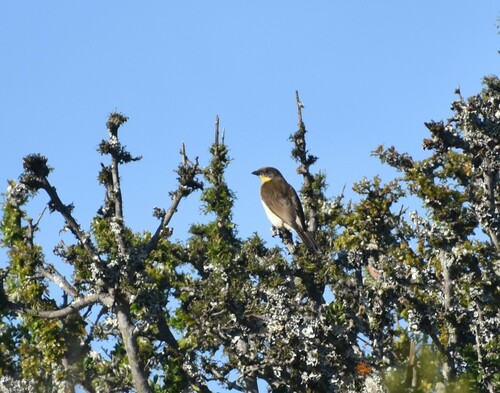 Schwarzkehl-Honiganzeiger
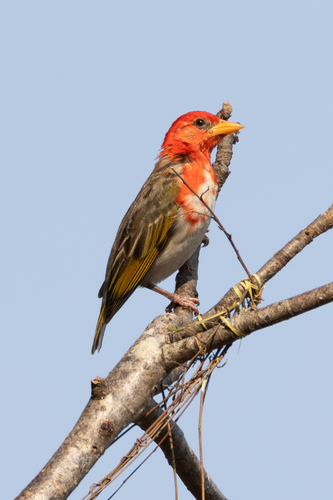 Scharlachweber
Kurz gesagt
The most reliable field mark to separate Greater Honeyguide from Red-headed Weaver is the honeyguide’s bold white tail patches, visible in flight and when perched, and the male’s black throat and pink bill. Red-headed Weaver males have a striking red head (northern races) or yellow head (southern females), a white belly, and brown wings, lacking any white in the tail. Juvenile Greater Honeyguides are olive-brown above with a yellow throat and white rump, which can be confused with female or immature weavers, but the honeyguide’s tail pattern and bill shape remain distinctive. Structurally, Greater Honeyguide is heavier-bodied with a stouter bill, while the weaver is more slender with a pointed beak and strong claws. Both species may be seen foraging in trees, but their feeding behavior and social context differ markedly.
Bestimmungstipps
- White tail patches (Greater Honeyguide): Look for bold white patches on the sides of the tail in all ages and sexes of honeyguide, especially visible in flight or when the tail is spread. Red-headed Weaver never shows white in the tail.
- Head color (Red-headed Weaver): Northern male weavers have a bright red head; southern females have a yellow head and yellow wing accents. No honeyguide ever shows a red or yellow head.
- Throat and bill (Greater Honeyguide): Male and female honeyguides have a black throat (male more pronounced), and males have a pink bill; females have a blackish bill. Weavers have a pointed, moderately long bill and never a black throat.
- Shoulder patch (Greater Honeyguide): Males show a yellow shoulder patch, which is absent in weavers.
- Underparts: Honeyguide underparts are white; weaver underparts are also white, so this is not a reliable separator.
- Upperparts: Honeyguide upperparts are dark grey-brown (adult) or olive-brown (immature); weaver upperparts are brown, but the honeyguide’s streaked wings and white tail patches are distinctive.
- Juvenile confusion: Immature honeyguides have a yellow throat and white rump, which can be confused with female/immature weavers, but the honeyguide’s tail pattern and bill shape help separate them.
- Bill shape: Honeyguide’s bill is stouter and more robust; weaver’s bill is pointed and slender, suited for probing.
- Feet and claws: Weavers have short, strong claws for hanging upside-down; honeyguides do not show this acrobatic behavior.
- Behavior: Honeyguides may be seen guiding humans or feeding at bee nests; weavers are more likely to be seen foraging acrobatically or near their distinctive stick nests.
- Nest: Red-headed Weaver builds a suspended, raindrop-shaped nest from sticks, sometimes with a long entrance tunnel. Honeyguides do not build such nests.
- Social context: Weavers may be in small flocks with one male and several females; honeyguides are usually solitary or with other honeyguides at bee nests.
- Vocalizations: Only the honeyguide’s guiding call is described—wavering, chattering notes. Use with caution, as weaver calls are not detailed here.
- Size and jizz: Honeyguide is heavier and bulkier; weaver is lighter, more slender, and agile in movement.
- Pitfalls: Female and immature weavers lack bright head color and can look drab, but will never show the honeyguide’s white tail patches or black throat. Immature honeyguides may lack strong contrast but still show the diagnostic tail pattern.
Größe
Greater Honeyguide is heavier, with a body mass of about 47 g [wikidata], and is about 20 cm long [wikipedia]. Red-headed Weaver’s mass is not provided, but it is generally lighter and more slender in build. The honeyguide appears bulkier and more robust, while the weaver is more delicate and agile, especially when foraging acrobatically among branches.
Gefieder
- Juvenile/immature Greater Honeyguide: Olive-brown upperparts, white rump, yellow throat and upper breast. No red or yellow on the head. Bold white tail patches are present from a young age and are a key mark in flight or when the tail is spread.
- Adult male Greater Honeyguide: Black throat, pink bill, dark grey-brown upperparts, white underparts, yellow shoulder patch, streaked whitish wings, and bold white tail patches. Female is duller, with a blackish bill and black throat.
- Red-headed Weaver (adult male, northern): Distinct red head, white belly, brown wings. No white in tail. Females (north) have brown heads; southern females have yellow heads and yellow wing accents. All have a pointed beak and lack the honeyguide’s black throat or tail patches.
- Juvenile Red-headed Weaver: Not described in detail, but lacks the honeyguide’s white tail patches and yellow throat. Head color is less vivid than adult males, and underparts are white.
- Key contrast: Only the honeyguide shows bold white tail patches and a black throat (male/female); only the weaver (northern male) has a bright red head, and only southern female weavers have yellow heads.
Verhalten
Greater Honeyguide is famous for its mutualistic behavior of guiding humans to bee nests, and for feeding on beeswax, larvae, and insects associated with hives. It often associates with other honeyguides at bee nests and can be seen feeding on wax after the nest is disturbed. Red-headed Weaver forages acrobatically, often hanging upside-down to probe bark, dead leaves, and spider nests for insects, and also takes fruit and nectar. The weaver is usually seen alone or in pairs, sometimes in small flocks with one male and several females, and builds suspended, raindrop-shaped nests from sticks. The honeyguide is rarely seen in flocks and does not build elaborate nests.
Lebensraum
Both species occur widely in the Afrotropics, often in wooded habitats. Greater Honeyguide is most often found near bee colonies and may be seen in a variety of woodland or savanna habitats where bees are present. Red-headed Weaver is found in trees and bushes, from saplings to large trees, and is often observed foraging in the canopy or at the tips of branches. The weaver’s presence is often indicated by its distinctive suspended nest, while the honeyguide’s presence is more likely detected by its guiding behavior or calls.
Stimme
Greater Honeyguide gives a series of wavering, chattering 'tya' notes mixed with peeps or pipes, especially when guiding or in aggression. Red-headed Weaver’s vocalizations are not described in the notes, so are not diagnostic for separation based on the provided information.
Schwarzkehl-Honiganzeiger · Scharlachweber · Meine schwierigen Vögel