

Motmot

Riesenglanzvogel vs Braunohr-Zwergspecht

Jacamerops aureus gegen Picumnus sclateri

Ein Quiz mit Riesenglanzvogel und Braunohr-Zwergspecht spielen
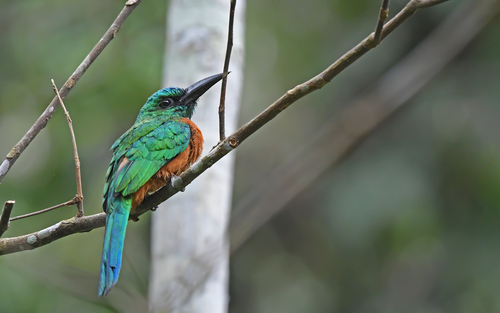
Riesenglanzvogel (Jacamerops aureus) Riesenglanzvogel
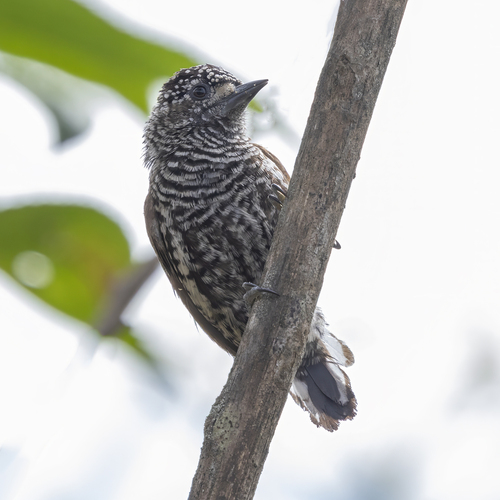
Braunohr-Zwergspecht (Picumnus sclateri) Braunohr-Zwergspecht

Medien

Laden…

Kurz gesagt

The most reliable way to separate Great Jacamar from Ecuadorian Piculet is by size and structure: Great Jacamar is an exceptionally large, heavyset bird for its family, while Ecuadorian Piculet is tiny and delicate, even for a woodpecker. In the field, the jacamar’s long, straight bill and metallic green-and-rufous plumage stand out against the piculet’s short, chisel-like bill, barred brown-and-white underparts, and blackish cap. Juvenile or immature-specific wing patterns are not described for either species, so focus on overall jizz, bill shape, and plumage. Both species are canopy or edge dwellers, but the jacamar is much more likely to be seen perched motionless in mid-levels, while the piculet actively forages on thin branches.

Bestimmungstipps

  1. Size is the most immediate clue: Great Jacamar is enormous compared to Ecuadorian Piculet—if the bird looks robin-sized or bigger, it cannot be a piculet.
  2. Bill shape and length: Jacamar has a long, straight, pointed bill, almost kingfisher-like, used for sallying after insects. Piculet’s bill is short, chisel-tipped, and woodpecker-like, adapted for pecking and tapping.
  3. Perched posture: Jacamar sits upright and motionless on exposed mid-canopy branches, often returning to the same perch. Piculet is restless, creeping and hopping along thin branches, rarely staying still.
  4. Plumage gloss and color: Jacamar is metallic green above with rufous underparts and a white throat patch (male), giving a bold, glossy look. Piculet is dull gray-brown above, with fine barring and streaking, and lacks any metallic or rufous tones.
  5. Cap pattern: Piculet has a blackish cap with tiny yellow (male) or white (female) spots; jacamar’s head is metallic green with blueish and coppery tones, lacking any spotted crown.
  6. Underparts: Jacamar’s underparts are deep rufous (except for the white throat), while piculet’s are whitish with black/dusky barring and streaks—never rufous.
  7. Tail: Jacamar’s tail is long, blue-black, and proportionally much longer than the piculet’s short, blackish tail with white patches.
  8. Flight style: Jacamar flies with strong, direct sallies from a perch; piculet’s flight is weak, undulating, and usually over short distances.
  9. Habitat context: If seen in the mid-canopy of mature rainforest, especially sitting still, suspect jacamar. If foraging actively on thin branches, especially in edge or secondary growth, suspect piculet.
  10. Sex differences: Female jacamar lacks the white throat spot but is otherwise similar to the male; female piculet has white spots across the entire crown, not yellow.
  11. No age-specific wing patterns: Neither species shows distinctive juvenile or immature upperwing marks in flight, so do not rely on wing panels or trailing edges.
  12. Leg color: Jacamar has dark horn-colored legs, but this is rarely visible in the field and not useful for quick separation.
  13. Behavioral cues: Jacamar often beats prey against a branch before eating; piculet is never seen sallying for insects, always forages by pecking.
  14. Range overlap: Only Great Jacamar occurs north of Ecuador/Peru; Ecuadorian Piculet is restricted to Ecuador and Peru.
  15. If in doubt, use a combination: Size, bill shape, and overall color pattern together will always separate these two, even at a distance.

Größe

Great Jacamar is dramatically larger: it measures 25–30 cm in length and weighs about 63 g, making it the largest jacamar by far and much bulkier than any piculet or small woodpecker. In contrast, Ecuadorian Piculet is only 9–10 cm long and weighs 10–12 g, barely a sixth of the jacamar’s mass. Even at a distance, the jacamar’s size and robust build are obvious, while the piculet is tiny, compact, and almost dainty.

Gefieder

No age-specific upperwing or flight pattern differences are described for either species, so rely on adult plumage and structure. Great Jacamar adult males have a striking combination: metallic green upperparts with gold and blueish tones, white lower throat, and rich rufous underparts. Females are similar but lack the white throat spot. The wings are black, and the tail is blue-black. Ecuadorian Piculet adults are much more subdued: gray-brown upperparts with faint bars, a blackish cap with tiny yellow (male) or white (female) spots, and whitish underparts with black/dusky barring and streaks. The tail is blackish with white patches on the inner and outer feathers. The piculet’s plumage is cryptic and finely patterned, while the jacamar is boldly colored and glossy. No juvenile-specific marks are noted for either species.

Verhalten

Great Jacamar typically perches quietly in the mid-canopy or shaded forest edges, sallying out to catch insects in flight and returning to the same perch. It often appears motionless and upright, using its long bill to snatch prey. Ecuadorian Piculet is much more active, foraging by picking and tapping on thin branches, often moving quickly and acrobatically through the lower canopy or edge vegetation. The jacamar’s behavior is reminiscent of a large flycatcher, while the piculet acts like a tiny, restless woodpecker.

Lebensraum

Great Jacamar inhabits subtropical and tropical moist lowland forests, especially in the mid-levels and shaded forest edges, often near water or along forest banks. Its range is broad across Central and northern South America. Ecuadorian Piculet is found in Ecuador and Peru, in similar lowland or foothill forests, but is more likely to be seen in secondary growth, edges, or disturbed habitats. While both can occur in forested areas, the jacamar is more strictly tied to mature forest interiors and mid-canopy, whereas the piculet is flexible and often found in edge or scrubby habitats.

Eine bessere Beschreibung senden

Nutze dieselben Abschnitte wie der Vergleich. Dein Text ist sofort veröffentlicht.

The most reliable way to separate Great Jacamar from Ecuadorian Piculet is by size and structure: Great Jacamar is an exceptionally large, heavyset bird for its family, while Ecuadorian Piculet is tiny and delicate, even for a woodpecker. In the field, the jacamar’s long, straight bill and metallic green-and-rufous plumage stand out against the piculet’s short, chisel-like bill, barred brown-and-white underparts, and blackish cap. Juvenile or immature-specific wing patterns are not described for either species, so focus on overall jizz, bill shape, and plumage. Both species are canopy or edge dwellers, but the jacamar is much more likely to be seen perched motionless in mid-levels, while the piculet actively forages on thin branches.

  1. Size is the most immediate clue: Great Jacamar is enormous compared to Ecuadorian Piculet—if the bird looks robin-sized or bigger, it cannot be a piculet.
  2. Bill shape and length: Jacamar has a long, straight, pointed bill, almost kingfisher-like, used for sallying after insects. Piculet’s bill is short, chisel-tipped, and woodpecker-like, adapted for pecking and tapping.
  3. Perched posture: Jacamar sits upright and motionless on exposed mid-canopy branches, often returning to the same perch. Piculet is restless, creeping and hopping along thin branches, rarely staying still.
  4. Plumage gloss and color: Jacamar is metallic green above with rufous underparts and a white throat patch (male), giving a bold, glossy look. Piculet is dull gray-brown above, with fine barring and streaking, and lacks any metallic or rufous tones.
  5. Cap pattern: Piculet has a blackish cap with tiny yellow (male) or white (female) spots; jacamar’s head is metallic green with blueish and coppery tones, lacking any spotted crown.
  6. Underparts: Jacamar’s underparts are deep rufous (except for the white throat), while piculet’s are whitish with black/dusky barring and streaks—never rufous.
  7. Tail: Jacamar’s tail is long, blue-black, and proportionally much longer than the piculet’s short, blackish tail with white patches.
  8. Flight style: Jacamar flies with strong, direct sallies from a perch; piculet’s flight is weak, undulating, and usually over short distances.
  9. Habitat context: If seen in the mid-canopy of mature rainforest, especially sitting still, suspect jacamar. If foraging actively on thin branches, especially in edge or secondary growth, suspect piculet.
  10. Sex differences: Female jacamar lacks the white throat spot but is otherwise similar to the male; female piculet has white spots across the entire crown, not yellow.
  11. No age-specific wing patterns: Neither species shows distinctive juvenile or immature upperwing marks in flight, so do not rely on wing panels or trailing edges.
  12. Leg color: Jacamar has dark horn-colored legs, but this is rarely visible in the field and not useful for quick separation.
  13. Behavioral cues: Jacamar often beats prey against a branch before eating; piculet is never seen sallying for insects, always forages by pecking.
  14. Range overlap: Only Great Jacamar occurs north of Ecuador/Peru; Ecuadorian Piculet is restricted to Ecuador and Peru.
  15. If in doubt, use a combination: Size, bill shape, and overall color pattern together will always separate these two, even at a distance.

Great Jacamar is dramatically larger: it measures 25–30 cm in length and weighs about 63 g, making it the largest jacamar by far and much bulkier than any piculet or small woodpecker. In contrast, Ecuadorian Piculet is only 9–10 cm long and weighs 10–12 g, barely a sixth of the jacamar’s mass. Even at a distance, the jacamar’s size and robust build are obvious, while the piculet is tiny, compact, and almost dainty.

No age-specific upperwing or flight pattern differences are described for either species, so rely on adult plumage and structure. Great Jacamar adult males have a striking combination: metallic green upperparts with gold and blueish tones, white lower throat, and rich rufous underparts. Females are similar but lack the white throat spot. The wings are black, and the tail is blue-black. Ecuadorian Piculet adults are much more subdued: gray-brown upperparts with faint bars, a blackish cap with tiny yellow (male) or white (female) spots, and whitish underparts with black/dusky barring and streaks. The tail is blackish with white patches on the inner and outer feathers. The piculet’s plumage is cryptic and finely patterned, while the jacamar is boldly colored and glossy. No juvenile-specific marks are noted for either species.

Great Jacamar typically perches quietly in the mid-canopy or shaded forest edges, sallying out to catch insects in flight and returning to the same perch. It often appears motionless and upright, using its long bill to snatch prey. Ecuadorian Piculet is much more active, foraging by picking and tapping on thin branches, often moving quickly and acrobatically through the lower canopy or edge vegetation. The jacamar’s behavior is reminiscent of a large flycatcher, while the piculet acts like a tiny, restless woodpecker.

Great Jacamar inhabits subtropical and tropical moist lowland forests, especially in the mid-levels and shaded forest edges, often near water or along forest banks. Its range is broad across Central and northern South America. Ecuadorian Piculet is found in Ecuador and Peru, in similar lowland or foothill forests, but is more likely to be seen in secondary growth, edges, or disturbed habitats. While both can occur in forested areas, the jacamar is more strictly tied to mature forest interiors and mid-canopy, whereas the piculet is flexible and often found in edge or scrubby habitats.

Änderungen verwerfen?

Du hast ungespeicherte Änderungen. Wenn du jetzt gehst, gehen sie verloren.

Riesenglanzvogel · Braunohr-Zwergspecht · Meine schwierigen Vögel