

Goldkopf-Zistensänger vs Rostkopf-Buschsänger
Cisticola exilis gegen Cincloramphus timoriensis
Ein Quiz mit Goldkopf-Zistensänger und Rostkopf-Buschsänger spielen
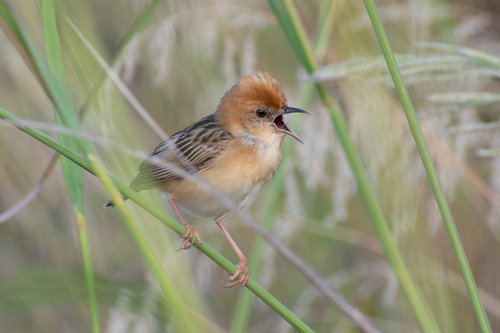 Goldkopf-Zistensänger
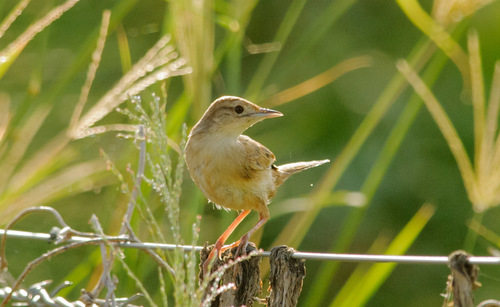 Rostkopf-Buschsänger
Kurz gesagt
The most reliable field mark is the tail length and shape: Golden-headed Cisticola in breeding plumage has a noticeably short tail, while Tawny Grassbird always shows a long, drooping, graduated tail. Outside the breeding season, cisticolas regain a longer tail, but it is still shorter and less obviously drooped than the grassbird’s. Both species are streaked above and pale below, but only the cisticola can show a rich golden or orange head in breeding males, while Tawny Grassbird has a rufous (rich brown) cap and rufous rump. Structure and size are also key: Tawny Grassbird is much larger and heavier-bodied. In flight or perched, focus on tail length and cap color for the quickest separation.
Bestimmungstipps
- Tail length and shape: In breeding season, Golden-headed Cisticola males have a very short tail; outside breeding, their tail is longer but still shorter and less obviously drooping than Tawny Grassbird’s. Tawny Grassbird always shows a long, drooping, graduated tail—this is the most consistent field mark year-round.
- Cap color: Breeding male cisticolas have a bright golden-orange head, unique among grassland birds. Tawny Grassbird has a rich rufous (brown) cap, not golden, and this is present in all ages and sexes.
- Body size and structure: Golden-headed Cisticola is tiny and delicate, with a fine bill. Tawny Grassbird is much larger, bulkier, and has a noticeably stouter, longer bill.
- Upperparts streaking: Both species are streaked above, but the cisticola’s streaks are black or dark brown on a brown background, while the grassbird’s are more diffuse and less contrasting.
- Underparts: Both have pale underparts, but the cisticola’s are cream, and the grassbird’s are unstreaked and paler, sometimes almost white.
- Rufous rump and wing fringes: Tawny Grassbird shows a rufous rump and rufous fringes to the flight feathers, especially visible in flight or when preening. Cisticola lacks these rufous tones except on the head in breeding males.
- Bill shape: The grassbird’s bill is stouter and longer, especially noticeable if both species are seen side-by-side or in good profile views.
- Display behavior: Cisticola males perform vertical, spiraling display flights with song, often with a raised crest. Grassbird males sing from perches or in less elaborate display flights.
- Voice: Listen for sharp, insect-like calls from cisticola ("teewip", "wheezz, whit-whit") versus the grassbird’s churring and explosive trills.
- Habitat context: In very tall, dense, wet grass or reedbeds, Tawny Grassbird is more likely. In shorter, patchier, or drier grass, cisticola is more expected.
- Juvenile confusion: Juvenile cisticolas are paler but otherwise similar to adults; no unique juvenile marks are described for either species, so use structure and tail length.
- Perched vs in flight: In flight, the grassbird’s long tail is obvious and often droops; cisticola’s tail is short and square-tipped in breeding males, less so outside breeding.
- Seasonal change: Only the cisticola male changes dramatically in breeding season, with a golden head and short tail. Grassbird does not show strong seasonal changes.
- Crest display: Cisticola may show a crest when singing; grassbird does not.
- Pitfalls: Non-breeding cisticolas and grassbirds can look similar in poor light or at a distance—always check tail length, cap color, and overall size before making a call.
Größe
Golden-headed Cisticola is a tiny bird, around 9–11.5 cm long and weighing about 8.5 g [wikidata]. In contrast, Tawny Grassbird is substantially larger and heavier (13–25 g per [wikipedia]), with a much longer body and especially a long, drooping tail. The grassbird’s bill is also stouter and longer relative to head size. If both are seen together, the cisticola looks almost half the size, with a more delicate build.
Gefieder
- Juveniles and non-breeding birds: Both species are streaked above and pale below, but Golden-headed Cisticola juveniles are paler overall and share the adult’s streaked brown upperparts and cream underparts. Tawny Grassbird juveniles resemble adults, with streaked upperparts, an unstreaked rufous cap, and unstreaked pale underparts.
- Breeding male Golden-headed Cisticola: Shows a striking golden-orange head and body, a much shorter tail, and a dull chin. This golden wash is unique and never matched by Tawny Grassbird.
- Tawny Grassbird (all ages/seasons): Always has a rich rufous (brown) cap, unstreaked underparts, obvious rufous fringes to the flight feathers, and a long, drooping, graduated tail. The rump is rufous, which can be visible in flight or when the tail is flicked.
- Upperwing pattern: No distinctive juvenile/immature upperwing marks are described for either species, but the grassbird’s rufous fringes to the flight feathers can be a subtle in-flight clue.
Verhalten
Golden-headed Cisticola males perform elaborate display flights during breeding: they ascend vertically, spiral up, circle while singing, and then descend steeply. These displays are often repeated and are accompanied by vocalizations. Tawny Grassbird males also sing from exposed perches and in display flights, but their flight is less acrobatic and more about advertising territory. Both species are active in grassland, but the cisticola is more likely to be seen low in grass or making short, fluttery flights, while the grassbird often perches higher and moves with a more deliberate, less erratic jizz.
Lebensraum
Both species are found in grassland and reedbed habitats, often overlapping in range in Australia and Southeast Asia. However, Tawny Grassbird is more strongly associated with tall, dense grass or reedbeds and is often found in wetter, ranker vegetation. Golden-headed Cisticola is more flexible, using shorter grass, edges, and even drier or more open patches. If the habitat is very wet, tall, and dense, Tawny Grassbird is more likely; in shorter, patchier, or drier grass, cisticola is more expected.
Stimme
Golden-headed Cisticola gives a variety of distinctive calls, including sharp "teewip" notes and a "wheezz, whit-whit" series, often delivered during display flights. When singing, the male may raise a crest. Tawny Grassbird produces loud, grumpy churring calls and a longer song that starts with a repeated "tick-tick-tick-tick" and ends in an explosive, descending trill. The grassbird’s song is more complex and musical, while the cisticola’s is simpler and more insect-like.
Goldkopf-Zistensänger · Rostkopf-Buschsänger · Meine schwierigen Vögel